



In February 2022, Russia invaded Ukraine. In an official televised statement, Russian President Vladimir Putin termed the conflict a "special operation" and explained to the world and his nation that the mission was, among other things, the "denazification" of Ukraine. Although this language accurately described the reality, the words "invasion" and "war" were not heard on Russian news broadcasts; Russian law prohibited the media, and ordinary citizens, from using them.
The absence of a free press in the Russian Federation led Israeli foreign news correspondents to frame their coverage of the war around what Russian citizens do not know and are not exposed to. "See what the Russians don't know" became a sub-genre of war coverage and studio commentary.
The fact that a bloody war is being waged in the name of citizens, affecting their global image and leading to international sanctions that directly impact their lives, all without their knowledge, was seen by us in liberal-democratic Israel as shocking, a terrible act of deception.
Who would have imagined back then that about a year and a half later, we — those very same Israeli journalists — would deny the Israeli public its right to know the truth about the war in Gaza? And this without anyone having forbidden us to speak, to report, to show, to cover. How did we reach this point where we, journalists fighting to defend freedom of the press and media, have curtailed that very freedom instead of exercising it?
Part of the answer is embedded within the question itself: Israel’s free press is forced to defend itself against a government that has singled it out as a target. The government seeks to influence the budget and future of public broadcasting through Knesset committees and actively fosters propaganda channels that operate under a completely different set of rules than mainstream broadcasters and outside the existing regulatory framework. It brands journalists as agents serving the opposition — or even the enemy. All this, and more, contributes to a complex mechanism that drives Israeli journalists to self-censor.
All of this holds true beyond just our small country. Populist regimes have long known how to undermine the free press to shield themselves from exposés about government corruption and national security breaches. In Hungary, Turkey, the UK, the US, Brazil, and elsewhere, leaders have eagerly adopted the playbook for attacking the free press. But there is no need for modesty: while Israel may lag behind in the education of its children, it excels in attacks on the press.
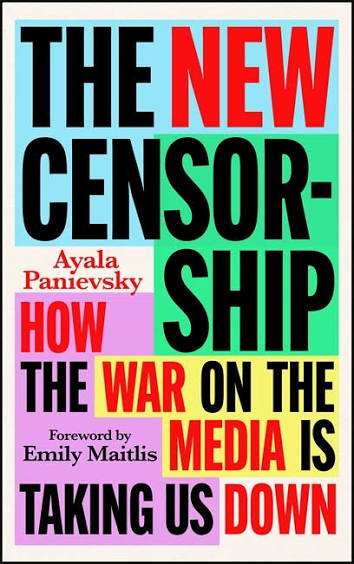
These insights are presented in an authoritative, detailed manner, backed by examples from around the world, in Dr. Ayala Panievsky’s new book, “The New Censorship” (Footnote Press Publishing). Panievsky, a political communications researcher at City University of London, a research fellow at the Molad Institute, and a board member of "The Seventh Eye", has spent years dissecting the mechanism by which populism influences our public discourse by leveraging the press and journalists. "Democracy no longer dies in darkness," Panievsky writes, "but in broad daylight and during prime time."
I turned to the book months ago, when it was first released in English, to try to understand. To understand why my pulse accelerates, my thoughts go haywire, and words struggle in my throat, trying to retreat rather than come out. Why it is that even though no manager, editor, or host has ever told me what to say or what not to say since the war began, there are words and phrases I know in advance will trigger intense reactions?
I am not referring to racist expressions that incite ethnic cleansing and genocide, such as "transfer," "to flatten Gaza," or "there are no innocents in Gaza." Where did this fear come from? Is there any logic or tangible reason behind it, or is it all in my head? And if it is just in my head, how did it get there at all?
Throughout the pages of “The New Censorship,” Panievsky demonstrates that there is a deliberate, calculated, and sustained mechanism: the method is not to silence through brute force, but to make us swallow our words — an entire repertoire of them — and avoid engaging with certain topics at all.
The authorities are not (yet) legally silencing Israeli (Jewish) journalists. However, there is a complete mechanism, which Panievsky identifies and deconstructs, that leads journalists to silence themselves. And in far too many cases, it works. Certainly regarding the war in Gaza.
Panievsky’s study of Israel’s most-watched newscast, the Channel 12 news broadcast, revealed that during the first six months of the war in the Gaza Strip, "out of 700 segments covering the war, only four mentioned civilian casualties in Gaza, and only two included footage depicting human suffering, death, bloodshed, and starvation." Even today, in mid-2026, the reality in Gaza, including the population's precarious living conditions and even IDF operations there, is almost entirely absent from the screen and, therefore, from Israeli public discourse.
"Decades of media research show us that often, the choice of topics we discuss, for example, immigration rather than healthcare [in England], can be just as influential as what we actually say about those issues," writes Panevsky. "Instead of making a considered, proactive editorial decision about what’s important and warrants public attention today, journalists lag behind a constantly shifting and artificial agenda."
The "constantly shifting and artificial agenda" is also the result of deliberate actions. It is a tactic, Panievsky notes: "flooding the zone with shit," in the words of Donald Trump’s former strategist Steve Bannon. To this endless news cycle, in a country already engaged in ceaseless war since October 7, 2023 — or maybe in fact since its inception?—one must also add the intrusion of bots and hate factories into our lives.
These are just some of the components of the sophisticated mechanism Panievsky reveals. Yet she does not stop at explaining how the "sausage factory" was engineered and how it operates; she also points out that the reaction to it sometimes feeds the monster of populism.
Panievsky writes about "strategic bias" as a survival mechanism. When a journalist is "suspected" of a lack of patriotism, when criticism is equated with treason, she explains, that mainstream journalist tends to want to demonstrate that he is "one of us," and so develops a "little censor" in his own mind. Often without fully realizing it, he skews his coverage to the right and embraces the principle of "sacred balance," which enshrines both sides at the expense of the truth.
“Objectivity and balance are means to an end, not a sacred goal in themselves. The goal is to report truth, to inform, to expose. When we witness journalists manufacturing symmetry, flip-flopping, or hiding or censoring what they know to be true — for the sake of balance or neutrality — the game is over. The means have defeated the end, and it is time to chart a new course.”
It is interesting to note that accusations of unpatriotic behavior and "self-hating Jew" have become so toxic in today’s Israel that Panievsky herself, who wrote her critical book from London, feels compelled to emphasize something self-evident, something that, in a healthy reality, would not need to be written at all: "I criticize Israel because I belong here. Belonging is both powerful and painful."
And Panievsky doesn’t just criticize. After presenting the problem with reasoned arguments, laying out years of research, and substantiating her premises, she also offers solutions. These are crucial sections of the book: calls to action for both journalists and the public. She suggests, for instance, that journalists need to learn to practice with a lighter touch, knowing how to use humor and to entertain. Populists know how to use entertainment as a weapon in the media war, where "anti-journalism" battles against journalism.
There is also a call for solidarity among professionals. I may be mistaken, but I fear that ship sailed long ago. Other concrete proposals could bring about rapid and significant change: for instance, ceasing to chase a fictitious agenda dictated by the authorities and once more take ownership of the news agenda.
"If freedom means anything at all, it means the right to tell people what they do not want to hear", Panievsky cites this quote by George Orwell (from 1945). Journalists hold on to this right through their pens, keyboards, and microphones, yet they are not the ultimate target of populist rule; the public as a whole is. The true aim of the "new censorship" is to strip the public of the right to know, and the book *The New Censorship* serves as a guide for anyone wishing to fight back.
This article was published in Hebrew on June 17, 2026
Translation: Harriet Brown