



A few days ago, a weather forecast was published on ynet that noted in passing: "Storm in Gaza too." A completely technical line, but the angry responses weren't long in coming. Almost simultaneously, the Security Council approved the American plan for the Strip's future, including a path to establishing a Palestinian state.
Both events – one mundane, the other historic – provoked an almost identical reaction: the mere mention of Gaza or a Palestinian future, in any context, immediately became a red line. Weather forecast? Treason. Diplomatic initiative? A reward for terror.
Since October 7, large parts of Israeli discourse have lost the ability to distinguish between different types of information. A meteorological forecast that acknowledges the existence of people living in Gaza is perceived as identification. A diplomatic move – as a reward.
Everything collapses into one threat, devoid of distinctions. This is a familiar mechanism of thinking in times of trauma: a binary pattern as a survival response. But when this cognitive state of emergency becomes entrenched and turns into the foundation of discourse in the public arena, the deeper problem begins.
On October 7, a horrific massacre occurred - that's a fact. There are two million people in Gaza who need a future – that's also a fact. But Israeli public discourse today struggles to hold both truths simultaneously. Whoever acknowledges the second fact is accused of betraying the first. Either you completely erase the existence of millions of people, or you're in the "terror supporters" group. There's no gray area, no spectrum, no continuum. No space to think
This is why a weather report about Gaza provokes fury. This is also why any mention of a political horizon is perceived as a prize for the enemy – even when it's a plan conditional on Hamas's disarmament and change of leadership in Gaza. The ability to simultaneously hold questions of security and questions about the future – of deterrence and rehabilitation – has almost entirely crumbled.
This binary, dichotomous thinking seeps into all areas of discourse. The issue of ultra-Orthodox conscription requires complex solutions, but instead of such discussion, forceful and democratically flawed solutions were proposed – like denying voting rights to those who don't enlist. This isn't determination; it's surrender to the binary of "with us or against us," instead of developing realistic, flexible, and sustainable paths.
Culture also pays the price. The debates surrounding films about October 7 reveal how every attempt to process trauma in a complex way is perceived as betrayal. Entire festivals conform to a single narrative. Art, whose role is to grapple with the unspeakable, what defies articulation, is required to become a one-dimensional poster.
But here comes the inevitable question: what is the media's own role in reducing discourse to opposing poles without continuity?
Public discourse didn't become binary on its own – it feeds off a fragmented media field, where each outlet primarily serves its own audience, and sometimes functions as enlisted media at the expense of its role as a reality mediator. This is how the public agenda is shaped – what enters the frame and what is omitted before the discussion even begins.
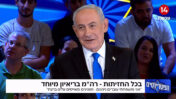
Since the war, media outlets have positioned themselves along three main tracks. On Channel 14, patriotic rhetoric serves as the entry gate to discourse – but the internal discourse boundary is mainly defined by uncritical loyalty to Netanyahu, which becomes the litmus test of who's "inside" and who's "outside."
On the other side, mainstream media outlets adopted a survival strategy: adhering to consensus out of fear of losing a hurt and upset audience, at the cost of avoiding reporting on the humanitarian reality in Gaza.
Meanwhile, media outlets identified with the left were deemed suspect from the start, so that merely presenting facts was interpreted as a political position. Instead of one media field containing diversity –camps were created that produce separate knowledge worlds.
Social media algorithms amplify this trend – anger and rage generate more interaction, polarizing stories get more shares, and journalists quickly learn what "works" and adjust coverage accordingly. Thus, a vicious circle is created: polarization feeds itself, the media reinforces it, and algorithms accelerate it.
Under such conditions, when Haaretz remains almost alone in reporting what's happening in Gaza, a particularly problematic situation arises.
There is a reality and it can be reported regardless of political perspective. But when mainstream media is silent and media outlets identified with the left are the ones reporting it, reality itself becomes "leftist." Facts are perceived as a political position. Thus "seeing" becomes an ideological act, and acknowledging reality becomes subversive.
This is doubly dangerous: first, because the public remains in a media bubble disconnected from what's happening. Second, because when reality is reported only by one politically identified actor, it's easy to dismiss it as "propaganda" and ignore it.
This flattening of thought creates two main distortions in public discourse. The first and most disturbing is the claim that peace – or merely believing in peace – is what brought the October 7 disaster, especially when this accusation is directed at the Gaza border communities.
The argument draws on real pain but ignores a central fact: for nearly two decades, no peace process has existed here – no negotiations, no concrete proposal, no plan with long-term vision. What did exist was a declared policy of "conflict management": an attempt to freeze an unsolvable reality and disguise it as stability. When this fact is pushed out of discourse, responsibility slides from the policy that failed to those who believed in a possible future – and the entire public discourse is shaped around blame that has no basis in reality.
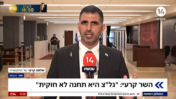
The second distortion manifests at the political level. The response to the decision approved by the Security Council reflects the same flattening. The Prime Minister chose to address it only in English, addressing the international community, while the President was forced to fill the void and address the public in Hebrew.
This choice indicates that discussion of a political future has become taboo in the Hebrew language itself. Will the future arrangement include certain demilitarization mechanisms? Enforcement mechanisms for educational changes? Educational steps on the Israeli side too? We don't know – not because there are no proposals, but because discourse, with the media's help, has been shackled in reactive frameworks that prevent real engagement with complex issues.
When language shrinks to automatic response language – "peace" as profanity, "political horizon" as betrayal, "Gaza" as taboo – it stops enabling thought. Democracy needs space where questions can be asked, ideas debated, and clarity sought. Without such space, it loses itself.
Here enters the responsibility of mainstream media. It's the one that addresses the broad center of the public, and it's the one with the power to reopen the space of discourse. Precisely because it sought to protect a hurt and upset audience – and adherence to consensus seemed like a careful choice – it inadvertently narrowed the scope of thought. For that exact reason, it's also the only arena where a small change in agenda, in questions, in tone, can restore to discourse the complexity that was lost.
Media in wartime does tend to mobilize, but its professional role is to discern when mobilization becomes self-censorship, when patriotism becomes a tool of control, and when silence becomes denial of reality. Precisely now, after the greatest trauma of our generation, we need to restore to language and discourse the complexity that was lost. This is a matter of professional responsibility.
The difficult questions won't disappear if they're not asked; they'll just become more dangerous. Media that returns to its role as one that enables discourse, perspective, and information – will be able to restore to the public the possibility to discuss, understand, argue, consider, and imagine a future.
Sagit Alkobi Fishman is a Doctorate Candidate, School of Communication, Bar-Ilan University. Her article was published in Hebrew on November 20, 2025