








The Supreme Court, in an expanded panel, deliberated (13.7) on the constitutionality of the Law for Preventing Harm to State Security by Foreign Broadcasting Entity. Although some of the panel judges questioned the state's representatives, most of the criticism was directed toward the representatives of the petitioners against the law, the Association for Civil Rights in Israel (ACRI) and Al Jazeera channel.
The law, known by the nickname "Al Jazeera Law" (despite already being applied to other media outlets as well), was enacted as a temporary provision following the October 7 massacre with the start of the war under security pretext and upon recommendation of security bodies, but coalition Knesset members in the National Security Committee of the Knesset, where the law was drafted, declared they see it only as a springboard to a much more draconian law.
Knesset members from Likud, Religious Zionism and Otzma Yehudit said they would expand the law to allow the Communications Minister and the Minister of National Security to close any media outlet, including Israeli media outlets, under any pretext they choose, without judicial oversight or time limitation. These days the Knesset is advancing an amendment to the law that would allow, among other things, the Communications Minister to act to disrupt satellite signals reaching Israel and Israelis' ability to browse the internet.
At the heart of the petitions stands the claim that the law is unconstitutional. In the main argument presented by the petitioners in recent days, ACRI claimed the law is not intended for security purposes but for political purposes. Among other things, they argued the law is ineffective, since limiting broadcasts leaves the possibility to consume the content on social networks and messaging applications. The Qatari network claimed the law is a personal law directed against them, with the aim of preventing the Israeli public from being exposed to the network's reports from Gaza.
What constitutes harm to security?
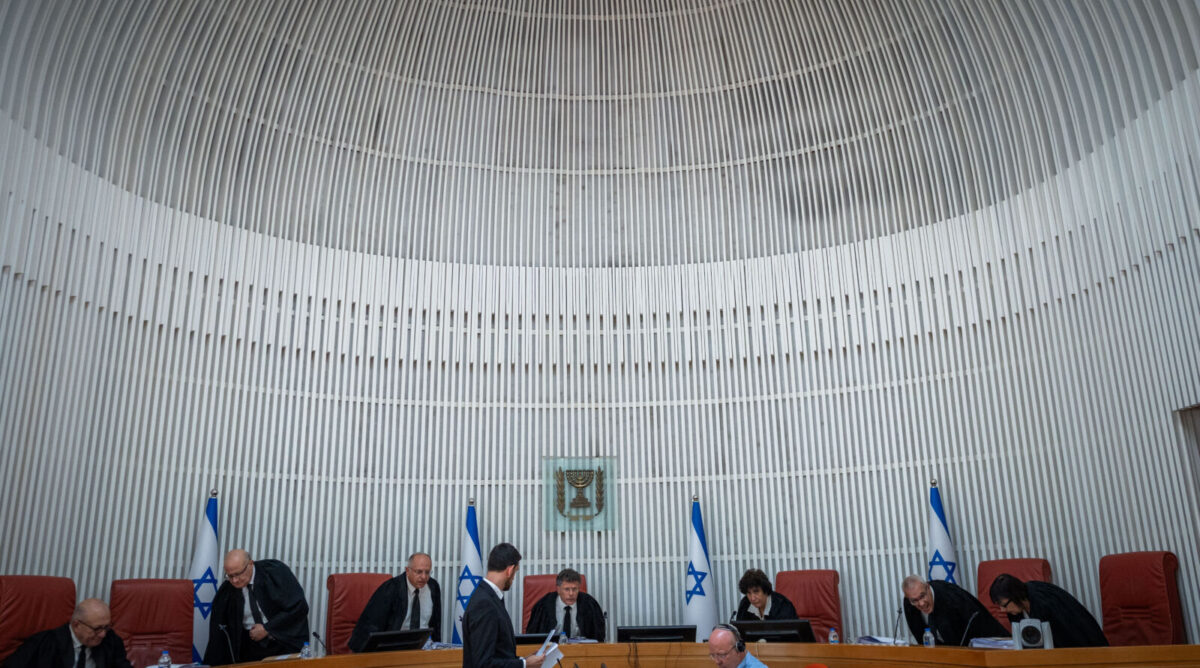
At the opening of the hearing held before Justices Yitzhak Amit, Noam Sohlberg, Daphne Barak-Erez, Yosef Elron, Ofer Grosskopf, Alex Stein and Gila Canfy-Steinitz, the state received the right to argue.
Attorney Ran Rosenberg, who represented Prime Minister Benjamin Netanyahu, Communications Minister Shlomo Karhi, Attorney General Gali Beharav-Miara and the entire government, clarified at the opening of his remarks that the state denies the claim that the law is intended for political needs and not security needs. As reinforcement for this, he emphasized that the district courts, which approved time and again the Communications Minister's orders limiting Al Jazeera broadcasts, clarified in their decisions that the channel indeed causes substantial harm to state security.
Justice Barak-Erez wondered whether there is need to introduce clearer definitions into the law that would clarify what is considered "harm to state security" and what is not. Later in the hearing she expanded and said: "There might be a need for public discussion on the open question of what constitutes harm to state security. For example, are certain types of criticism that might cause unrest considered harm to state security or part of a vibrant democratic culture? There is sterilization of public discourse around the law, when what constitutes state security is not defined and is discussed under a veil of closed doors. [...] There are district courts whose work I greatly respect, but who checks the harm? The law has no mechanism that checks this thing. What price did we pay in public discourse? The district courts won't check this and aren't supposed to check this."
In response, Attorney Rosenberg argued that proportionality in the law does not stem from defining what constitutes harm to state security, but from the fact that after security agencies determine that the channel indeed causes substantial harm to state security, the Prime Minister must be convinced that this is the case and bring the order for approval by the Political-Security Cabinet or the government, and even afterwards there is automatic judicial oversight of the approval.
"Here, in practice, was this presented before the Cabinet or the government?", wondered Supreme Court President Justice Amit. As recalled, in the wording of emergency regulations set even before the law's legislation, it was determined that the Political-Security Cabinet would be the body approving orders to limit foreign channel broadcasts for security reasons. Later, following insistence by Knesset members in the National Security Committee, the government was added.
According to Attorney Rosenberg, the approval given to the Communications Minister's orders the second time was received both by the Cabinet and by the government. However, since then it was the government that approved the minister's orders.
Later in the hearing, Supreme Court President Amit said that "one of the problems" in the law, and immediately corrected himself to "one of the weighty issues," relates to the fact that "a situation was created where Israeli citizens cannot see what the whole world sees." However, immediately afterwards Justice Amit argued that in practice this is not the situation, since the law is ineffective.
"If I open YouTube I can see Al Jazeera in Arabic and English," said Justice Amit. "Most smart TVs have YouTube applications, in the Arab sector there are many satellite dishes. The question is, and the Knesset was aware of this and knew it's not hermetic, the question is how ineffective is it?"
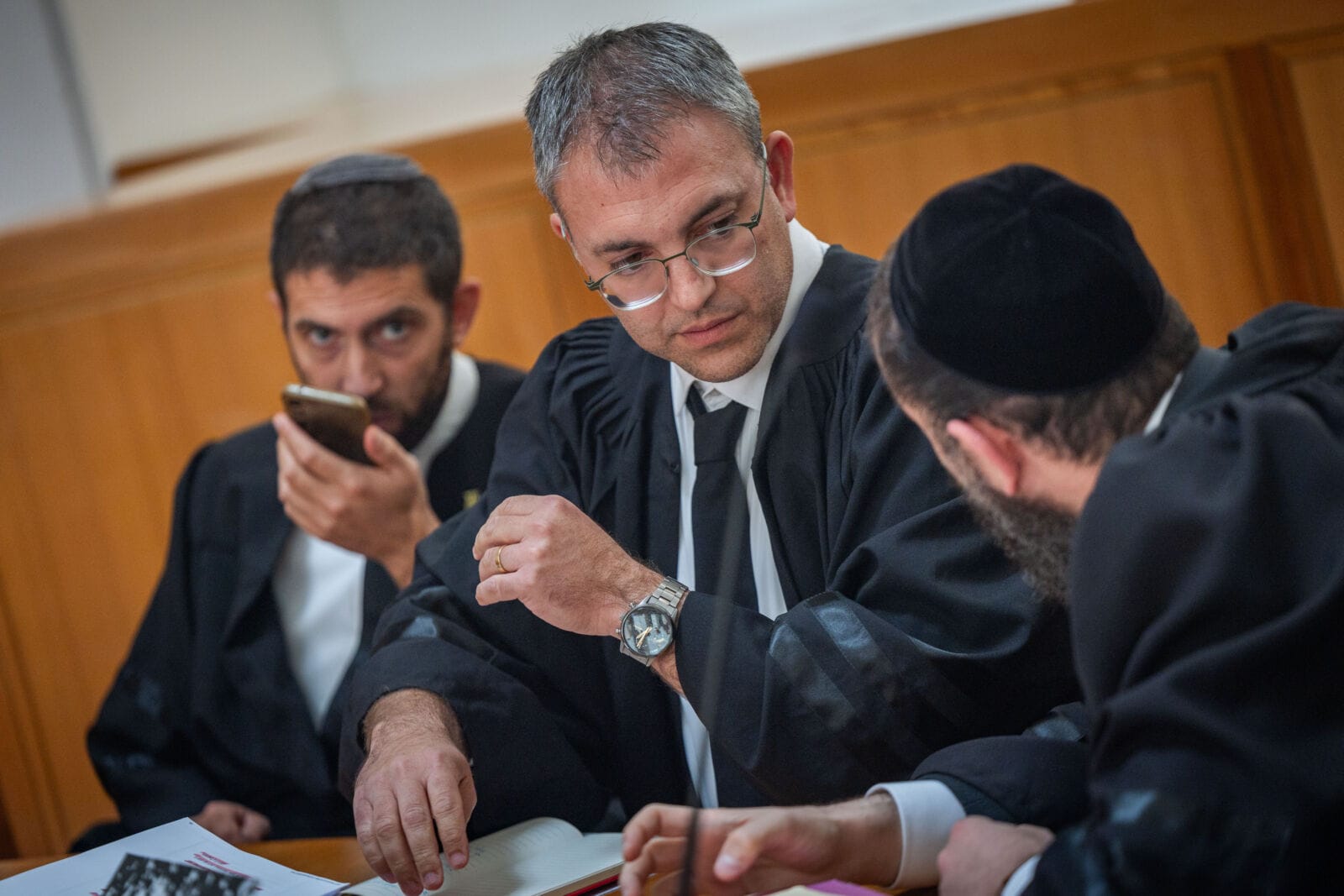
Israeli attorneys arrive for a court hearing on the Israeli government law to shut down Al Jazeera’s operations in Israel, at the Supreme Court in Jerusalem on July 13, 2025. Photo by Yonatan Sindel/Flash90
The state's representative argued that the law has effectiveness even in its current version. "A person needs to make an effort to consume this more than when it's accessible to him on the remote." Later he added explicitly: "This effectively contributes to state security." According to him, "there are contents that could have been accessible much more, in a much broader way, if not for the law's implementation. The law reduces and makes distribution of the contents more difficult."
Justice Grosskopf wondered what is the test for the question of effectiveness. "I was very surprised that it's on YouTube and the state says it's effective," he remarked. "Each of us can watch on any smart TV, on any smartphone. And most people also know how to do this."
After several follow-up questions, Attorney Rosenberg argued that evidence of effectiveness lies in the fact that it's important for Al Jazeera to be broadcast on platforms where it's currently blocked. Justice Barak-Erez rejected this argument, and Attorney Rosenberg retreated to the original argument "We believe this makes it more difficult and reduces exposure to contents that harm state security," without specifying the test.
Attorney Pinchas Gurt, who represented the Knesset, argued that the district courts, before which the orders were brought, would not have approved them if they did not believe it was an effective step. Attorney Gurt added that he was exposed to positions of security agencies given in the Knesset in classified discussions "and things are clear."
The state wanted to present to the judges in ex parte proceedings part of the evidence materials presented to the district judges in ex parte proceedings, namely those same opinions of security agencies and the publications themselves that allegedly cause substantial harm to state security. After a short recess, the judges decided this was unnecessary since the hearing is supposed to deal with the constitutional aspect of the law and not with specific cases of its implementation.
The Judges Against the Association for Civil Rights
Attorney Hagar Schechter, representative of the Association for Civil Rights, directed the judges among other things to the conclusions of the Zadok Committee, a public committee headed by former Justice Minister Haim Zadok, established in the 1990s to recommend on legislation matters related to journalism. The committee reached the conclusion that the requirement to obtain a license as a precondition for publishing a newspaper should be abolished, as was then required by law, since this constitutes disproportionate harm to freedom of expression.
The committee also emphasized there is concern for "unequal application of authority power toward different expressions" especially in cases where an administrative decision is given to close a media outlet for security reasons, since these are "hidden from public view" and "by nature cannot be subjected to thorough and clear examination."
When Attorney Schechter referred to these committee conclusions, Justice Stein was surprised and wondered whether Israeli law "supports this position."
Throughout her remarks, Attorney Schechter argued that while the law requires that the broadcasts themselves harm state security substantially, in Knesset discussions and in the state's response to petitions, much more amorphous concepts were discussed such as "orchestrated consciousness campaign" that "might constitute tailwind" for actions that would harm state security.
When Attorney Schechter argued that in practice, the number of broadcasts that apparently were presented to judges in ex parte proceedings as those that harmed state security was not large, Justice Sohlberg was astonished. "Will you count the cases where a channel teaches how to harm a tank? How to harm its fighters?"
Attorney Schechter argued in response that if these are isolated cases, the censor's authority can be used to handle harm caused to state security. On the other hand, if it's a general propaganda channel, then the Counter-Terrorism Law and Internet Powers Law can be used, which allow blocking media outlets serving terror bodies.
Justice Stein questioned Attorney Schechter and referred to comparative law from other countries. When Attorney Schechter replied that she doesn't know the circumstances of the legislation, Justice Stein responded: "This was, madam, in the context of circumstances where when you have a bitter enemy who wants to kill you, don't let him."
Another point Attorney Schechter emphasized relates to the powers of Communications Ministry inspectors, who confiscate equipment used by the foreign channel and already confiscated equipment belonging to AP agency, and recently also acted against a Reuters cameraman, just because Al Jazeera used the news agencies' live feed.
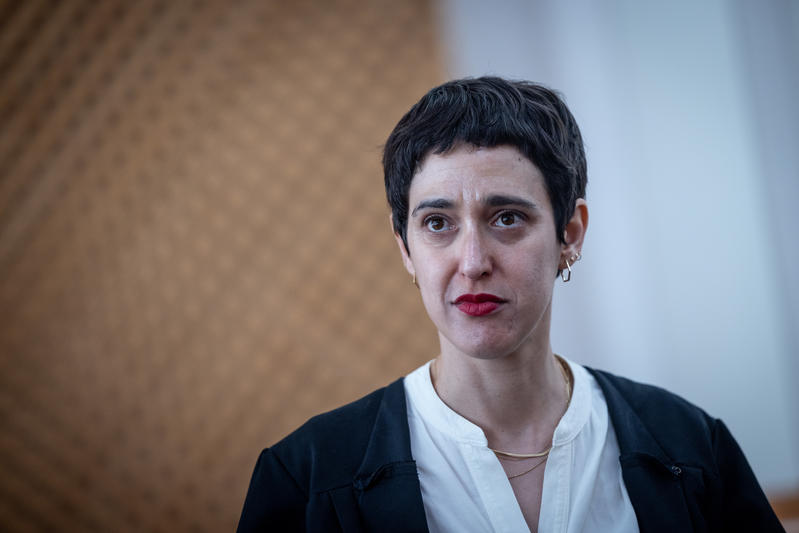
A court hearing on the Israeli government's decision to shut down Al Jazeera's operations in Israel, at the Supreme Court in Jerusalem on June 3, 2024. Photo by Chaim Goldberg/Flash90
Later, the state's representative was asked to address the confiscation of AP equipment and Reuters broadcast disruption and argued that "in the AP story there was indeed a mistake" and that "regarding Reuters, things were also clarified."
"In what sense was it a mistake?", asked Justice Barak-Erez.
"Inspectors' mistake," replied Attorney Rosenberg. According to him, one cannot hang onto "this small bureaucratic issue" to attack the law's constitutionality.
Additional difficulties were piled by Supreme Court justices on ACRI's representative when she argued that the law gives the political level influence over media.
"Our perception is that this is one of a series of hints that undermine the fact that we're dealing with a proportionate security purpose," said Attorney Schechter.
Justice Elron responded to this with a question: "Based on hints, can a judgment be made?"
Justice Sohlberg followed suit. "The lady quotes hints and there is reality and it's proven, among other things in a very long series of publications, no need for hints."
Later in the hearing, Attorney Schechter wanted to give an example that Supreme Court justices could identify with. "If there is a foreign media channel, not Israeli, that regularly incites against the Supreme Court, and seeks to encourage demonstrations, and in these demonstrations they use an air gun to shoot at the Supreme Court, can this channel be closed or viewing it prevented?
"There are media outlets that incite repeatedly against Palestinians, we see that just last week they broadcast a program where they called Palestinians 'cockroaches,' spoke about 'eliminating the cockroaches at home.' And if we talked about Radio Rwanda, you know who called whom cockroaches in media networks and what this leads to.
"We are in a period of radicalization and there are very harsh statements, but just as statements made on Facebook that led to the January 6 Capitol attack cannot lead to Facebook's closure, so the fact that a foreign media body over which Israel has no authority broadcasts something abhorrent, ignites the flame, what will we do? will we darken everyone's screens? If this is the approach, we'll remain with a reality where only the government line can be broadcast. What will we do next time CNN does an investigation on Sde Teiman, will we shut down CNN?"
Acting Against Coverage Line
When Attorney Jamal Abdo, Al Jazeera's representative, received speaking rights, he argued that "there is no doubt this is a personal law." Justice Grosskopf interrupted his remarks and determined: "Great doubt."
Justice Sohlberg joined and said: "The language speaks prima facie exactly to the contrary. The language speaks about substantial harm, this can apply to any foreign channel broadcasting in Israel. In the language there is no hint of anything personal. CNN should be treated same as Al Jazeera. Reality on the ground also teaches. The powers were also applied regarding Al-Mayadeen channel. ACRI explicitly said that also AP and Reuters. Not the language, not the reality, nothing teaches about personal nature."
Attorney Abdo argued that the law comes after long years in which a series of Israeli officials called to close Al Jazeera, but the judges were not convinced. "There is no doubt that Al Jazeera is the motive because of which the legislator needed the law, this doesn't make the law personal," said Justice Grosskopf.
Later in the hearing, Attorney Abdo attacked the effectiveness claim. "The Arabic-speaking public, nothing will affect them if Al Jazeera is removed from cable and satellite services. They watch on a private satellite dish or via the internet. I must tell you something - my mother, at 89, tells me 'how did they close Al Jazeera? I see it on television.'"
Additionally, Al Jazeera's representative argued that in the first decisions of district judges, emphasis was indeed given to the harm of the broadcasts themselves and not to general relations between the channel and Hamas terror organization, but according to him "slowly, because of the law's comprehensiveness, we saw that the approach in district courts changed. The connection with Hamas and how Hamas sees Al Jazeera as its mouthpiece did constitute one of the reasons for extending the injunction's validity."
Therefore, argued Attorney Abdo, the law actually operates against Al Jazeera's "coverage line" and not against this or that specific publication.
The article was first published in Hebrew on July 14