








Israel’s indicted prime minister, Benjamin Netanyahu, misled the international news agency Reuters and succeeded in getting doctored photographs of his wife, Sara Netanyahu, into its photo archive. The agency’s ethics code explicitly prohibits the manipulation of news photographs and requires such images to be removed immediately. Reuters has yet to respond to an inquiry from The Seventh Eye.
Founded in London in 1851, Reuters is one of the world’s oldest and most influential news agencies and a major source of news for thousands of media outlets, governments, financial institutions and companies around the globe. Its importance stems not only from the breadth of its coverage, but also from its standing as a journalistic organization committed to accuracy, independence and integrity.
As reported on The Seventh Eye, Netanyahu has long exploited state events and official photographs taken by the Government Press Office (GPO) to distribute doctored portraits of his wife - and, more recently, of himself. The director of the GPO even resigned over Netanyahu’s insistence on continuing the practice, which directly violated the GPO’s own rules and the ethics code governing Israeli government spokespeople.
In January 2026, The Seventh Eye reported that the international news agency AP had warned that Netanyahu’s practice of falsifying official photographs could contaminate Israel’s national photo archive. It can now be revealed that the Reuters photo archive - run by one of the world’s largest and most trusted news agencies - has also been contaminated.
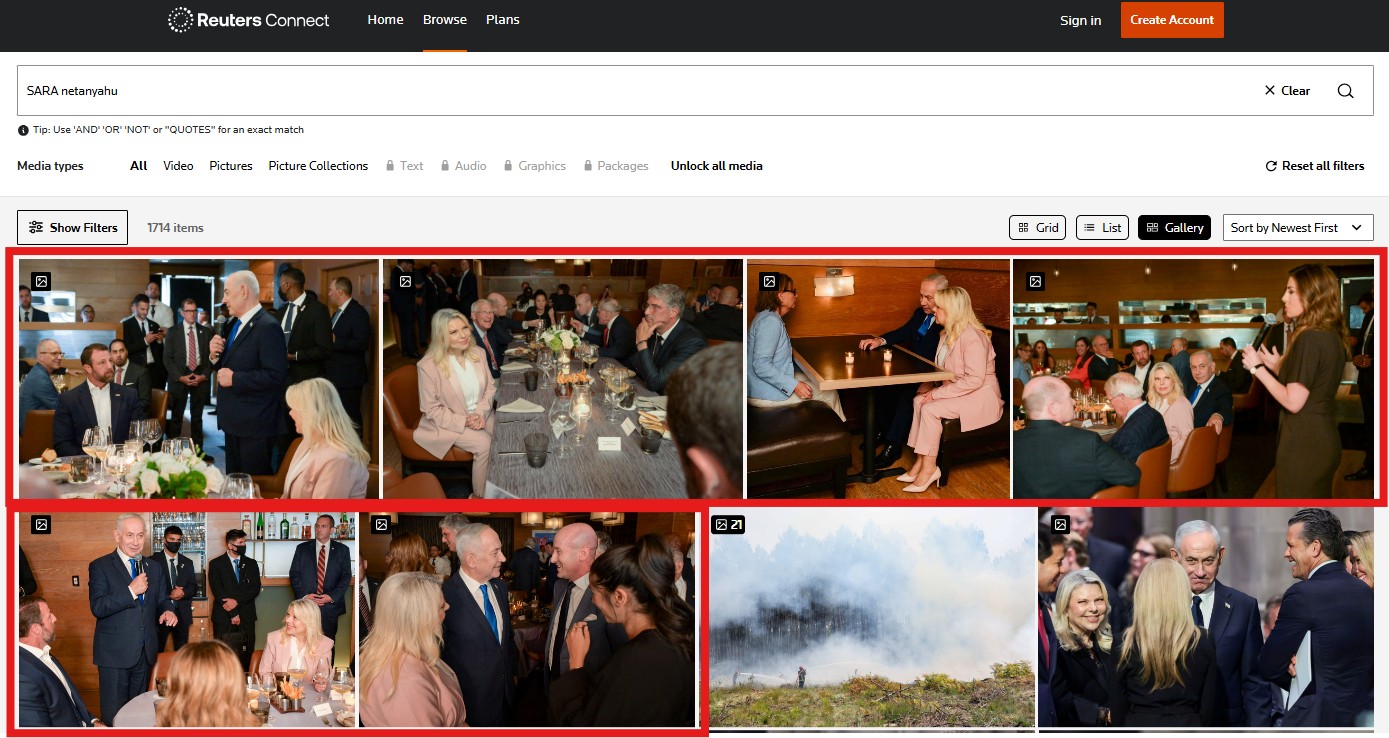
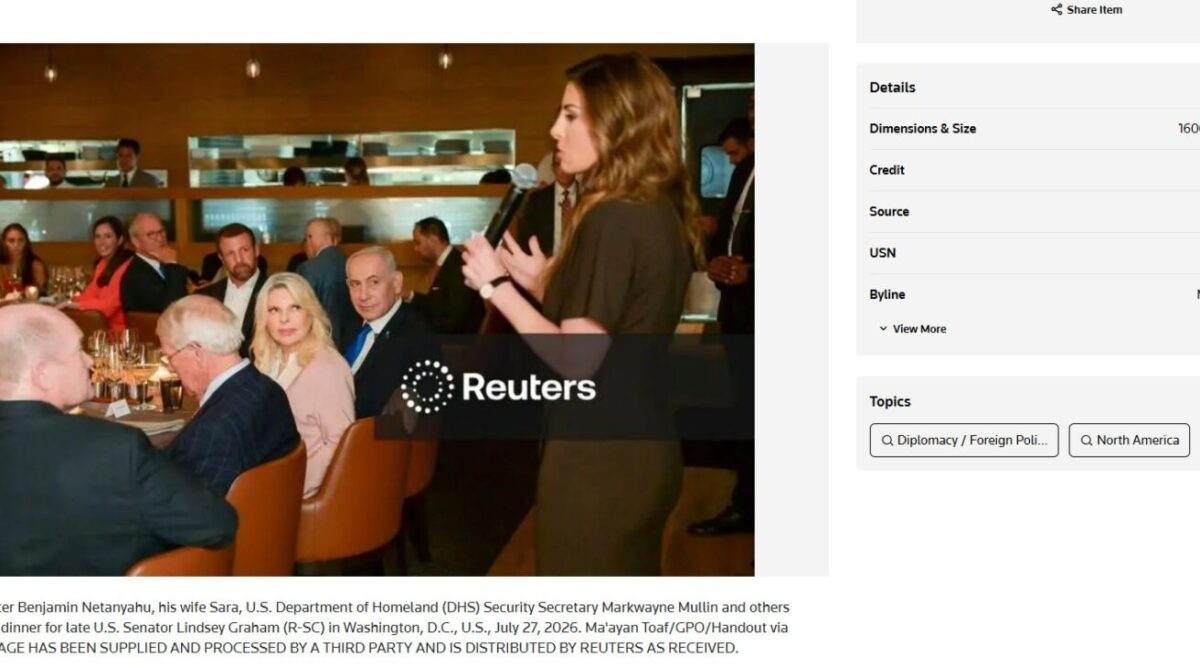
Reuters had added six airbrushed photographs of Sara Netanyahu (Screenshot from the Reuters website)
The Seventh Eye found that Reuters had added six airbrushed photographs of Sara Netanyahu to its archive in recent days. They were part of a set sent to the agency on Tuesday, July 28, documenting the prime minister’s attendance at a memorial dinner in Washington honoring the late Senator Lindsey Graham. The event was attended by members of Graham’s family, his close friends, senior administration officials and members of Congress.
They join another airbrushed photograph that has been in the Reuters archive since 2025, taken during U.S. Secretary of State Marco Rubio’s visit to Israel on September 14. The alterations made to the photograph supplied by the Prime Minister’s Office are apparent when it is compared with an authentic image of the same occasion published by the U.S. Embassy in Israel.
The original photographs taken this week were shot by GPO photographer Maayan Toaf. In the materials distributed by Netanyahu’s office and the GPO, Sara Netanyahu’s name was added to the photo credit in both Hebrew and English. This was the bizarre solution devised by the Netanyahu family after GPO photographers protested that their images were being altered.
However, in the Reuters archive, Sara Netanyahu’s name was omitted from the credits, depriving users of even this minimal disclosure. It remains unclear whether the deception in this case originated with Reuters or with the party that supplied the photographs to the agency.
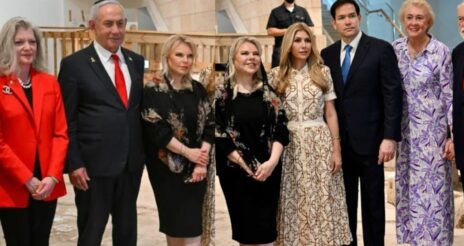
Sara Netanyahu during U.S. Secretary of State Marco Rubio’s visit to Israel on September 14, 2025. Right: the photograph published by the U.S. Embassy. Left: the airbrushed photograph supplied by the Prime Minister’s Office and published by Reuters.
The image includes an explicit notice stating that it was supplied by a third party and not taken by the agency. This suggests that Reuters wrongly assumed that the Israeli Prime Minister’s Office and Government Press Office were trustworthy sources whose photographs could be presumed authentic, consistent with the professional and ethical standards governing journalists, spokespeople and photographers.
That assumption may once have been justified, but it has collapsed completely during Netanyahu’s current term. Netanyahu has introduced a policy of “enhancement” and falsification into Israel’s official documentation apparatus. Such practices may be common and tolerated on private social media accounts, but they are wholly unacceptable in journalistic and government records.
Nor is the practice confined to dramatically altering the appearance of the prime minister’s wife. Netanyahu has recently begun having his photographs retouched as well. As dictatorship researcher and attorney Itay Mack has previously explained, doctoring images to conceal signs of aging is a familiar and widespread practice among dictators around the world.
Examinations of Israeli media coverage conducted by The Seventh Eye in recent weeks found that Israel’s mainstream media - with the exception of propaganda platforms such as Channel 14 and sector-specific media outlets - have avoided using the doctored images. Now an international news agency has fallen into the trap as well.
This article was published in Hebrew on July 30, 2026