








Amid the vote count, the chairman of the Central Elections Committee, Supreme Court Justice Noam Sohlberg, issued a statement directing Shin Bet chief David Zini to investigate suspicions that Qatar had interfered to influence the elections.
In his letter to Zini, Sohlberg wrote that there were “serious suspicions of improper interference in the elections through foreign funding of entities acting against Israel’s interests.” Yet, inexplicably, despite describing the suspicions as “serious,” Sohlberg made clear that he was unable to “testify to the nature of the suspicions.”
According to a source at the Central Elections Committee, among the allegations brought to its attention were claims that Qatar, and possibly other countries, had invested undisclosed sums to increase voter turnout among Arab citizens of Israel. It was also alleged that funds had been transferred for this purpose to Mansour Abbas’s Ra’am party and possibly to the Joint List.
At the same time, in a predawn raid the morning before the elections, police arrested several political activists in the Arab sector of the Negev. Officers searched them and their belongings without a warrant and found envelopes containing cash. During questioning, the activists said the money was intended to support needy families, not to finance political activity.
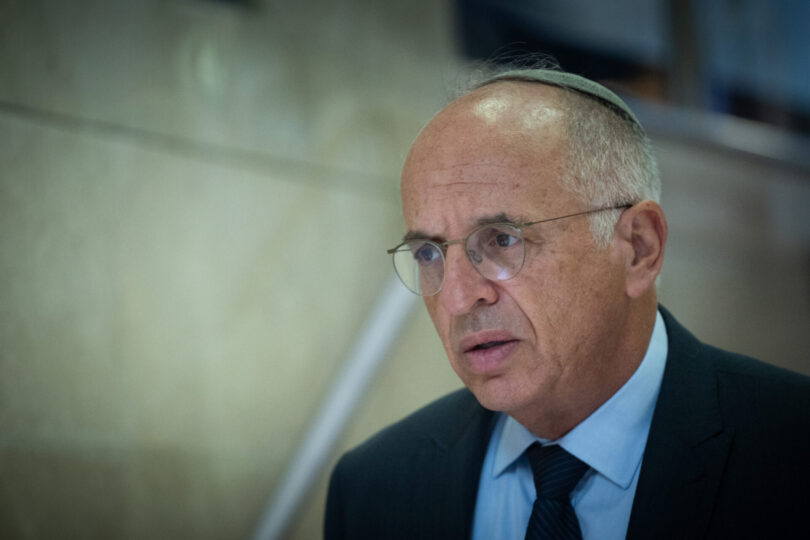
Elections Committee chairman Judge Noam Sohlberg (Credit: Yonatan Sindel, Flash90)
At the time, Sohlberg’s announcement seemed dramatic. In retrospect, however, the affair has come to reek of political manipulation by Netanyahu and his associates, while serious questions have emerged about whether Shin Bet chief David Zini told the truth.
The Shin Bet claimed that it had gathered the information through its own intelligence capabilities several weeks earlier and that the Attorney General had been informed immediately afterward. Zini, however, claimed that he had briefed Justice Sohlberg only the day before the elections so the judge could initiate an investigation. It subsequently emerged that Zini had misled Sohlberg: the investigation had already been opened some time earlier.
It also emerged that Zini had briefed Netanyahu and informed opposition leader Yair Lapid and prime ministerial candidate Gadi Eisenkot only afterward. Moreover, Channel 12 reported that the initial information had come from Netanyahu’s chief of staff, who had passed it to Zini.
Zini’s conduct is particularly troubling given that he is a Netanyahu appointee who has, on several occasions, acted to advance Netanyahu’s interests. It raises suspicions that, once again, Zini may be serving Netanyahu’s political objectives.

First work meeting between Benjamin Netanyahu (right) and David Zini, 5.10.25 (Credit Amos Ben Gershom, EPO)
Zini also requested that Mossad chief Roman Gofman be involved in the investigation. This can be interpreted in two ways. On the one hand, it suggests that the Shin Bet is struggling to conduct the investigation on its own. On the other hand, one could argue that Gofman, himself a controversial Netanyahu appointee, has joined forces with Zini to serve their common boss.
More broadly, a fundamental question arises: why is the Mossad becoming involved in an investigation targeting Israeli citizens, in apparent contradiction to its mandate to operate outside Israel’s borders?
As if all this were not enough, on election day, Zini and Police Commissioner Danny Levy issued reassuring statements praising the elections’ orderly conduct. The warning about an alleged attempt at foreign interference emerged only after the election results were known and Netanyahu’s defeat was clear. It has since served Netanyahu’s campaign to delegitimize the election results.
In response to the criticism, the Shin Bet issued a defensive statement. Its bottom line was: “It should be emphasized that, just as the Shin Bet operates in all its areas of responsibility on a case-specific basis, this investigation too is focused and narrowly defined. It does not cast suspicion on or accuse an entire sector that went out to vote democratically and legally. Only those who acted unlawfully will be dealt with.”
In an unusual move, Qatar also responded to developments in Israel:
“We reject the accusations by certain Israeli politicians and their media contacts, who have launched yet another disinformation campaign to drag Qatar into Israel’s political disputes following this week’s elections,” the Qatari Foreign Ministry said. “They accuse us of buying Netanyahu, the Left—and now the Arab vote. If all these claims were believed, Qatar would apparently own the entire State of Israel.”
For weeks before the elections, Netanyahu singled out Arab political parties and Arab voters as targets of incitement and vilification. Now, on election day and in its aftermath, he appears to be pursuing the very target he had identified in advance.
Netanyahu’s central political objective, following the election results and the realization that he cannot form a government, is to delay the convening of the Knesset. The camp known as the "Change Bloc," which opposes him, commands a majority in the incoming parliament and can begin exercising its parliamentary power regardless of the negotiations to form a government.
The parties in the Change Bloc have already announced their intention to replace Likud-appointed Knesset Speaker Amir Ohana at the first opportunity, and to appoint new members to the Knesset committees.
Under the law, the Knesset must convene within two weeks of the official announcement of the election results. Netanyahu, Likud, and the coalition parties intend to do everything possible to disrupt, delay, and postpone the swearing-in of the new Knesset and Ohana’s replacement.
It is worth recalling that in 2020, following the elections to the 23rd Knesset, Ohana called on then-Knesset Speaker Yuli Edelstein to defy a High Court of Justice ruling requiring him to comply with the law and vacate his position.

Knesset Chairman Amir Ohana (left) with Benjamin Netanyahu at his criminal trial (Credit: Chaim Goldberg)
All the parties in the Change Bloc have called for the investigation to be completed promptly. Ra’am chairman Mansour Abbas himself has declared that there is no basis for any suspicion against his party.
“Safeguarding the integrity of elections and upholding the rule of law are civic and democratic obligations that we have made central to our principles. Ra’am has no connection whatsoever to this affair or any other alleged affair. We declare that we will fully cooperate with all law enforcement authorities to establish the truth.”
The parties have also addressed the question marks surrounding the investigation and Netanyahu’s political exploitation of it.
“This is a coordinated campaign, funded by elements within Likud, that began months ago and is intended to cast doubt on the election results and undermine their legitimacy,” the Joint List said in a statement.
“We went out to vote in unprecedented numbers and achieved a historic result, both for our community and for the entire democratic camp. The Right began this campaign with incitement and attempts to disqualify all Arab parties, continued by sending hundreds of armed far-right activists to polling stations on election day, and has now spent recent days promoting this blood libel.”
Eisenkot accused Netanyahu of exploiting allegations of foreign interference in the elections to undermine their legitimacy.
“Netanyahu, who has grown accustomed to confronting reality through lies, perception management, and the spread of chaos, is leading, together with his partners, an illegitimate influence operation targeting the Israeli public. Its purpose is to delay the publication of the election results as scheduled and to manufacture a pretext for delegitimizing the activities of the Knesset.”
He added: “Any decision relating to the elections must be taken with the utmost gravity and with a clear understanding that the swearing-in of the 26th Knesset must take place on schedule.”
Yair Golan, chairman of the Democrats party, wrote:
“Netanyahu has suffered a crushing democratic defeat. He is now trying to challenge the election results through a campaign to delegitimize the public in general and Arab citizens in particular. If there are genuine suspicions, they must be investigated and the truth established. Until then, let Netanyahu continue barking while we get on with the work of replacing him.”
Outgoing opposition leader Yair Lapid emphasized that, on election day, he had spoken with representatives of Justice Sohlberg at the Central Elections Committee and had also met with Zini.
“Based on my familiarity with the material and in light of the position of the authorities dealing with the matter, there is no threat to or challenge to the election results, and there is no impediment to swearing in the new Knesset.”
Against the backdrop of allegations of a possible foreign influence operation by Qatar, it is worth recalling that the Shin Bet, both under its former chief Ronen Bar and now under his successor Zini, has failed to investigate an influence operation by Qatar that we know for certain took place. As part of that operation, the Persian Gulf autocracy paid millions of shekels, including payments to Netanyahu advisers Yonatan Urich and Eli Feldstein.
Even now, the Shin Bet is dragging its feet in submitting its legal assessment to the Attorney General, who will determine, in the eventual indictments, the severity of the offenses to be attributed to them and to other individuals involved in the affair.
Another point worth noting is the security authorities’ failure to address allegations against Netanyahu himself regarding the receipt of money from Qatar.
If it emerges that Qatar did indeed conduct an illegal influence operation targeting Israel’s elections, this would demonstrate that it is replicating a pattern of behavior exposed in countries around the world: bribing politicians, leaders, and opinion-makers across a wide range of fields, from academia to football.
Such findings could lend weight to allegations that Qatar offered, as far back as 2012, to provide millions of dollars in funding to Likud under Netanyahu and to Yisrael Beiteinu under Avigdor Lieberman. Both parties deny the allegations, which are based on Qatari documents obtained through a hack, the authenticity of which has been disputed.
Netanyahu has also filed a lawsuit against former Defense Minister Moshe Ya’alon and Yigal Carmon, the president of the Middle East Media Research Institute (MEMRI), who called on the security authorities to investigate suspicions that Netanyahu had received bribes from Qatar.