










The politicization of the Shin Bet (Israel’s domestic security service) has reached a new level under Prime Minister Benjamin Netanyahu. According to former senior military officers, IDF generals are now afraid to speak freely or exchange messages on their phones out of concern that the Shin Bet may be monitoring them, ever since David Zini assumed office as head of the agency on October 5, 2025. This is what I learned from former senior officers who heard similar concerns from several of their colleagues currently serving on the IDF General Staff.
When they want to speak openly and unburden themselves, they rely on their aides, family members, or close friends. It is hard to believe that the Shin Bet would dare to monitor generals. Yet the very fact that senior officers harbor such suspicions — that there may be a “Big Brother” watching them — reflects the erosion of trust between senior figures in the security establishment and the political leadership, as well as the low point to which Zini has brought an organization whose traditional guiding principles have been service to the state, defending Israeli democracy, respecting democratic institutions, and obedience to the law.
This concern, reported here for the first time, comes on top of the startling revelation by Channel 12 that the security service used surveillance tools and communications metadata as part of an investigation into leaks to journalists.
It should be emphasized that metadata does not involve intercepting the content of conversations. Rather, it consists of information about communications: who contacted whom, when, how long the conversation lasted, locations, and similar details. Such information can reveal relationships between journalists and their sources without the authorities listening to the conversations themselves. The Shin Bet denies monitoring journalists or collecting data about them. In any event, in the past, any such request required approval from the prime minister and the attorney general.
“We never surveilled journalists,” a former veteran division head who recently retired told me. “The idea never even arose as an option. But today? In the Zini era? Who knows.”
David Zini is married and the father of ten children. Until about a year ago, he served as a general in the IDF. Zini was educated at a right-wing religious yeshiva that critics accuse of promoting racist ideas, hostility toward Arabs, opposition to liberal democratic principles, and support for transforming Israel into a theocracy — religious nationalist state. His father is a rabbi who has expressed extreme views and called for the destruction of the Supreme Court.
About three years ago, Sara Netanyahu, whose influence over her husband is considerable and whose relationship with him has been compared by critics to the symbiotic relationship between Eva Perón and the Argentine dictator, suggested that Zini be appointed as the prime minister’s military secretary. Benjamin Netanyahu rejected the idea at the time, arguing that Zini was too extreme.
But about a year ago, as Netanyahu’s political standing deteriorated amid the wars and the corruption proceedings against him, he changed his position and appointed Zini as head of the Shin Bet — a move critics argue was intended to ensure his control over the agency. Unlike previous Shin Bet chiefs, Zini effectively agreed to become Netanyahu’s puppet.
The latest chapter in the David Zini saga is his meeting at Shin Bet headquarters in Ramat Aviv, north of Tel Aviv, with Yaakov Bardugo — a businessman, political adviser, Netanyahu confidant, and commentator on Channel 14, a network viewed as supportive of Netanyahu.
Bardugo came to demand that the agency open an investigation into alleged leaks of classified information to Channel 12 regarding the outbreak of the war against Iran on February 28, 2026.
Zini yielded to pressure from Bardugo and Netanyahu and agreed. But if such an investigation is opened, why not also investigate Channel 14, whose presenters and reporters have repeatedly published sensitive, prohibited, and at times highly classified information?
With each passing day, it becomes clearer that the arrogant and complacent Zini, who lacks sufficient intelligence experience, believes he knows better than everyone else and displays contempt for the organization’s veterans, is neither worthy nor qualified to lead Israel’s domestic intelligence service.
He did not oppose Minister Itamar Ben-Gvir’s proposed legislation imposing the death penalty on Arab terrorists but not Jewish terrorists, contrary to the longstanding position held by generations of Shin Bet directors.
He minimizes settler violence and acts of terrorism against Palestinians, describing them as “friction incidents” rather than calling them by their proper name: terrorism is terrorism, regardless of religion, gender, or ethnicity.
As I previously reported, he refused to shake hands at a ceremony appointing female Shin Bet employees to senior departmental positions.
He allowed his wife to distribute, through a Shin Bet communication channel, her fundamentalist views on family values — views rooted in a biblical or medieval worldview — while addressing only the wives of employees and excluding the spouses or partners of female employees.
Zini canceled Pride Month events that Shin Bet employees had been permitted to observe for years.
He has sidelined the organization’s legal adviser and is seeking to remove the head of the Investigations Division because the latter insists on investigating Jewish terrorism suspects as well.
For months, he failed to defend one of his own employees — the husband of left-wing political activist Professor Shikma Bressler — after the right-wing extremist Knesset member Tally Gotliv violated Shin Bet law by revealing his identity.
Displaying insensitivity, he ordered the dismantling of a memorial corner dedicated to Shin Bet personnel who were killed fighting Hamas in the Gaza border region on October 7, 2023.
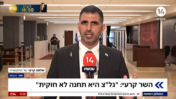
Zini reached the height of his missteps last week. During a public lecture at Argaman, a right-wing conservative institute, he declared that he was loyal to the political echelon — meaning Netanyahu, who appointed him — rather than explicitly emphasizing loyalty to the law. This was not merely a slip of the tongue; it was, critics would argue, a Freudian slip.
Yet through his own lack of political sophistication, Zini also handed the opposition a potential opportunity. If Gadi Eisenkot or Naftali Bennett were elected prime minister, then under the same principle of loyalty to the political leadership, they could demand that he leave office. It would be unprecedented, but arguably legitimate, because Zini himself established the precedent.
Yair Golan, leader of the left-wing Democrats party, has already made clear that if a change of government occurs, Zini should be dismissed. Naftali Bennett has hinted that he would remove any public official who refused to implement the policies of a new government, without specifically naming Zini.
Gadi Eisenkot announced that he opposed Zini’s appointment as Shin Bet director. As IDF chief of staff, Eisenkot promoted Zini to the rank of brigadier general. One may assume that Eisenkot now regrets having promoted and mentored him.
Zini would do well, even at this stage, to make clear that if a new prime minister is elected in approximately four months, he will offer his resignation. Whether that happens or not, the next prime minister — if it is not Netanyahu — should make clear that he has no confidence in Zini and remove him from office.
This article was published in Hebrew on July 12, 2026