



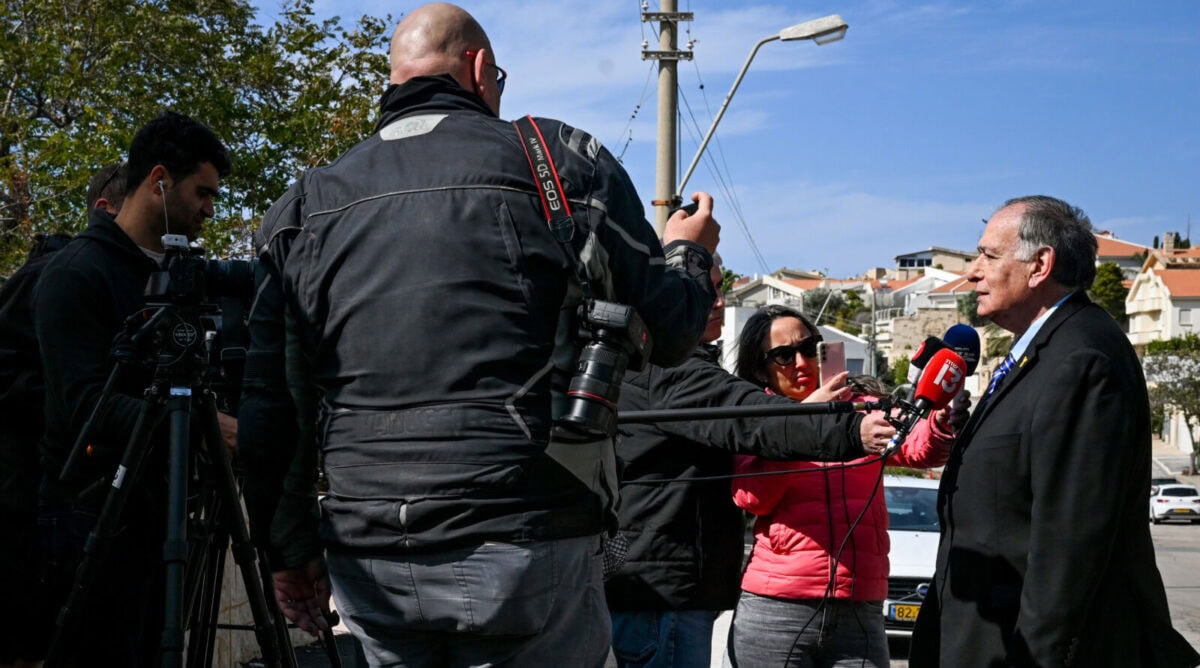


Inspectors from Haifa municipality, headed by Yona Yahav, expelled reporters and photographers from broadcast positions in the city on the grounds of maintaining state security, even though the reporters had received explicit permission from the authorized body, the Israel Police, to remain there and continue their journalistic work, and even though the broadcasts are already subject to military censorship regulations.
The actions of the municipal inspectors, bypassing the police and barring journalistic work, allegedly without authority, expose the Haifa municipality to lawsuits from journalists and the international broadcast networks that hired them. In the past, Ministry of Communications inspectors’ harassment of photographers working for the Associated Press, on the orders of Minister Shlomo Karhi, caused a diplomatic crisis and led to an extraordinary intervention by the White House.
On Saturday, February 28, with the outbreak of the second war with Iran, reporters and photographers from international media outlets took up positions in the plaza next to Stella Maris in Haifa, above two local restaurants.
Among the crews there were Saudi Al-Arabiya correspondent Marwan Atamna and Samir Abdel Hadi, a photographer for the Turkish Anadolu News Agency, which provides footage to CNN Turkey, BBC, Fox News, and others.
According to the two journalists, as soon as they reached the location, a police team arrived, spoke with them at length, and coordinated with them what to film and how. The journalists even gave the police the live broadcast coding from their positions so the police could monitor the broadcast in real time and ensure it did not violate any instructions.
"After a few minutes," says Abdel Hadi, "municipal inspectors arrive and tell us to leave the place." According to the journalists, even after explaining to the municipal inspectors that they had received permission from the police and that inspectors had no authority to ask them to leave, Haifa municipal representatives insisted they clear the plaza.
"Then the inspector tells me, 'If you don't go, we'll give you reports,'" says Abdel Hadi. "I told him, 'Give us reports,' he told me, 'Give me an ID card,' I told him, 'I'm not giving you an ID card,' he told me, 'Then I'll call the police,' I told him, 'That's what I want, call the police! Are you an idiot? The police are on our side.'"
The municipal inspector, Abdel Hadi says, did call the police, but they did not send a police car because, as mentioned, the police had coordinated with the journalists and authorized them to work there.
When a police car happened to pass by, the inspector stopped it and told police there were photographers from the Qatari network Al-Jazeera, whose broadcasts from Israel are prohibited by order of the Minister of Communications. Abdel Hadi clarified in a conversation with The Seventh Eye that neither he nor anyone else who was with him in the square were broadcasting for Al-Jazeera. The police officer, however, left immediately after confirming that the journalists had received permission to be there and take pictures.
After the intervention of the Israel Police's Arabic-language spokesman, Hassan Faraj, who spoke directly with officials in the Haifa municipality, it was agreed that the journalists could stay there, but according to them, the inspectors did not let up. For four days, Abdel Hadi says, they would "come and provoke."
"On Thursday morning," recounts Atamna, "an inspector arrives, irritated, and we return to the starting point - like on Saturday." According to the journalist, after the crews refused to comply with instructions given to them once again without authority, the inspector told them that he had the authority to report the restaurant owners and order their closure for 90 days.
What was the inspector's reason for filing the report? "The fact that I was arguing with him that he couldn't do anything to me, the fact that he was renting the restaurant to you without the city’s permission. He started throwing out all sorts of clauses."
This threat, allegedly, involves an abuse of the authority given to inspectors to act according to municipal bylaws, in order to achieve another goal, which is not within their authority. The journalists who spoke to The Seventh Eye did not express any intention at this stage to take legal action against the municipality and its senior officials for violating their freedom of occupation, but the inspectors' actions expose the municipality to such lawsuits.
In order not to harm the restaurants that provided them with the roof as a filming location, as well as electricity and drinks, the crews decided to evacuate and took up positions on the street. However, the bullying did not stop. "Another municipal van arrives and one of the guys jumps right out at me in front of my camera and wants to touch the camera, and 'You're not allowed to be here' and all that," says Atamna.
The official explanation Atamna received from Haifa Municipality Spokesperson Ofer Harel, he says, was that "they don't want a picture to come out of Haifa, they are firing, you are broadcasting live, so they know how to aim." But this is a false argument. The relevant security agencies, including the police and the censor, approved the broadcast. "I've been in the profession for 25 years and have covered countless wars, I can lecture the municipality about it," says Atamna. "Even the Navy came to us, saw our footage and said, 'Okay.'"
Press photographers, both those broadcasting to the Israeli media and those broadcasting to the international media, are already prohibited from photographing missile landing sites. And in general, a hostile entity who wants to set up a camera and photograph the bay area can do so from any of the many buildings overlooking it, without anyone knowing about it.
So clearly the security reason is not the real reason. What do you think the real reason is?
"I don't know what's going on with them, but the attitude is quite forceful, quite rude."
Following the harassment, the I'lam Center, the Arab Center for Media Freedom, Development, and Research, appealed to Mayor Yona Yahav, demanding that he act to stop the harassment by the municipal inspectors and allow journalists to carry out their work legally.
"The picture emerging from the complaints indicates unjustified interference in the work of journalists, which may amount to professional harassment. Such conduct is not a technical or 'marginal' matter in the field. It harms the core of the protections given to journalistic work in the public sphere, and raises concerns about a serious violation of fundamental rights: freedom of expression, freedom of occupation, and the public's right to know," wrote the organization's CEO, Kholod Massalha, to the mayor.
"It is precisely during times of war that the public weight of journalism intensifies," they claim in the appeal. "During such a period, the public relies on journalistic coverage to receive reliable and updated information. Repeated dispersal operations produce a distinct chilling effect, and the message that goes out to the field is that media presence is 'abnormal' or 'undesirable' even when it is done legally and in compliance with police and censorship guidelines."
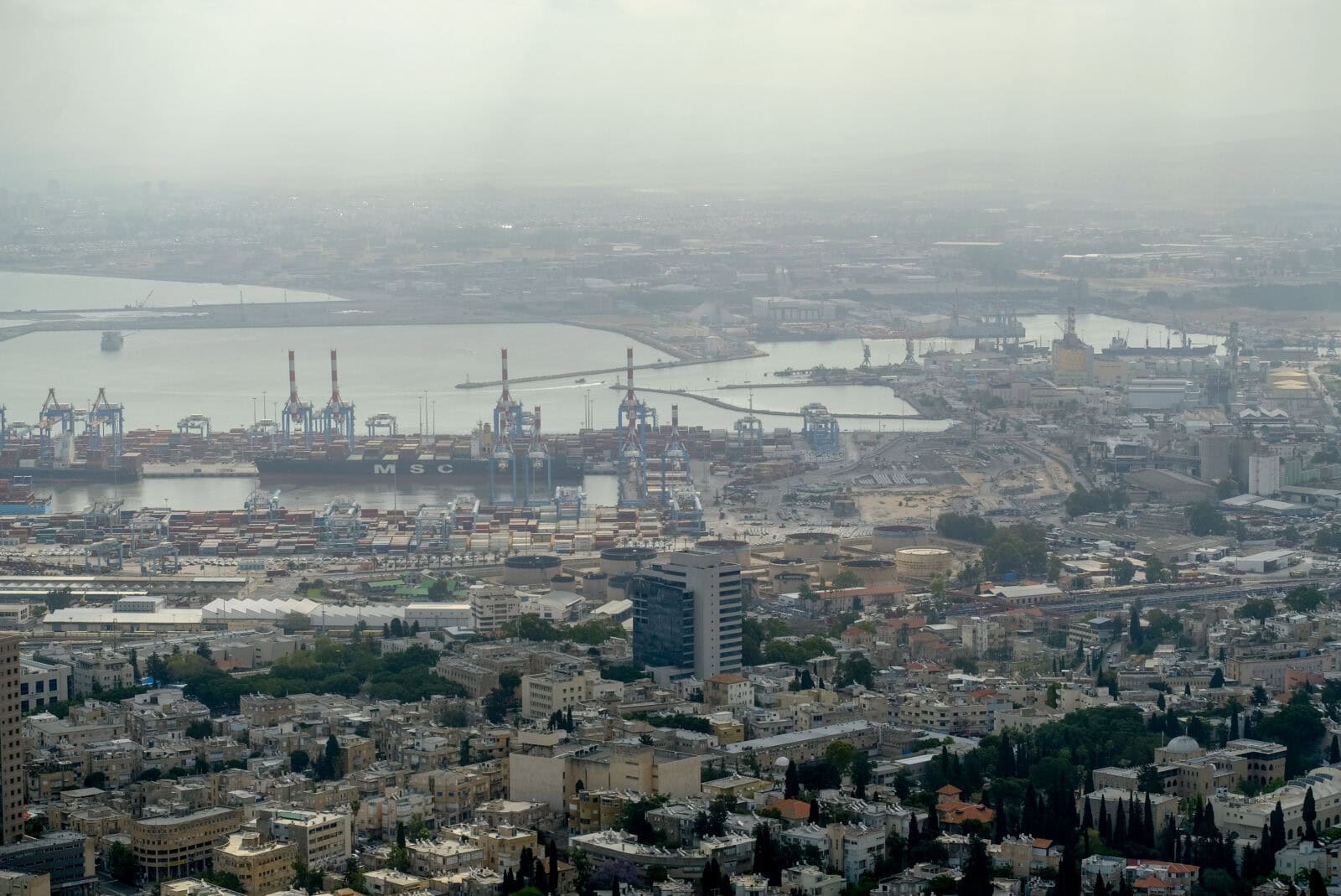
View of the oil refineries of Haifa and the industrial area, on May 5, 2017. Photo by Yaniv Nadav/Flash90
Since being expelled from the Stella Maris area, Abdel Hadi has been filming from various locations. "We go out secretly," he says, "some of us have rented a house, we go to some alley where no one sees us, and from there we film. When the police come, they talk to the spokesman and he confirms to them that we are fine, when the municipal patrol cars come we start fighting with them, a fight to the heavens."
So they succeeded.
"They succeeded, because I don't want to go to jail because I beat someone up. They'll stand there and interfere, and then they'll send their criminals, the settlers, and then what good did we do?"
Atamna, by contrast, doesn't take up a different position each time, but instead moved to film regularly from a different location in the city.
The Haifa Municipality Insists on Not Telling the Truth
The Haifa Municipality's response, sent through spokesman Ofer Harel, is factually incorrect and also lacks internal logic: The authorities have determined that there is no security problem with the broadcasts, and they are approved by both the Israel Police and the military censor.
In addition, anyone interested in photographing the Bay Area for hostile purposes could do so from every one of the thousands of buildings overlooking it without the city inspectors being able to do anything to prevent it.
And more: Contrary to the apologetic conclusion of the response (which is also steeped in absurdity, as if there was something unique about the initial location where the photographers stood), the evidence presented in the article proves that the inspectors harass photographers in additional locations.
Although Harel was invited to correct the inaccurate parts of the response, he insisted on the wording of the incorrect and misleading response, as follows:
"There are and will be no compromises on the safety of Haifa residents and the safety of the city. The Haifa municipality does not prevent any journalist from covering within the city and the city itself, and it even encourages it and cooperates with anyone who wishes to do so.
"Regarding the cases in question — the documentation by foreign networks is sometimes done from certain locations in the city overlooking Haifa Bay and the north of the country, in a way that could help the enemy (unintentionally) obtain an up-to-date and accurate picture of the petrochemical industry plants, military bases, Iron Dome batteries, airports and seaports, etc. — thereby creating serious security risks — lead the city administration to make a decision not to allow filming locations there."
"There is no intention to give the enemy such 'gifts', which could endanger the lives of residents and damage critical infrastructure. During the "A Nation Like a Lion" war, Haifa was hit with direct attacks that caused great destruction, enormous risk (including the damage to the BAZAN plant) and claimed human lives,
"Therefore, the goal is to reduce exposure to the enemy as much as possible. Therefore, this is not harassment by inspectors, but part of the work they carry out throughout the city 24/7 to prevent reporting that could help the enemy. The foreign networks have many other alternative locations available throughout Haifa."
This article was published in Hebrew on March 3, 2026
Translation: Harriet Brown