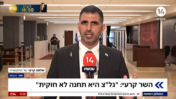











The Minister of Diaspora Affairs, Amichai Chikli, whose ministry is responsible for a global network of covert government propaganda, refuses to provide basic information about his connections with Israeli and foreign influence experts.
The network of influence operated by Chikli and his ministry since the outbreak of the war has been the focus of a series of investigations by The Seventh Eye and Shakuf. A petition filed by The Movement for Freedom of Information seeks to compel the Ministry of Diaspora Affairs to disclose information about Chikli's correspondence with non-governmental contractors involved in the campaigns.
After the outbreak of the war on October 7, 2023, the government tasked the Ministry of Diaspora Affairs with coordinating public diplomacy efforts targeting international audiences. Journalistic investigations revealed that the Ministry hired professionals specializing in disinformation, political activists close to the Likud party and Chikli, a communications advisor involved in international bribery cases, and a mysterious company established by a former commander of the IDF's psychological warfare unit.
The propaganda targets also drew criticism: one campaign aimed to create "deterrence" among Arab citizens of Israel, and Haaretz revealed a covert effort to influence the positions of American elected officials – a move considered illegitimate between friendly nations. The Ministry of Diaspora Affairs refused to provide information about most of these operations and in some cases even denied the findings.
In November 2024, following these publications, The Movement for Freedom of Information submitted a freedom of information request demanding the Ministry of Diaspora Affairs to provide information about "public opinion and influence experts" that Minister Chikli corresponded with through instant messaging apps – including dates, number of messages and shared discussion groups.
Obtaining this basic information about Chikli's use of apps such as WhatsApp, Telegram and Signal could support a future request for the content of the correspondence – information that in Israel is almost never disclosed through freedom of information procedures.
The Ministry of Diaspora Affairs broadly rejected the request, claiming that the information is stored on "personal information systems," meaning Minister Chikli's personal cell phone – and therefore, supposedly, "does not constitute information 'held by a public authority' as defined in the Freedom of Information Act."
Hodaya Shtiglitz, the official responsible for implementing the Freedom of Information Act at the ministry, completely ignored an additional section of the request that asked for details about budgetary engagements with those same "public opinion and influence experts" who maintain direct communication with the minister.
Earlier this month, the Movement for Freedom of Information petitioned the Jerusalem district court demanding the ministry disclose the information.
"In investigations published in Israel and around the world, it was revealed that the respondent [Ministry of Diaspora Affairs], on behalf of the State of Israel, initiated covert influence activities on social media through a commercial company, all with the goal of influencing the opinions of legislators in the United States and enlisting their support for Israel's actions in the war – activities perceived as highly subversive," wrote the petitioners, attorneys Dan Rosenthal and Or Sadan from The Movement for Freedom of Information.
The Ministry of Diaspora Affairs does not carry out these "covert influence activities" itself. They are executed by a network of organizations established in the previous decade by the Ministry of Strategic Affairs and exposed in a series of investigations by The Seventh Eye. After the formation of the current government, the network was transferred to the responsibility of the Ministry of Diaspora Affairs.
In this context, the petition mentions an entity called Kela Shlomo (Solomon's Sling) that was established and controlled by the Ministry of Strategic Affairs and later transferred to the responsibility of the Ministry of Diaspora Affairs. Kela Shlomo was supposed to function as a kind of "brain" for covert influence efforts, but also to create an artificial barrier between the Israeli government and NGOs from Israel and abroad that received money in order to spread governmental messages.
"This pattern of operation not only causes discomfort to a significant part of Israeli society, as actions taken in the name of the state by shadow organizations are not considered acceptable in democratic societies, but also raised serious concerns about violations of the American Foreign Agents Registration Act (FARA). According to this law, any entity acting in the service of a foreign government and seeking to influence public opinion or decision makers in the United States is required to register as a foreign agent and operate with full transparency," the petition states.
"The similarity between the activities of the two ministries raises concerns regarding the activities of the head of the ministry as well as the ministry's engagements, and highlights the importance of enabling effective public oversight, including through freedom of information requests. It is clear that there is a significant public interest in publishing such information when there is concern that the State of Israel is carrying out actions perceived as interference in public consciousness in various countries, by transmitting governmental messages through local 'agents'."
The Movement for Freedom of Information rejects the Ministry of Diaspora Affairs' claim regarding the inability to provide information about correspondence conducted by the minister through his personal phone. According to the petition, in the current technological reality, it is impossible to separate a "personal" device from an "institutional" one, as it is clear that the minister uses his personal device to perform actions that derive from his ministerial role.
"Any attempt to create such a separation is, in practice, a significant violation of the provisions of the Freedom of Information Act," the petition states. "It is clear that the minister, who is part of the ministry's staff, is an integral part of the public authority and constitutes one of its organs. His activity is the activity of the ministry. Public authorities are made of public servants – and the information they hold, related to their work, is public information belonging to the public authority. Any other distinction would create an 'information refuge' – a reality that would severely harm the public's right to information."
The Movement for Freedom of Information notes that in other Western countries, such as Britain, the United States, Australia and the Netherlands, freedom of information laws also apply to ministerial correspondence. According to the petitioners, this is also the legal situation in Israel. "In these circumstances, we are dealing with public information," the petitioners note, "and substantial reasons must be given for not providing it, even if it is stored separately from the respondent's systems or any other public authority."
The Ministry of Diaspora Affairs has not yet responded to the petition.