








The decline of democracy in Israel has severely damaged press freedom in the country, according to a new report by the Open University and "The Seventh Eye," published by the Van Leer Institute. According to the report's authors, press freedom in Israel is under substantial threat, and if the processes that have intensified in recent years continue, the media in Israel will no longer be able to function as a fourth estate overseeing the other three. As a result, democracy in Israel will also suffer.
The report, entitled "On the Brink of Collapse," seeks to offer a new quantitative framework linking democracy and the media, through an empirical analysis of data in six different fields: the ownership structure of the media market, concentration and dominance in the media market, legislation restricting press freedoms, violence against journalists, defamation and silencing lawsuits, and the degree of toxicity and polarization in social media.
The ownership of Israeli media has been studied by "The Seventh Eye" continuously since 2006 through the "Ownership Map," the latest version of which was published in 2021. The new report publishes up-to-date data on media ownership and examines new trends.
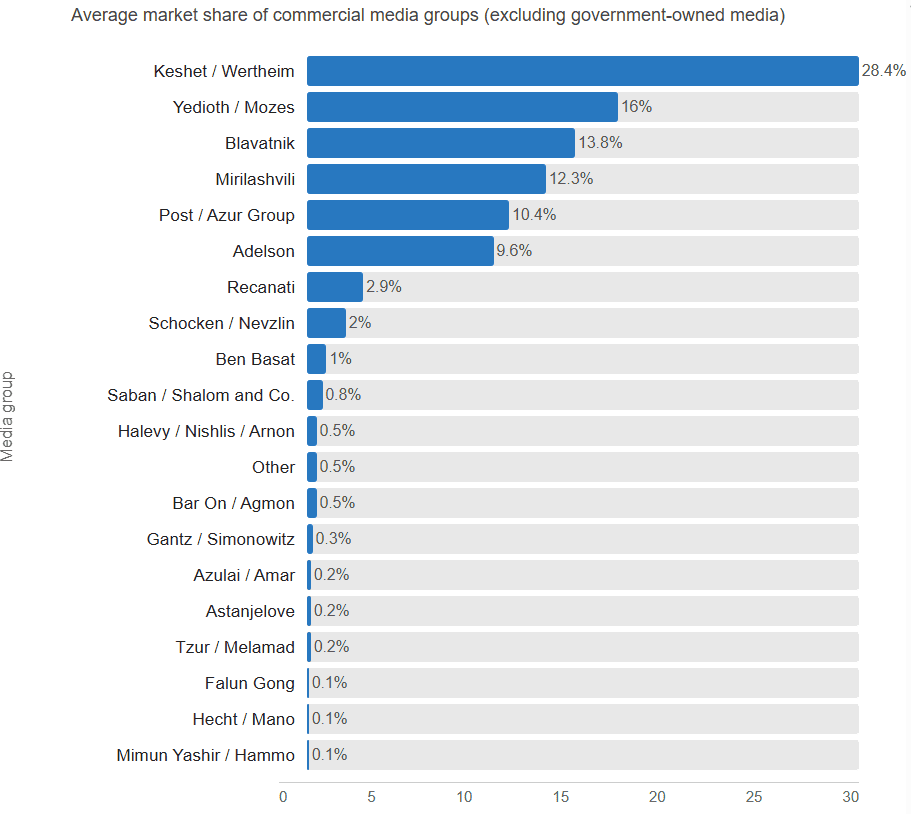
The findings suggest that the downward trajectory of the Yedioth Ahronoth group, which includes the newspaper “Yedioth Ahronoth” —which for generations monopolized the Israeli media world —continues; the Ynet website, still a top competitor among Israeli news websites; the financial newspaper Calcalist; and other media outlets. At the same time, the Keshet Media Group, controlled by David Wertheim (Coca-Cola, Mizrahi Bank) — which includes the Keshet 12 channel and the websites N12 and mako, and operates News 12, the television news monopoly, and other media outlets —continues to strengthen.
The outlet that has seen its dominance in the Israeli media market surge is the "Post" group of gas and gambling tycoon Eli Azur, which includes the radio station 103FM and the "Walla!" website, the "Jerusalem Post" and "Ma'ariv" newspapers, and other media outlets. Finally, a notable trend is the intensification of a new group, owned by Yitzchak Mirilashvili, son of oligarch Michael Mirilashvili, which includes Channel 14, the Economics Channel ("Channel 10"), Kol-Chai Radio, the websites 0404 and "Emess," and other media outlets.
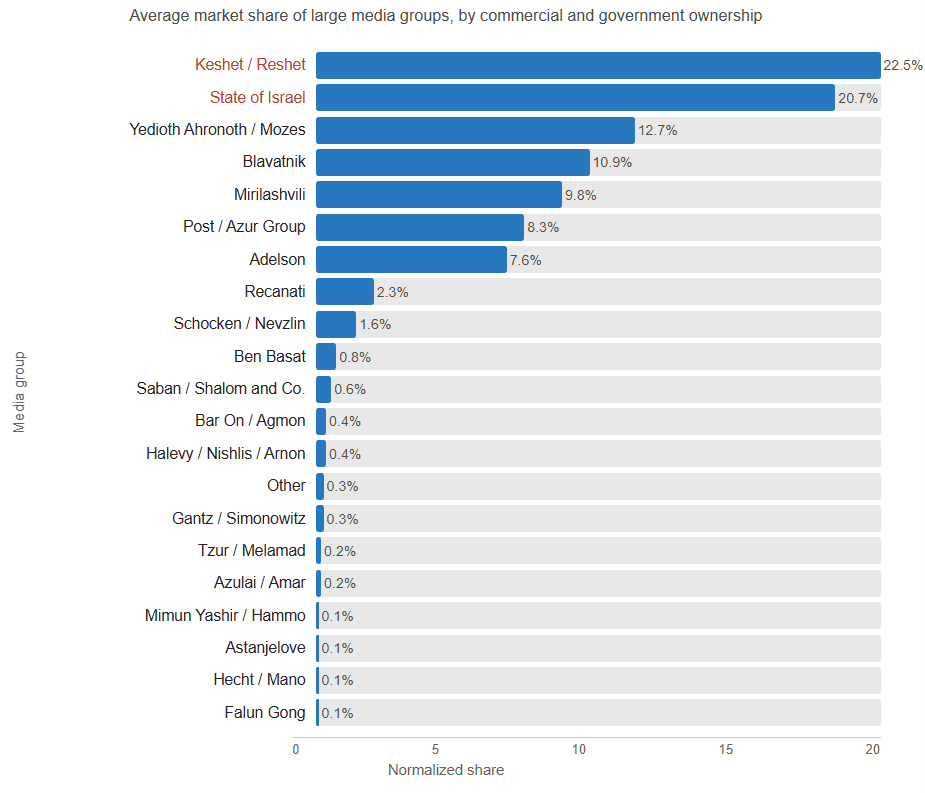
Besides the "trends in the game of thrones," as the report's authors call it, there was a notable rise in the power of media moguls and media outlets affiliated with the government. Besides the Adelson family, which owns the powerful print brand "Israel Hayom," which originally arose to serve politician Benjamin Netanyahu, the Mirilashvili family has emerged, as mentioned, whose media outlets openly serve Netanyahu.
Another prominent trend, according to the report's authors, is the "establishment of a media oligarchy." In other words, the takeover of the country's popular media outlets by a few of the wealthiest people in Israel. While in the past there were more media outlets held by owners focused only on media, today control of the media is concentrated in centralized groups owned by multi-billionaires with a variety of intersecting interests.
In addition to examining the scope of media ownership, the report also examined the degree of market concentration in Israel, through the creation of a first-of-its-kind dominance index that pulls together television, radio, print media, and the Internet. The dominance index aims to address the lack of transparency in the Israeli media market: the economic data and media exposure data of media outlets are largely confidential, and there is certainly no complete and uniform database on Israeli media. The dominance index combines, for the first time, all of the Industry-standard exposure data, in various media fields, into a uniform index.
The examination shows that the Keshet Group is the most dominant, but not far behind is the State of Israel, which operates public broadcasting through its two branches: the Israel Broadcasting Corporation and Galei-Tzahal. According to the concentration indices used, it’s clear that the concentration in the Israeli media market is moderately high — the four owners of the main media groups control almost two-thirds of the market.
The situation could have been worse: In light of the government's moves to eliminate public broadcasting in Israel, the report's authors emphasize that without the Broadcasting Corporation and IDF Radio, the Israeli media market would be even more concentrated. Such concentration has a distinctly negative impact on democracy.
The report's authors have reservations and further note that "part of the appearance of this level of medium-high concentration can be attributed to the rise of a media group characterized by a distinctly anti-journalistic nature, whose contribution to diversity in the market is negative." The authors are referring to Mirilashvili's Channel 14, whose existence and success in the public eye reduce the degree of concentration in the market, but whose anti-journalistic nature harms democracy.
In the chapter dedicated to legislation against the media, the report's authors review all the laws submitted in the 25th Knesset (up to May of 2025) and the laws submitted in the 24th Knesset that dealt with the media. According to the examination, while in the 24th Knesset, which was dominated by the Bennett-Lapid coalition, a total of eight bills were submitted, two of which were intended to strengthen the media and six that aimed to harm it, in the current Knesset the number of media bills has increased to 38, although the ratio remains the same — about three-quarters aimed to promote measures that damage press freedoms.
Of the 38 bills submitted in the current Knesset, only seven made it into law, but all of them were detrimental and all of them, except one initiated by a member of the Knesset from the ruling Likud party, were government bills. A breakdown by political blocs revealed that Netanyahu's bloc, both when in opposition and when in coalition, drove the legislation that damaged the media.
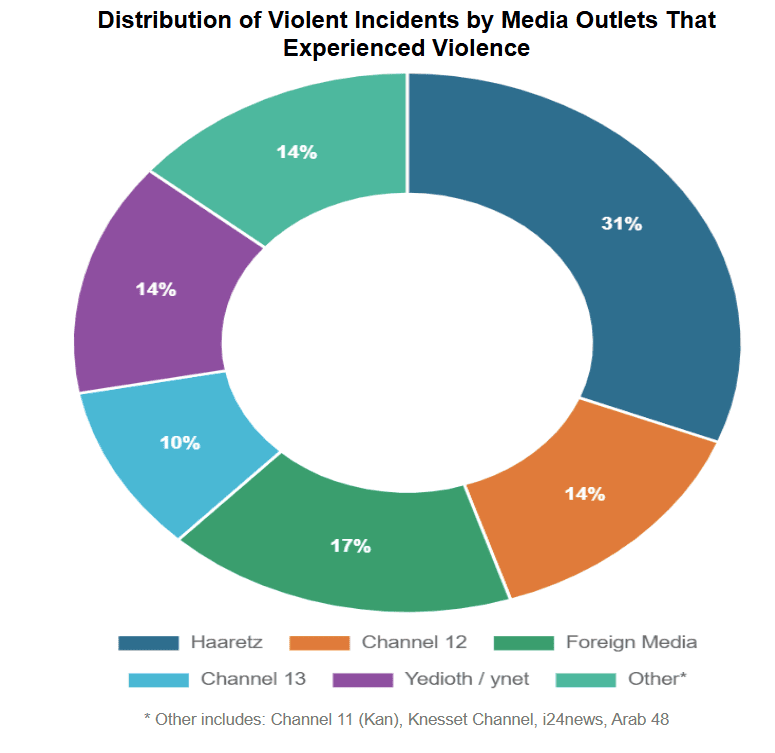
According to an examination of cases of violence against journalists in Israel, the report's authors conclude that it is more dangerous to be a journalist in Israel than in Europe. According to the report, which bases this chapter on the updated database of the Union of Journalists in Israel, the greatest danger to journalists stems from violence by ordinary citizens. They have pushed, hit, kicked and spit on journalists, thrown objects at them, poured water, eggs and horse manure on them. Alongside violence from citizens, police violence is also prominent, which is also characterized primarily by physical violence, including the use of batons, beatings and shoving.
A breakdown by media outlet shows that Haaretz journalists are more exposed to violence, along with foreign journalists working in Israel. Both, it seems, are subjected to violence over positions critical of the government. And indeed, according to the report, anti-government events are the most dangerous for journalists in Israel.
A comparison with data on violence against journalists collected in Europe revealed that the leading form of violence against journalists there is also physical violence, although this is less common than in Israel.
The defamation and SLAPP lawsuits chapter, which is based on data from "Tolaat Hamishpat" ("The Law Worm"), shows that in the last 17 years there has been a significant increase in both the number of defamation lawsuits and the damages sought, with a notable decrease in the years 2021-2022. The report's authors attribute this to the impact of the change of government, along with the coronavirus pandemic.
The authors distinguish between defamation suits against citizens and suits against media outlets, and find that while defamation suits against citizens are accepted in almost half of the cases, defamation suits filed against media outlets are accepted in only a third of the cases.
Despite this, as mentioned, the number of lawsuits and their scope are on the rise. The report's authors attribute this to two possible reasons: "Either the severity of the harm they claim is particularly severe and therefore it is worth it for them to risk their lawsuit not being accepted, or it is a lawsuit to silence, the chances of which are clearly low from the outset, but it is useful for the message the plaintiff wants to convey: Be careful when reporting on me or my interests."
Another finding concerns fluctuations in the volume of defamation lawsuits against media outlets. According to the report, these lawsuits are influenced by current events, and flourish during periods of public upheaval. "In this reality, journalists may be deterred from dealing with sensitive issues precisely when such dealing is required and when it is essential that the facts be exposed to the light of day," the report's authors write.
A notable innovation in the report concerns the analysis of clusters of Twitter (X) users in Israel. After the report's authors extracted the list of the 2,000 largest Israeli accounts online, and mapped the list of follows and followers for each account, they got a database of about 21,000 accounts and approximately 40,000 connections between them.
This database is broken down into three main clusters, according to the main affiliation of each account: "Green Cluster," which includes a large group of journalists along with politicians, mainly from the opposition or those who are no longer serving in the Knesset; "Purple Cluster," which includes Prime Minister Benjamin Netanyahu along with other politicians from the coalition and several media figures affiliated with the Netanyahu government, such as Amit Segal, Yinon Magal and Ayala Hasson; and "Blue Cluster," consisting mainly of official institutional accounts of the country's government and military bodies.
An examination of the clusters revealed that the first cluster is characterized by decentralization and heterogeneity, the second cluster is characterized by high concentration and homogeneity, while the third cluster is characterized by a formal but isolated presence.
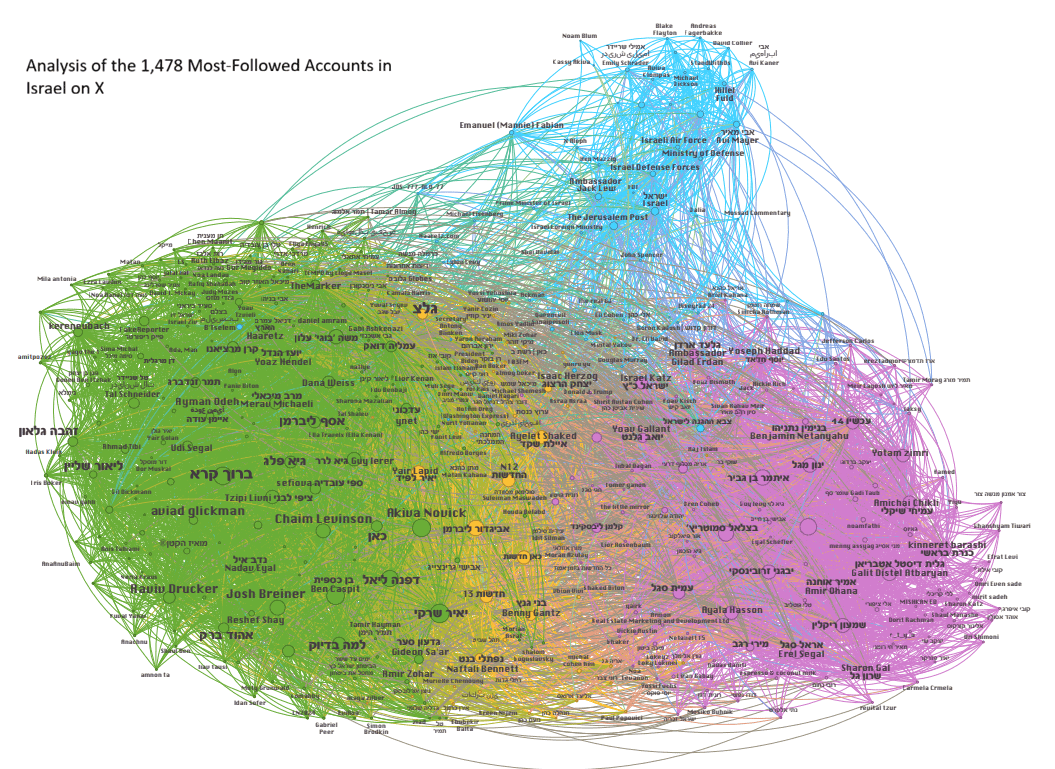
It also emerged that there is also a fourth cluster ("orange"), which bridges clusters 1 and 2 and includes the accounts of the main media outlets in Israel. "This finding is important because it contradicts the claims of Netanyahu and the government ministers, according to which the 'media' is leftist and hostile towards them," claim the report's authors, noting that while channels 11, 12, 13 and Galei Tzahal bridge the two camps, "Channel 14 is located deep in the right-wing camp on the X network, close to government officials and coalition members, as well as to the prime minister himself."
The authors of the report point out that the high concentration in the purple cluster indicates the degree of closeness among politicians, journalists, and channels in the right-wing camp. The common phenomenon of the Israeli "star journalist," who has more followers than the total followers of the media outlet in which he is employed, also emerges from the research. A clear example of this is Amit Segal, the star of News 12 — but in fact a star in his own right.
A separate analysis, which focused on the toxicity of the discourse, revealed that the degree of toxicity and the degree of violence in the responses to Amit Segal are slightly lower than the degree of toxicity and violence in the responses to Ben Caspit. "Israeli society is splitting into two distinct media camps, which are characterized by a coherent identity and internal dynamics, but barely conduct a dialogue with each other," say the report’s authors.
According to the report, the state of the free press in Israel is dire, but improvement is still possible. However, the current trend, unfortunately, is one of democratic regression and ongoing harm to the media. "If the erosion of Israeli democracy continues, press freedom will fade with it until, eventually, a truly free press will also erode," warn the report's authors.
"The public will lose trust in the information given to them in the media; they will not know whether it is real information, information on behalf of the government, or information aimed at enriching the bank account of the controlling shareholder. This is the soil in which apathy, distrust, and conspiracy theories grow.
"A free press is the only entity that demands accountability from those in power and authority. When it is weak, the government operates unhindered and without accountability to anyone. When it is controlled by the government and its cronies, democracy is replaced by the appearance of democracy: false freedom, false pluralism, and false transparency."
The report was authored by Prof. Anat Ben-David and Dr. Keren Tsuriel from the Open University, alongside Shuki Tausig, Chen Egri and Shabi Gatenio from the Seventh Eye. On behalf of Van Leer, the project was led by Prof. Hagai Boas, head of the "Technology and Democracy in Retreat" project at the institute.
This article was published in Hebrew on January 6, 2026
Translation: Harriet Brown