









When Britain, Canada, Australia and France recognized a "Palestinian state," headlines celebrated. CNN wrote of "deepening Israel's isolation" and acting "to keep alive the possibility of peace." "Al Jazeera" called it a "historic diplomatic shift."
The coverage spoke of "hope," "breakthroughs," and "righting historical wrongs." But Gaza lies in ruins, split between areas Hamas controls, areas Israel controls, and areas no one controls. The West Bank fragments into a puzzle - Area A under a Palestinian Authority whose president last faced voters in 2006, Area C under Israeli control, Area B in perpetual limbo.
Hamas and Fatah haven't formed a joint government since their unity deal collapsed in 2014. They literally maintain separate governments that refuse to recognize each other's legitimacy. No unified territory. No functioning government. No agreed borders. No control over resources. How does recognizing this as a "State" help actual Palestinians build something real? Almost no major outlet asked such questions pertaining to the facts themselves. The recognition became the story - the symbol substituted for substance.
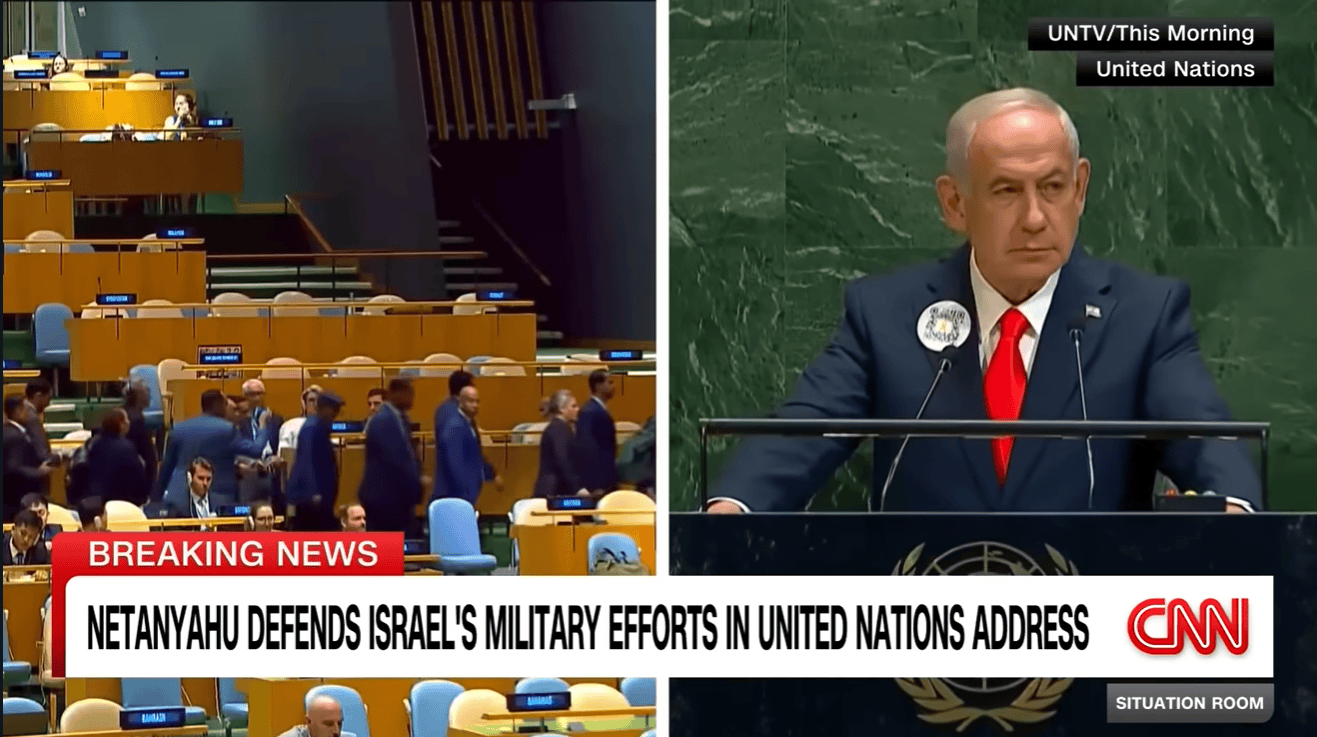
A few days later, dozens of diplomats walked out as Israeli PM Benjamin Netanyahu approached the UN podium. CNN and the BBC focused on the dramatic protest and the emptying hall. Al Jazeera celebrated the international cold shoulder. Major news networks spoke of an almost-empty auditorium, a mass walkout, growing isolation.
The walkout - pre-coordinated, cameras positioned perfectly, statements prepared in advance - dominated coverage. Lost in the theater: What Netanyahu actually said. His direct broadcast into Gaza. The substantive issues at stake. Most importantly, whether such gestures help anyone - Palestinian or Israeli - move closer to peace. The performance became the news.
Then came Trump's 21-point plan. The Washington Post highlighted the "Trump development plan" for rebuilding Gaza. CNN detailed the "comprehensive peace framework." Al Jazeera analyzed the proposed "Gaza International Transitional Authority." Point 6 promises amnesty to Hamas members who commit to peaceful coexistence. Point 11 proposes a temporary technocratic government for Gaza. Point 13 states Hamas will have no role in governance. Point 15 promises a temporary international stabilization force.
But where were the basic questions? When has a group that threw its rivals off rooftops in 2007 to seize power given it up for amnesty? Which technocratic government has survived without popular legitimacy or military force? What international force would risk its soldiers where UN forces refuse to enter? This wasn't journalism. It was a transcription of a fantasy.
The coverage of these three events reveals a clear pattern: mainstream international media accepts diplomatic theater as reality, documents it instead of analyzing, transmits messages instead of asking questions. It abandoned the basic journalistic role - observing from the sidelines without participating.
By choosing to make the walkout the main story instead of examining the content, by turning symbolic recognition into headline news instead of questioning what lies behind it - the media failed its journalistic duty. This isn't simple bias - one outlet pro-Israel, another pro-Palestinian. It's something more sophisticated: journalism that instead of documenting reality, became a partner in creating the theater.
The theoretical framework developed by peace researcher and sociologist Johan Galtung helps explain what's happening. Galtung distinguished between "war journalism" - focused on conflict, winners-and-losers, us-versus-them, and "peace journalism" - exploring complexity, humanizing all parties, seeking solutions.
But what we're witnessing is a third category: journalism that speaks the language of peace while practicing the dynamics of war; mobilized not for any particular side but for the simple story of diplomatic progress, of symbols becoming achievements, of theater replacing reality.
Consider, for example, the recognition coverage. Peace journalism would probe: Does recognizing a "State" help Palestinians build one? Does it incentivize reconciliation between Hamas and Fatah or cement their division? Does it create pressure for democratic elections or let autocrats off the hook?
War journalism would at least be honest, saying something like "Western nations back Palestinians against Israel," or "against the Israeli government" if applying the principle of charity.
Instead, we get mobilized journalism disguised as objectivity. Humanitarian language - "hope," "justice," "historic" - packages what's essentially empty political theater as meaningful progress.
Symbols do have power - they can inspire hope, mobilize legitimacy, shift discourse. But when they become substitutes for reality rather than bridges to it, they become dangerous. Complex realities get flattened into simple narratives. Theater gets reported as substance.
This pattern isn't limited to these events. When UN data revealed 87% of Gaza aid trucks were "intercepted" between May and August 2025, much mainstream coverage continued focusing on Israeli restrictions on aid entry. The fact that aid was being stolen at unprecedented rates - by armed groups or desperate civilians - received limited attention.
When discussing Palestinian prisoner releases, coverage tends to blur the distinction between prisoners from Gaza and those from the West Bank, ignoring the hostility between the two entities. When many Israelis take to the streets against their government, the protests tend to be subsumed into a narrative of "Israel refuses compromise."
The apparent polarization in coverage - with some outlets branded "pro-Palestinian" and others "pro-Israeli" - masks a deeper uniformity. The Guardian may emphasize Palestinian suffering while The Telegraph highlights Israeli security concerns, but both operate within the same zero-sum framework. This isn't diversity of perspective; it's the same war journalism dressed in different colors. True peace journalism would transcend these camps entirely.
Palestinians - in Gaza and the West Bank alike - need functioning institutions, economic development and leadership that represents them, not recognition ceremonies that change very little on the ground. Israelis need real security arrangements and regional integration - not diplomatic isolation that hardens positions. Both peoples need media that asks hard questions of all sides, not cheerleaders for their one-sided narratives.
This phenomenon of global journalism lacking the outside perspective, actively participating in empty diplomatic moves, has immediate consequences for reality itself. Journalism shapes what's possible. When diplomatic theater receives coverage as substance, leaders learn that empty gestures are worth more than real negotiation. When symbolic moves get more headlines than actual progress, the incentive to build something real disappears.
Media rewards performance over achievement, and gets exactly what it encourages - endless performances, no real progress.
The path back isn't complicated but requires global media to abandon its comfortable assumption of moral clarity for the uncomfortable work of actual journalism - not just any journalism, but true peace journalism: one that explores how both peoples are trapped in systems perpetuating conflict, that seeks solutions rather than victories, that humanizes all sides rather than encouraging dehumanization.
This is still possible. In a conflict where both peoples deserve better than endless performance, it's not just professional responsibility - it's professional necessity.
Sagit Alkobi Fishman is a PhD Candidate in the School of Communication, Bar-Ilan University. Her article was published in Hebrew on September 30, 2025