






In the past, it was popular to keep manual cast iron meat grinders in Israeli homes to make cutlets. In recent years, Dr. Eran Rolnik, who serves as chief physician in the Personal Compensation Unit at the Ministry of Finance, has been going through Netanyahu's regime's grinder that is trying to turn him into a submissive cutlet. The one turning the handle is Prime Minister Netanyahu. There's no need to identify a personal directive from him to deal with Dr. Rolnik - unspoken orders are sufficient.
Haaretz and TheMarker extensively covered the affair. To understand the current stage in the evolution of Netanyahu's regime, it's particularly important to listen to Dr. Rolnik's interview on Lior Kodner's "The Week" podcast, where he described in detail the progression of the disciplinary proceedings against him at the Civil Service Commission because of critical articles about the government he published in Haaretz.
A democratic regime is characterized by broad protection of freedom of expression and rule of law, as well as action according to uniform, egalitarian and transparent rules. In contrast, an authoritarian regime is characterized by the fact that a citizen exercising freedom of expression risks having the regime punish him if he is saying or writing something that the regime doesn't like - but also by the fact that life is subject to arbitrary and fluid rules that change according to the regime's whims and needs.
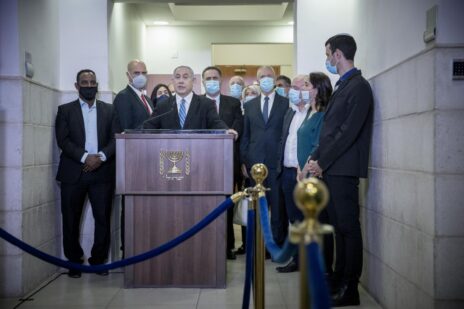
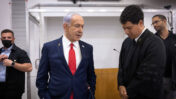
Prime Minister Benjamin Netanyahu in a Brutal attack on the judicial system, before the opening of his criminal trial, with Likud MKs and ministers behind him. Jerusalem District Court, May 24, 2020 (Photo: Yonatan Zindel)
Netanyahu's regime has not yet completed its takeover of the judicial system, so it cannot publish a "blacklist" of citizens or announce mass dismissals of all those who participated in protests against it. Instead, one of its main weapons is arbitrariness, which leads to anxiety, uncertainty and self-censorship.
Through arbitrary conduct, Netanyahu's regime creates a situation where every citizen must carefully consider his past and future statements. Without knowing in advance which statements the regime will regard as crossing an invisible red line, any remark could later be used to justify labeling a citizen as a target.
Accordingly, Dr. Rolnik advanced from stage to stage in the grinder in an arbitrary manner, and his story raises a question among every Israeli citizen - can what happened to him happen to me too?
The first arbitrary stage in the grinder was the very decision to file the complaint and then the "tailoring" of the complaint by selection of content from Dr. Rolnik's articles on Haaretz.
When the junior official at the Ministry of Finance was asked on what basis she filed the complaint with the commission, she refused to reveal who instructed her to complain and replied that she didn't even read the articles Rolnik published and complained only based on the headlines, since she had no subscription to Haaretz at all.
But Dr. Rolnik was interrogated not only about the articles he published, but was also asked if he "comes to the protests at Kaplan [against Netanyahu's government] every Saturday night."
Who in Netanyahu's regime decides to file a complaint against a citizen and what are the criteria for choosing a particular citizen from among many? What puts a citizen in the regime's "crosshairs": publishing articles in a newspaper, critical writing on social networks, holding a sign at a demonstration, mere participation in a demonstration, or a combination of all these?
Is there significance to the citizen's friendship or family connections? Was Dr. Rolnik chosen randomly or because his brother Guy is the founder of TheMarker and deputy publisher of the Haaretz group, The only self-proclaimed liberal media outlet in Israel?
Dr. Rolnik published about 35 articles in Haaretz. Of these, five were selected, published starting from February 2023. To what extent does Netanyahu’s regime retroactively scrutinize a citizen’s past statements? Does the regime have a database of statements? And from the regime's perspective, is there "statute of limitations" on some of them?
The second arbitrary stage in the grinder was Rolnik's summons for interrogation and the questions he was asked.
Dr. Rolnik was not told in advance why he was summoned for interrogation. Who decides in Netanyahu's regime that a complaint will become an investigation? From Netanyahu's regime's perspective, is the investigation an end in itself? A "fishing expedition" so that the interrogated person will be pressured and confess to offenses he committed and even ones he didn't commit? Or is an evidentiary and legal infrastructure required for the very opening of an investigation?
For about three hours, Dr. Rolnik was questioned not only about the content of his own articles, but also about comments posted in response to them, as well as headlines from pieces written by others that editors had linked to in his articles. From Netanyahu's regime's perspective, is a citizen responsible for his statement as a whole, or can it be broken down into parts and each examined separately and without context, and even hold him responsible for others' statements?
Dr. Rolnik was interrogated about whether he mocked the Prime Minister's wife, since in one of his articles he called on her as a professional (Sara Netanyahu worked part-time as a child psychologist) to protest against promoting a law that would allow treating children without academic training. From Netanyahu's regime's perspective, are the Prime Minister's family members and associates part of the regime and therefore reference to them could be considered harming the state?
The third arbitrary stage in the grinder was the decision to put Dr. Rolnik on disciplinary trial and its timing.
Dr. Rolnik contacted the commission and the Ministry of Finance director-general to clarify the investigation results and received evasive answers. Only after about a year from the investigation, when Dr. Rolnik tried to compete in a civil service tender, the chairman of the examining committee revealed to him a document on the matter that was attached to his file.
The commission claimed in response to Haaretz that the delay in the disciplinary department's handling was due to "shortage of manpower." What are Netanyahu's regime's considerations for putting a citizen on trial? Is it better for a citizen to "keep a low profile" and not compete in additional tenders so as not to attract the regime's attention? Is it better for a citizen summoned for interrogation to understand the hint and withdraw on his own initiative?
Dr. Rolnik was put on disciplinary trial for private work without a permit, since he did not renew the approval for additional work in time and received payment of 450 shekels (about 134 dollars) for some of the articles.
In addition, he was put on trial for the offense of "conduct that is inappropriate and likely to harm the image and good name of the civil service," a broad and vague offense that almost anything could be included in, if there is political will to do so in order to terrorize a citizen.
How does Netanyahu's regime choose the offense clauses? Should a citizen fear that ants he has already managed to forget will retroactively become elephants or offenses in the regime's eyes?
The fourth arbitrary stage in the grinder is Dr. Rolnik's uncertainty about the future. Has Netanyahu's regime finished dealing with Dr. Rolnik or does it have additional plans for him? Will investigations be opened against him in other areas, or will attempts be made to make his livelihood difficult even outside the civil service?
On a day of protest against the stalled negotiations for the hostages’ return from Gaza, doctors and other healthcare professionals marched from the Israel Medical Association building in Ramat Gan to Hostages Square in Tel Aviv, calling for their release. Dr. Zvi Fishel, manager of a closed ward at Geha Hospital, told Ynet: "I'm demonstrating first and foremost for the release of the hostages. But not only. I'm also protesting against the dictatorial government in office, which has brought most of the Israeli public to despair, and I'm fighting for the return of hope."
Will all the doctors and healthcare system personnel who participated in the demonstration, or who published support for it on social networks, be summoned to the interrogation room? For now apparently not, but from Netanyahu's regime's perspective, they all already need to be afraid.
The article was published in Hebrew on August 20 2025.