












Degel HaTorah has been engulfed in political drama in recent weeks: party leader Moshe Gafni and veteran Knesset member Uri Maklev face removal from its slate in what looks like a palace coup orchestrated by party operatives seeking to install fellow lawmaker Yaakov Asher in Gafni’s place.
It is a real political drama. But readers who rely on the Haredi party newspapers for their news, including Degel HaTorah’s Yated Ne’eman (literally, “Faithful Stake”), will know nothing about it. They will probably learn what the leading rabbis have decided only when the candidate lists are finalized.
In many ways, this story perfectly illustrates the relationship between Haredi newspapers and journalism. Physically, they are real newspapers: they smell of fresh print and leave ink on your fingers. But when it comes to the reality a newspaper is expected to reflect, the picture they offer their readers is limited, to put it mildly. The range of subjects they cover is extremely narrow, as is the scope of the questions they ask and the answers they provide.
There is a clear reason for all this. These publications serve an audience defined, in part, by an explicit desire to remain apart from the wider society in which it lives. The Haredi press is intended not only to report the news and keep readers informed but also to shape a worldview and reinforce the community’s ideological and social foundations.
So while Haredi newspapers may not tell us much about the world, they can reveal quite a lot about their writers and readers. That is one of the things this column will set out to do in the coming months: explore the rules and boundaries of discourse in the Haredi world. What must be said? What may be said? What is forbidden? And what can be said only through hints, homilies, or coded language?
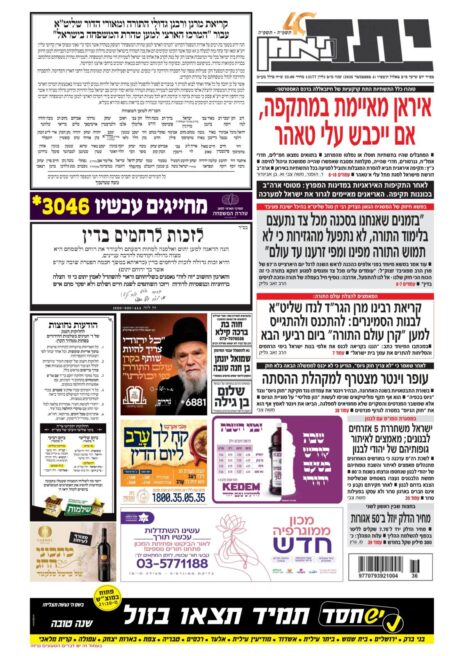
The front page of Yated Ne’eman, September 4, 2026. Headlines on the right, from top to bottom: “Iran threatens to attack if Ali Taher is captured” / “At a time when dangers surround us, we will redouble our Torah studies. We will not be intimidated by the decrees, for the Torah will never depart from our mouths or those of our descendants” / “Rabbi Dov Lando calls on female seminary students to gather next Wednesday in support of the World of Torah Fund” / “Ofer Winter joins the chorus of incitement.”
We will also sample the coverage itself: which subjects the Haredi press addresses, what it reports extensively, what gets less attention, what goes entirely unreported, and how editorials and opinion pages frame the news.
But before getting into all that, it helps to understand the landscape: who the players are and how we got here. This week’s column will address those questions so that, in the columns to come, we can let the newspapers speak for themselves.
The Haredi media landscape is a tangled web. It includes daily and weekly newspapers, websites, radio stations, and, of course, the telephone news hotlines known as nayes, which remain popular. Yet in Haredi terms, this entire dynamic market exists as a compromise rather than an ideal. It would have been better had it never come into being, but under the circumstances, there is no choice but to accept it.
Reservations about mass media, and before that about secular printed material, are part of a broader Haredi resistance to anything that carries a whiff of change or modernity. That was already the case in the late nineteenth century, when the first Haredi newspaper appeared in Galicia: the weekly Machzikei Hadat (“Upholders of the Faith”), founded by the Belzer Rebbe, Rabbi Yehoshua Rokeach.
Its publishers sought to offer an alternative to the newspapers of the Haskalah, the Jewish Enlightenment movement, which were circulating at the time. Their premise was that if a newspaper could not be avoided, it should at least be entirely faithful to religious principles. Even so, many Haredi leaders opposed the paper. A well-known story recounts how the Gerer Rebbe, Yehuda Aryeh Leib Alter, ordered two copies out of respect for the Belzer Rebbe, then ordered them burned to set an example for his own followers.
Yet in the following generation, Rabbi Aryeh Leib’s successor, the Gerer Rebbe Avraham Mordechai Alter, founded the Haredi daily Hamodia (“The Informer”), the newspaper of Agudat Yisrael. In various incarnations, it has continued to appear to this day and remains one of the Haredi leadership’s principal mouthpieces.
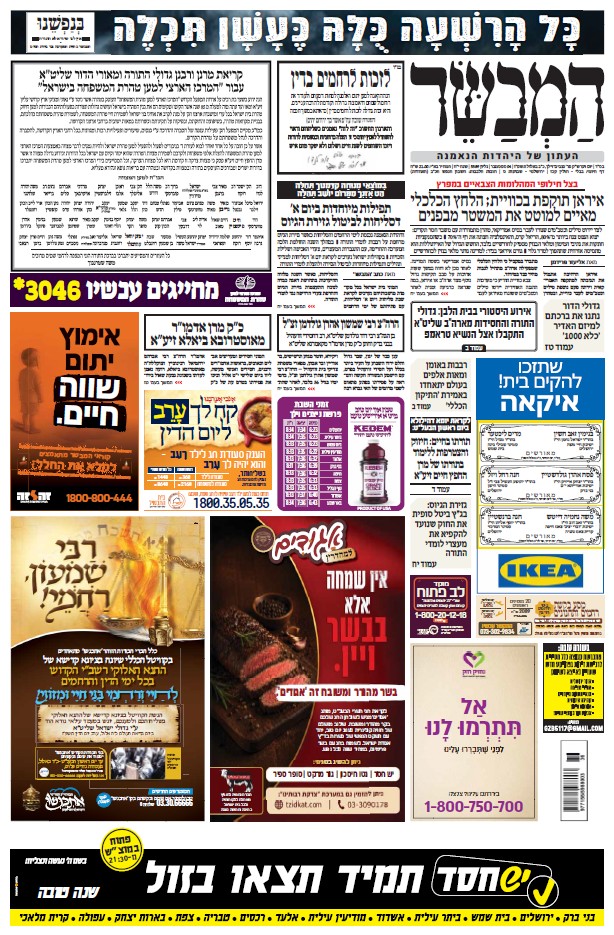
The front page of Hamevaser, September 4, 2026. Headlines from right to left: “Iran attacks in Kuwait: Economic pressure threatens the regime from within” / “Special prayers and Selichot penitential services on Sunday to overturn the conscription decree.”
Hamodia was not published continuously. In 1950, it was reestablished in Israel by Rabbi Yitzhak Meir Levin, the leader of Agudat Yisrael and a close confidant of the Gerer Rebbe. For years, it was the country’s leading Haredi newspaper until an internal conflict between the Hasidim and the non-Hasidic Lithuanian stream, led by Rabbi Shach, prompted the founding of a separate Lithuanian newspaper, Yated Ne’eman, in 1985.
In 1988, when the Lithuanian faction broke away from Agudat Yisrael and founded Degel HaTorah, Yated became the new party’s mouthpiece. For roughly two decades, Hamodia was the Hasidic Haredi newspaper and Yated the Lithuanian one. That arrangement lasted until 2009, when, following a dispute with the Ger Hasidic leadership, Jerusalem’s Porush family established Hamevaser (“The Herald”): a daily intended to give medium-sized and smaller Hasidic communities a voice and advance their interests, both within Agudat Yisrael and more broadly. Belz, despite being the second-largest Hasidic community, is also closely associated with Hamevaser.
In 2012, following the death of Rabbi Yosef Shalom Elyashiv, the Lithuanian camp also split. Supporters of Rabbi Shteinman took control of Yated, while supporters of Rabbi Shmuel Auerbach, known as the Jerusalem Faction or the Bnei Torah party, founded Hapeles (“The Level”). Since then, the paper has taken the most radical position within the Haredi mainstream, as distinct from groups such as Edah HaHaredit (the Haredi Community of Jerusalem) and Satmar, and has spearheaded the “We’ll die rather than enlist” protests.
Alongside these four papers, the Hasidic Hamodia and Hamevaser and the Lithuanian Yated Ne’eman and Hapeles, there is also the Sephardi Haredi newspaper Haderech (“The Way”). Aryeh Deri founded it in 2017 as a weekly for the Shas movement; in 2020, it became a daily. These five party newspapers will be the main focus of this column, with occasional looks at less prominent publications such as Edah HaHaredit’s HaEdah (“The Community”).
As in most other areas, Haredim are conservative in their media habits. Despite the wide range of Haredi and non-Haredi news sources available, a 2025 Israel Internet Association survey found that printed Haredi newspapers were the community’s preferred medium. Apart from conversations with friends and family, they were also the most common way to keep up with the news.
Trust in the printed press is also substantial: 66% of respondents said they trusted newspapers at least moderately. When I asked Haredi friends about these findings, they were not surprised. They said that although newspapers had lost influence in the Haredi media market, as they had in the wider market, the average Haredi reader still placed considerable trust in their party’s paper.
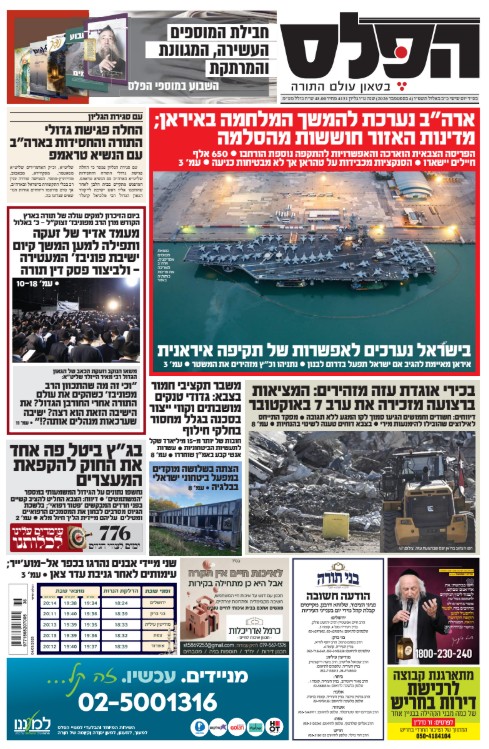
The front page of Hapeles, September 4, 2026. Headlines, clockwise from top left: “Meeting with Trump gets under way for leading Torah scholars and Hasidic leaders in the U.S.” / “U.S. prepares for continued war in Iran; neighboring countries fear escalation” / “Senior Gaza Division officers warn: Conditions in the Strip recall the eve of October 7” / “Severe IDF budget crisis: Tank battalions out of action and production lines at risk amid spare-parts shortage” / “Two stone-throwers killed in Al-Mughayyir; clashes follow sheep theft” / “High Court unanimously strikes down law halting arrests” / “Mass rally of prayer and protest to save Ponevezh Yeshiva and uphold the rabbinical court’s ruling.”
Readers reserve the knowing wink and the celebrated Haredi cynicism for reports about their own community, where they can readily see through the flowery exaggerations. When it comes to foreign affairs and security, or, in another vein, the attorney general, the High Court of Justice, or “the left,” they tend to take what they read at face value. Either way, these findings are essential to understanding the Haredi press’s role and influence among its readers.
Since the discontinuation of the TGI surveys focused on the Haredi press, it has been difficult to obtain readership figures for individual newspapers. Kantar Media, which conducted the surveys, said Haredi advertising agencies had stopped paying for them. The last survey, conducted in 2019, found that Yated Ne’eman was the most widely read paper, with a readership rate of 26.6%. Hamodia followed with 15.8%, then Hamevaser and Hapeles, at 10.5% and 9.9%, respectively.
Haderech had not yet become a daily and was therefore not included in the survey. Various reports, however, indirectly suggest that it has struggled to build a readership on its own. In 2017, it was reported that employees of the Shas school network were required to subscribe to the newspaper, then still a weekly, and that salaries were withheld from those who refused. A 2023 report said that money to pay Haderech employees’ salaries had been transferred through dubious channels from the budget of the school network, which receives state funding.
Yes to Defense, No to the Draft
When an ordinary non-Haredi reader picks up a Haredi newspaper, the first thing they are likely to notice is the disproportionate prominence of military and security news. Take Yated Ne’eman’s August 31 lead headline: “Security officials make clear: There is no alternative to a ground offensive and the conquest of Gaza City.” A few days earlier, on August 24, Hamevaser’s lead headline read: “After seven kites are launched toward Israeli communities near Gaza: Israel threatens to evacuate parts of the Gaza Strip.”
On September 2, Haderech carried two large headlines. One announced a “wave of strikes in Iran” by the U.S. military; the other reported the “capture in the heart of Gaza” of Hamas’s internal security chief. That day’s lead headline in Yated likewise read: “Hamas’s ‘Shin Bet chief’ abducted from Gaza and taken to Israel.”
Israel’s defense partnerships also receive extensive coverage. On September 1, Hamodia reported on its front page that a “huge defense deal with Greece” had been signed. That day, Yated covered the same story and reported that Finland and Israel had “extended their defense agreement until 2034.” And so on. Wars among the gentiles, such as the one between Russia and Ukraine, also receive extensive coverage.
The disproportionate focus on security is apparent not only in comparison with other subjects, but also alongside another issue that makes headlines, though not on the same scale: the campaign against attempts to draft young Haredi men into the military.
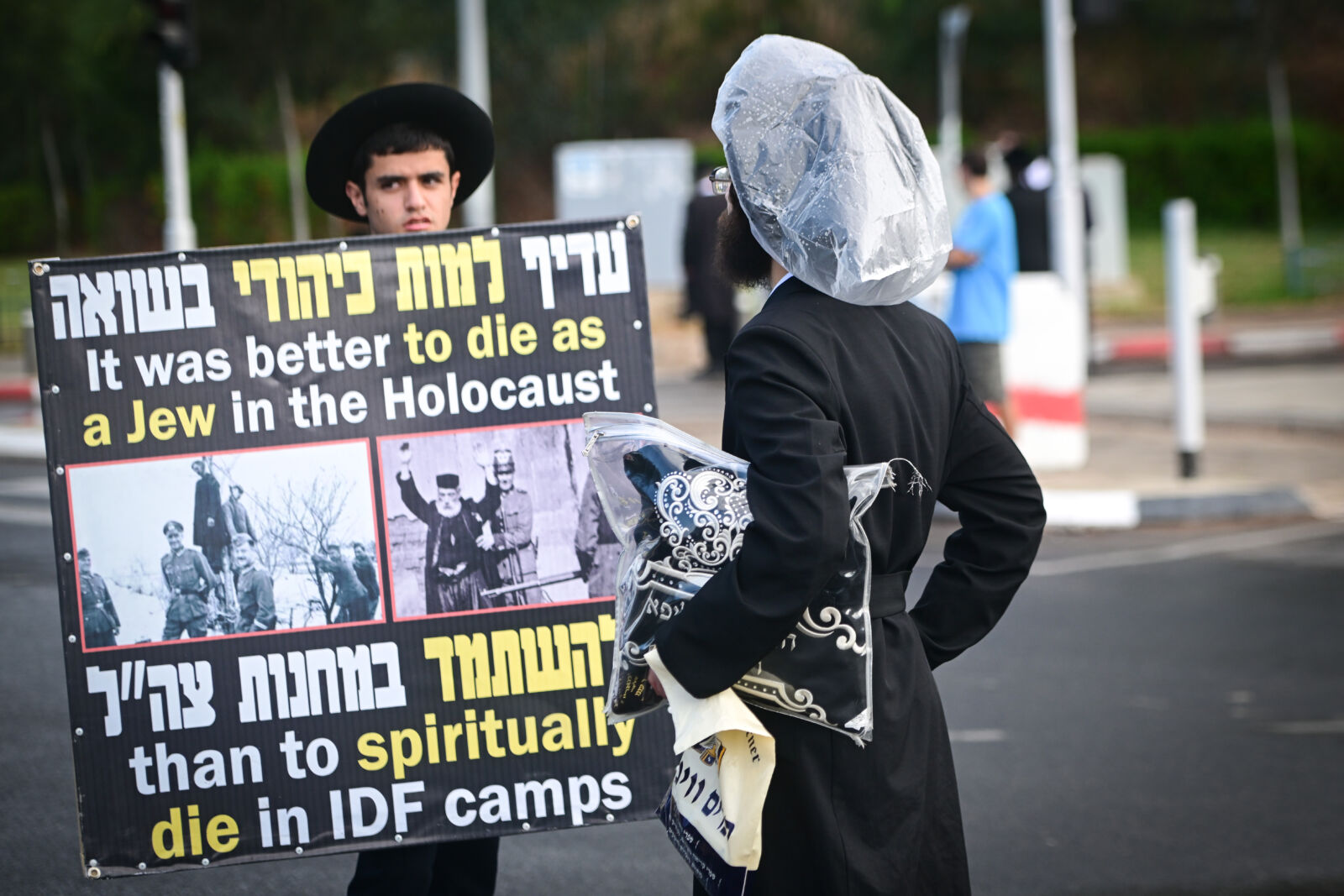
Ultra orthodox Jews protest army draft outside Tel haShomer army base in Ramat Gan, August 31, 2026 (Photo by Avshalom Sassoni/FLASH90)
The contradiction is likely to strike a non-Haredi reader, but it rarely surfaces explicitly. One exception was Hamevaser’s August 24 editorial on the danger of a multinational force entering Gaza in place of the Israeli military:
“At the crucial moment, a foreign force will not risk its soldiers’ lives to save Jews from those seeking to kill them, God forbid. True, Jews of faith place no trust in soldiers or weapons. Even so, human beings have a duty to make an effort, and foreign armies will not do even that. In any serious clash, they will flee for their lives.”
In other words, even if it is obvious that soldiers are not what really protects us, foreign soldiers will not even go through the motions as Jewish soldiers do. At any rate, contrary to what one might expect, the Haredi press is full of admiration for Jewish military power. That admiration, which sometimes borders on adoration, is consistent with the firmly right-wing politics of the overwhelming majority of its writers. Their politics, in turn, reflect views prevalent across the Haredi community.
What Can Be Discussed
These political leanings reflect a very particular form of integration into Israeli society, perhaps not the one liberals hope for. But there is also a practical explanation for the extensive military and security coverage. The Haredi press places fundamental limits on what it covers. Crime is almost entirely absent. Gossip, the lifeblood of any newspaper that hopes to survive, appears only in hints. And anything to do with sex, including sexual offenses, is of course unmentionable.
Investigations intended to expose wrongdoing or corruption are also rare. These restrictions come on top of those more familiar to secular readers, such as the complete absence of photographs of women and the near-total avoidance of their first names. That leaves five main subjects: military and security affairs, foreign news, politics, health, and news from within the Haredi community.
All these restrictions naturally apply to foreign news as well, leaving a fairly narrow range of permissible coverage. A look through the relevant pages reveals reports on major world events, this week chiefly the disaster in Nepal and tensions between the United States and Iran, alongside extensive coverage of Jewish life in the diaspora. In the Haredi press, that usually amounts to various manifestations of antisemitism.
Alongside reports of incidents and concerns in Europe and North America, this week also brought extensive coverage of President Trump’s planned meeting with American Haredi leaders, who wanted to raise the plight of yeshiva students in Israel.
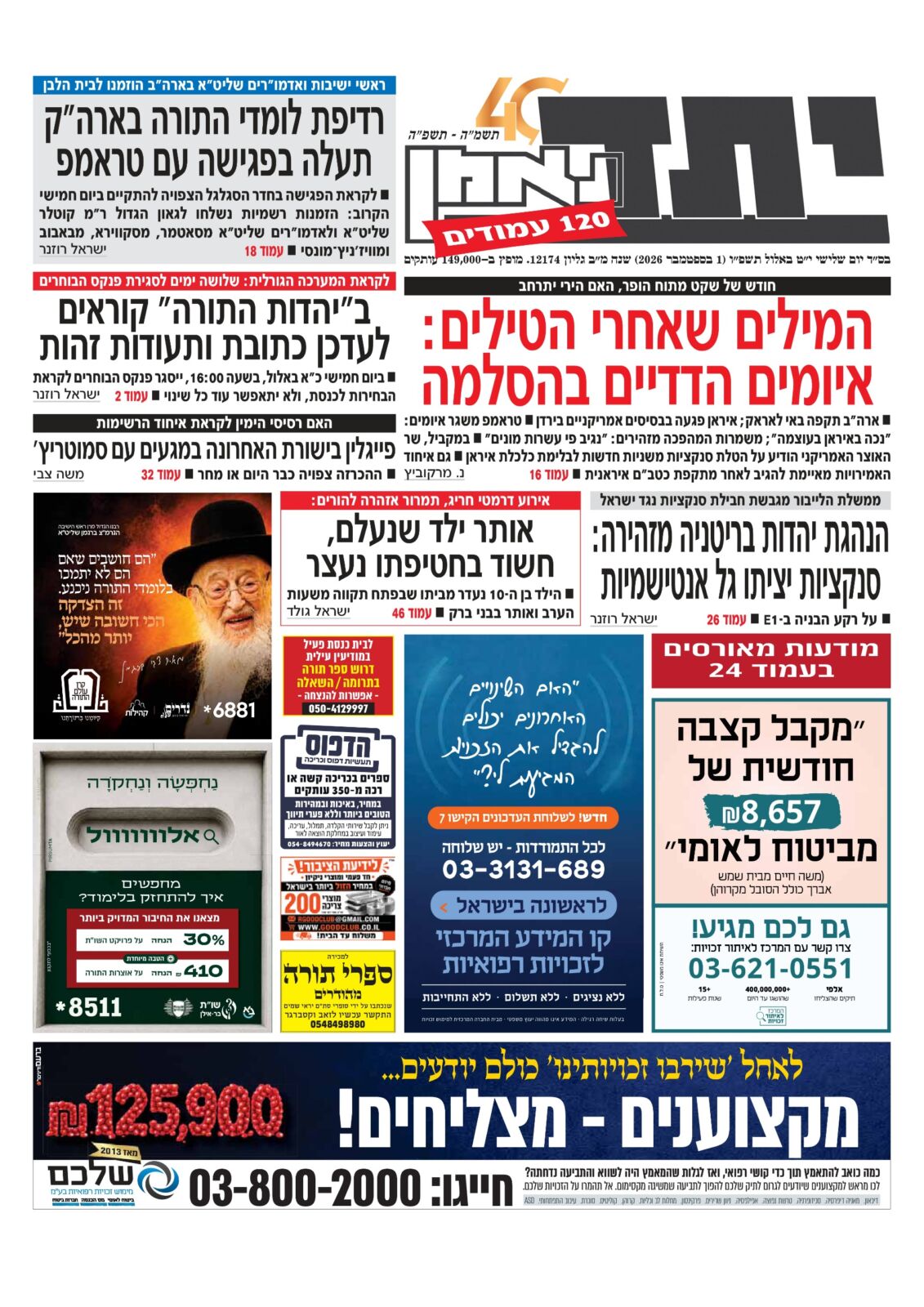
The front page of Yated Ne’eman, September 1, 2026. Headlines, clockwise from top left: “Persecution of Torah students in the Holy Land to be raised at meeting with Trump” / “Words follow rockets: Mutual threats of escalation” / “British Jewish leaders warn: Sanctions will spark a wave of antisemitism” / “Missing child found; suspected kidnapper arrested” / “Talks between Feiglin and Smotrich enter final stages” / “United Torah Judaism urges voters to update their addresses and identity cards.”
The same principles shape political coverage. As noted, the potential palace coup in Degel HaTorah went entirely unmentioned in this week’s papers. So did the ongoing financial crisis at Bnei Brak’s municipality. It is a reminder that these are not newspapers in the conventional sense, but party organs serving very specific interests within Haredi politics.
Critical coverage of the Arab Joint List focused on the alleged influence of Mahmoud Abbas and the Palestinian Authority over its reestablishment. The sexual harassment allegations against Hadash candidate Jafar Farah, which could have provided ample material for criticism, were of course unmentioned. Criminal violence in Israel’s Arab communities is entirely absent, while Jewish nationalist violence is mentioned in passing in broader discussions of the situation in the West Bank.
One article worth noting appeared in Hapeles’s September 4 Sabbath supplement. Addressing the assassination attempt that may or may not have been made against Yair Netanyahu, it reported at length, and with explicit attribution, the doubts Yossi Melman had raised in The Seventh Eye about the prime minister’s family’s account.
But the political and legal battle over Haredi conscription receives the most space, along with the various sanctions the authorities impose on those the military calls “deserters” and Haredim call “prisoners of the holy Torah.”
Reporting on the news pages is relatively matter-of-fact. The Haredi position emerges chiefly through the choice of words: “the persecution of Torah students,” “the dismissed attorney general,” or “Supreme Court President” Yitzhak Amit. In the last example, the quotation marks appear in the original, signaling a refusal to recognize his appointment. There are differences even here: Yated, Hamodia, and Hapeles are more restrained; Haderech and Hamevaser less so. Opinion pages allow greater freedom, which is how Yitzhak Roth could write in the August 31 Yated Ne’eman of “Israel’s judicial system, which tramples every democratic value under the cover of legal lies.”
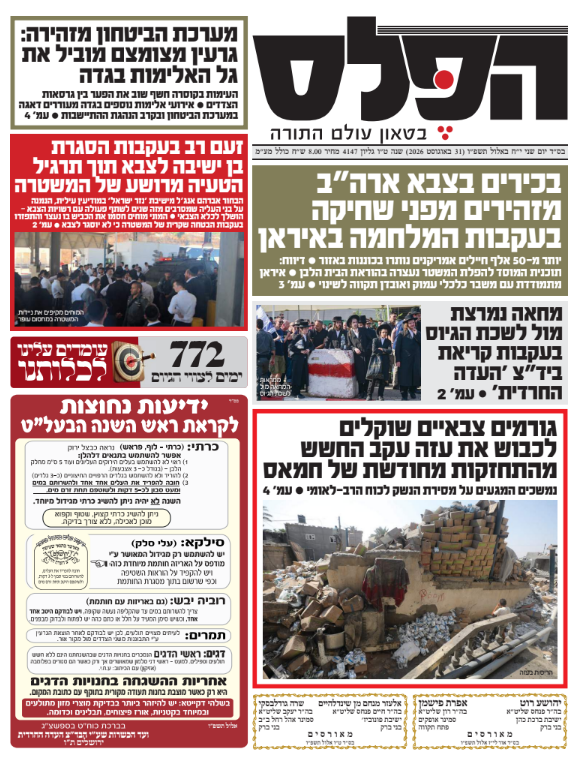
The front page of Hapeles, August 31, 2026. Headlines, clockwise from top left: “Defense establishment warns: Small core group drives violence in the West Bank” / “Senior U.S. military officials warn of strain caused by war with Iran” / “Large protest outside recruitment office following a call from Edah HaHaredit’s rabbinical court” / “Military officials weigh capturing Gaza amid fears of Hamas gaining strength” / “Outrage after police use a vicious ruse to hand a yeshiva student over to the IDF.”
Still, we should remember that the assault on Israel’s democratic system by Netanyahu’s sixth government, and the struggle against it, have somewhat obscured a longstanding fact: the Haredi public has viewed the High Court and the judiciary as bitter enemies for years.
Longtime readers will surely remember the “half-million demonstration” of February 1999, when hundreds of thousands of Haredim took to the streets of Jerusalem to protest the Supreme Court’s interventions in matters of religion and state. Even then, Haredi lawmakers Gafni and Porush accused the justices of “antisemitism.” The main difference was that the secular right’s leaders, including then-Prime Minister Netanyahu, expressed reservations.
There is therefore no reason to be surprised by Haredi politicians’ enthusiastic embrace of Yariv Levin’s judicial overhaul, or by the venomous tone of the Haredi press’s coverage. Deri’s trial is another factor. It remains a traumatic memory, particularly among Sephardi Haredim, and contributed significantly to the broader Haredi distrust of the judiciary.
Articles such as Yitzhak Roth’s, then, are ultimately expressions of loyalty to the Haredi way of life as much as they are specific political critiques.
Ido Harari holds a PhD in Jewish thought and studies modern Jewish thought, with a particular focus on Haredi thought.
This article was originally published in Hebrew on September 6, 2026