









"An arbitrary, unilateral declaration of a Palestinian state would constitute a fundamental violation of the Oslo Accords. It would bring about the total collapse of the process. I urge the Palestinian Authority not to take this path. Such actions will inevitably prompt unilateral responses on our part," Prime Minister Benjamin Netanyahu declared in 1998, in his first address to the annual session of the UN General Assembly in New York.
Twenty-eight years later, Netanyahu is once again addressing the UN in opposition to recognition of a Palestinian state. This time, however, an international arrest warrant for alleged war crimes and crimes against humanity hangs over him; Israel is mired in the longest war in its history; and a record number of countries have declared their recognition of Palestinian statehood.
The 2026 address will be Netanyahu's fifteenth at the UN General Assembly's annual session. During the first two years of his first term as prime minister, Foreign Minister David Levy traveled to address the annual session. But Netanyahu, whose main claim to fame is as a communications wizard, soon grasped the media potential of the event–and has missed the opportunity to appear in New York only twice, in 2010 and 2019.
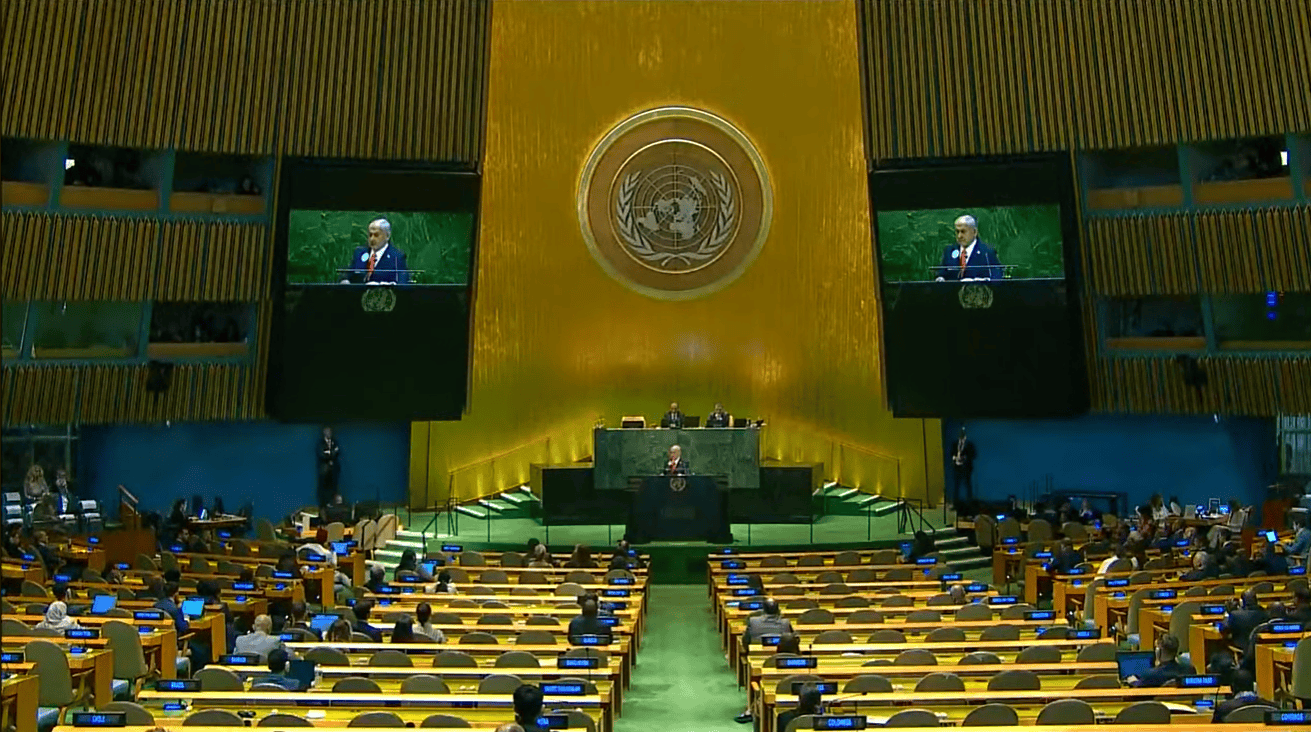
The half-empty hall during Netanyahu's UN General Assembly address, September 26, 2025 (screenshot)
Netanyahu treats his UN addresses as media spectacles, from selecting catchy slogans that can become newspaper and broadcast headlines to using gimmicks and visual props to draw attention to himself.
A journey from one speech to the next reveals both the evolution of Netanyahu's public persona and what has always been there. His hollow promises to pursue a political settlement, or declarations of a desire for peace, have become steadily scarcer–almost in lockstep with the proliferation of technical props and theatrical gestures.
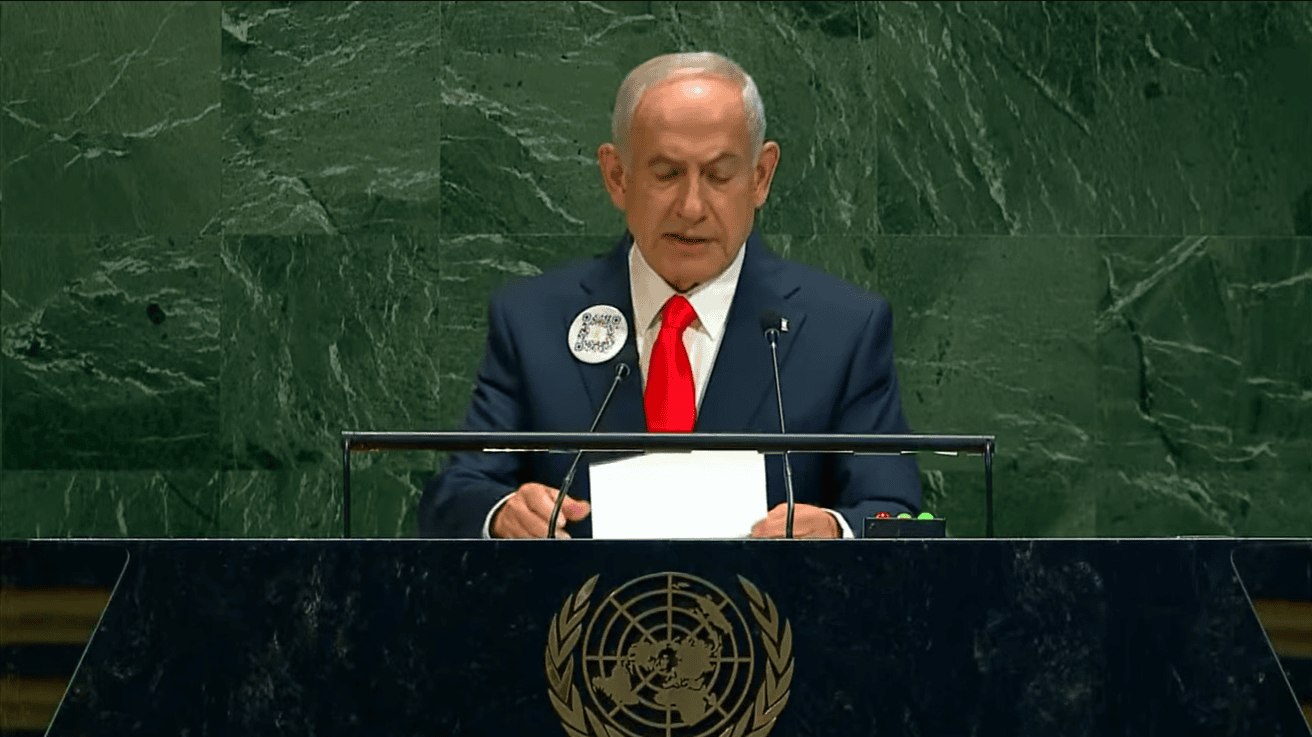
The latter probably peaked in his latest speech. Netanyahu wore a barcode on his lapel that led to a video of Hamas's October 7 atrocities, while the Prime Minister's Office announced that the speech would be broadcast over loudspeakers in the Gaza Strip. As for lip service, "peace" had been replaced by "the hostages."
Israel's media has always been there to accompany Netanyahu and dance to his tune. The Palestinians, Iran, and the other ostensible subjects of his speeches carried on regardless. The speeches' limited importance and impact were symbolized by the nearly empty hall in which Netanyahu delivered his latest address.
But Netanyahu's real audience has always been his base in Israel. The propaganda wizard knew he would find faithful allies among Israeli editors and reporters, who would give his New York performances prominence, fall under the spell of his sound bites, and swoon over the cardboard props raised above the podium.
1998: The First Speech
Twenty-eight years ago, just as this year, Netanyahu came to the UN General Assembly to halt diplomatic momentum that could force Israel to choose the path of peace. Then, he was trying to thwart Palestinian Authority Chairman Yasser Arafat's plan to declare a Palestinian state at the assembly.
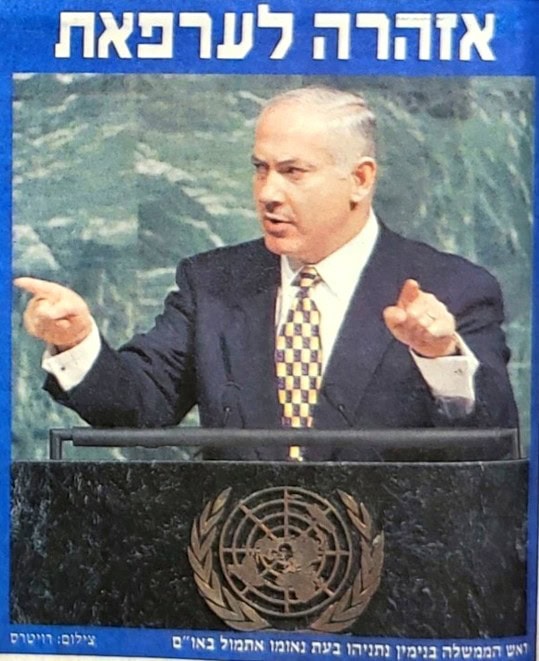
Benjamin Netanyahu's first UN General Assembly address as prime minister. Headline: A Warning to Arafat (Maariv, September 25, 1998)
As Israel's ambassador to the UN, Netanyahu was well acquainted with the speakers' platform at the General Assembly. But that year was the first time he addressed it as Israel's prime minister.
After the speech, Netanyahu was invited to the White House for a meeting with Arafat, part of another attempt by U.S. President Bill Clinton to restart the peace process between Israel and the Palestinian Authority–much to Netanyahu's dismay.
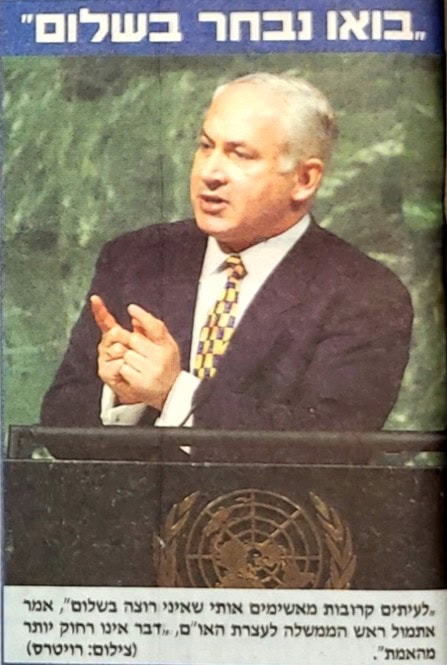
Netanyahu speaks at the UN General Assembly for the first time. Headline: Let Us Choose Peace (Yedioth Ahronoth, September 25, 1998)
"A Warning to Arafat" was the headline chosen by Maariv. Yedioth Ahronoth emphasized the conciliatory message in Netanyahu's speech: "I am often accused of not wanting peace," it quoted him as saying. "Nothing could be further from the truth."
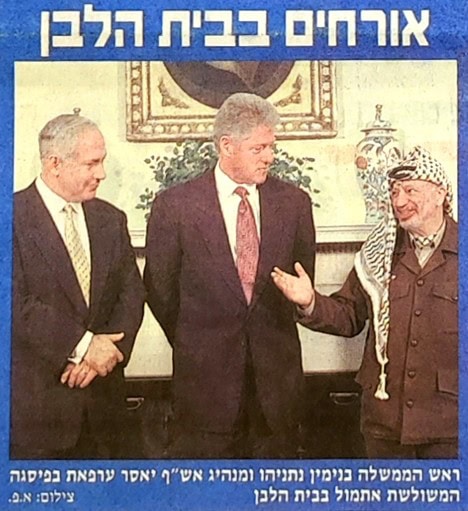
Netanyahu and Arafat visit the White House during Bill Clinton's presidency. Headline: Guests at The White House (Maariv, September 29, 1998)
Three days later, Netanyahu and Arafat met with Clinton at the White House, announcing that a Camp David-style summit would be held on October 15. Despite Netanyahu's impassioned declaration of his desire for peace, the process languished and was then buried.
Netanyahu's first term as prime minister ended earlier than he had expected. He would not speak again from that same podium as prime minister for another eleven years.
2009: "I Have Waited My Whole Life for This Speech"
After returning to power, Netanyahu delivered his second UN General Assembly address as prime minister. He took the podium a day after Iranian President Mahmoud Ahmadinejad, an antisemite and Holocaust denier. For Netanyahu, this was a golden opportunity. Instead of getting bogged down in the conflict with the Palestinians, here was a distant, cartoonish enemy–a political gold mine.
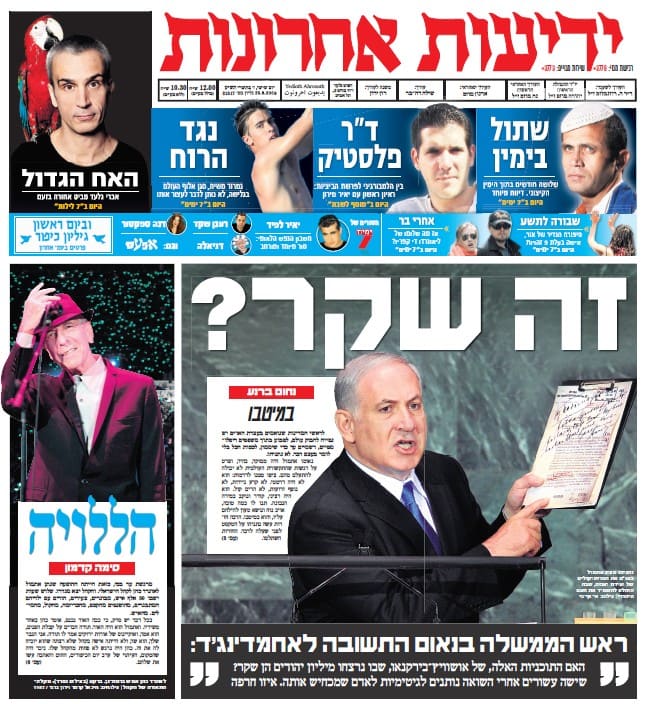
Netanyahu during his second UN General Assembly address. Headline: Is That a Lie? (Yedioth Ahronoth, September 25, 2009)
Netanyahu came to the UN General Assembly as though he were putting on an audiovisual show at a high school, equipped with props meant to prove the reality of the Holocaust: maps of the Auschwitz death camp and other documents. "Are these plans of Auschwitz-Birkenau, where one million Jews were murdered, a lie? Six decades after the Holocaust, legitimacy is granted to a man who denies it. What a disgrace."
Iran was not impressed. But the pyrotechnics did win over the media–Netanyahu's first and oldest permanent enemy, long before Iran. In Yedioth Ahronoth, still Israel's most powerful news platform at the time, Itamar Eichner quoted Netanyahu saying "I waited my whole life for this speech." Nahum Barnea published a column about the address titled "At His Best."
2011: Draining Hope
Netanyahu arrived for his third General Assembly address and locked horns with Palestinian Authority President Mahmoud Abbas, known as Abu Mazen, who came to the assembly seeking recognition of a Palestinian state.
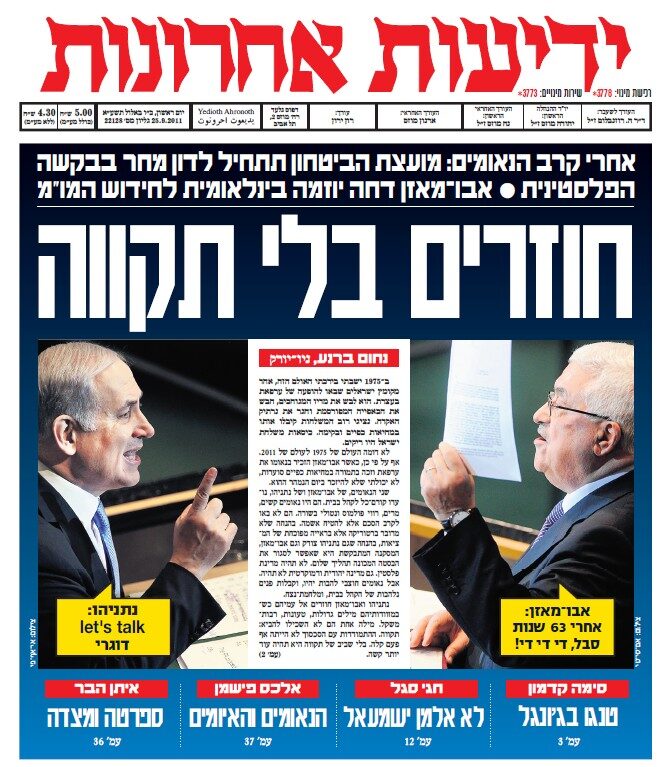
Netanyahu delivers his third UN General Assembly address. Headline: Returning With No Hope (Yedioth Ahronoth, September 24, 2011)
Nahum Barnea, who covered the assembly from New York, was a little less naive than he had been two years earlier. He offered a prophecy: "The obvious conclusion from the speeches is that we can close down the shop called the peace process. There will be no Palestinian state. Nor will there be a Jewish and democratic state. But there will be fiery speeches–and eternal war."
2012: The Bomb Speech
In his fourth UN General Assembly address, Netanyahu used a cartoon bomb familiar from animated films to illustrate the state of Iran's nuclear program. "By next spring, or at the latest next summer, the Iranians will have finished enriching uranium. From there, they will be months–or weeks–away from the bomb," he warned.
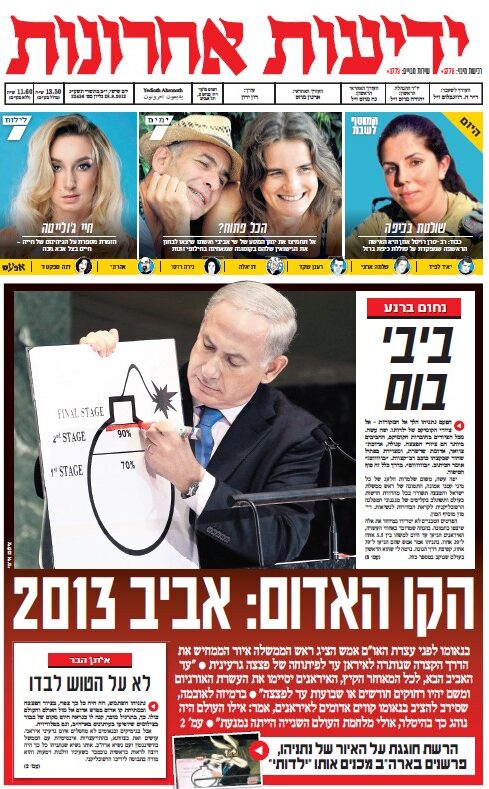
Netanyahu delivers the "Bomb Speech" at the UN General Assembly. Headlines: Bibi Boom (above) and The Red Line: Spring 2013 (Yedioth Ahronoth, September 28, 2012)
Social media, still in the early days of the algorithmic era, mocked the childish gimmick. But Netanyahu was signaling that he was back in his element. Good night, Palestine; good morning, Iran.
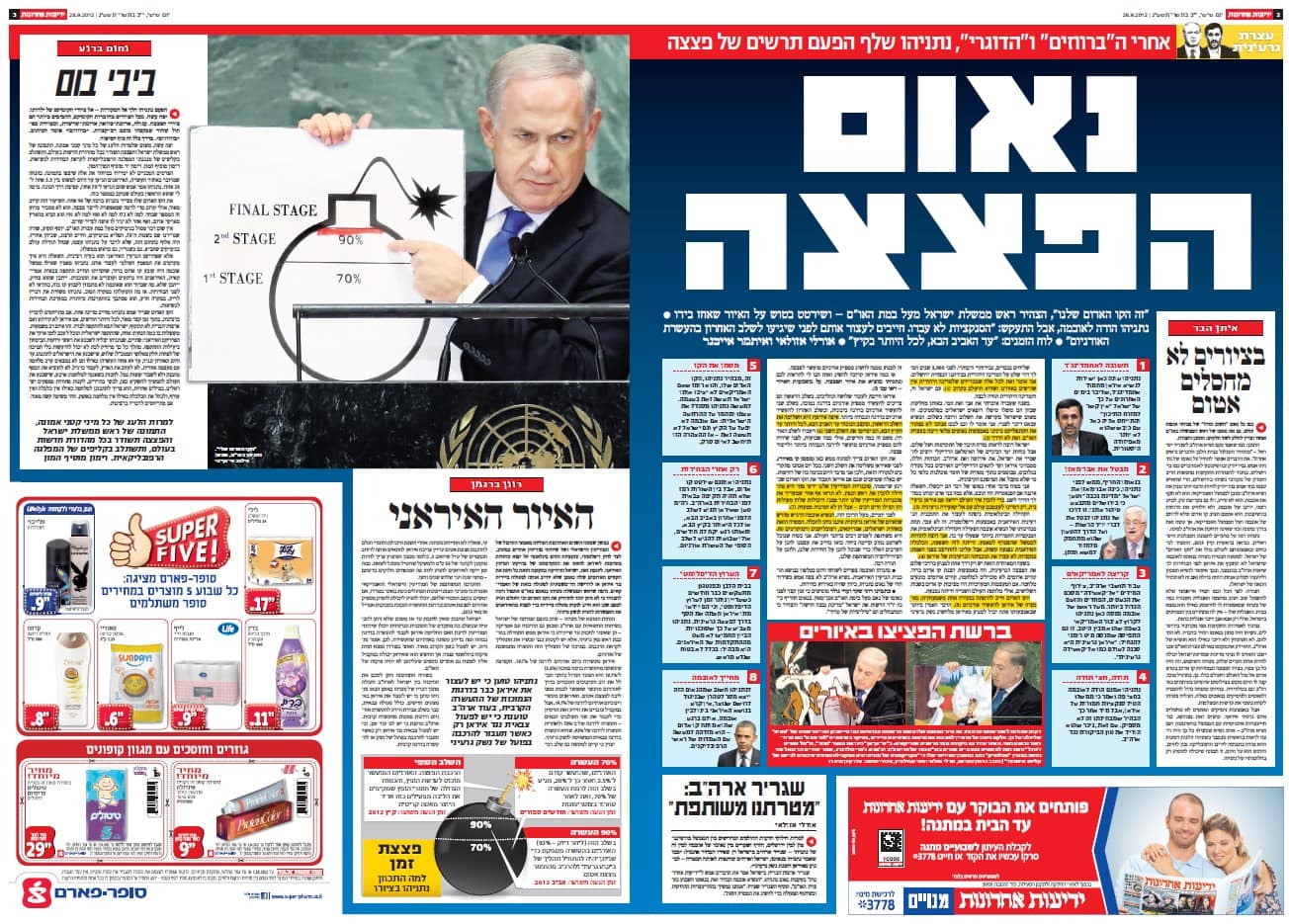
The "Bomb Speech" (Yedioth Ahronoth, September 28, 2012)
2013: Netanyahu Threatens Us With International Isolation
The fifth speech was marked by Netanyahu's growing fundamentalism, which would intensify over the years as his inner circle and political allies narrowed to representatives of extreme, messianic, and racist positions.
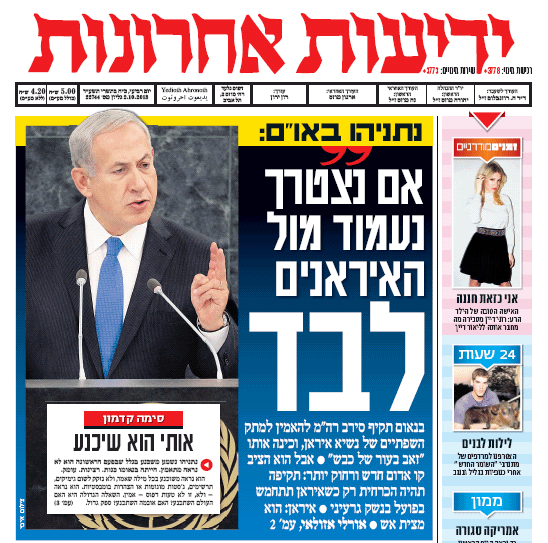
Netanyahu at the UN General Assembly in 2013. Headline: Netanyahu at the UN: If We Have to, We Will Stand Alone Against the Iranians (Yedioth Ahronoth, October 2, 2013)
"If we have to, we will stand alone against Iran," Netanyahu declared from the UN podium. The cartoon bomb from the preceding year's address was replaced by a cartoon of Netanyahu himself shouting, "Somebody hold me back, or I’ll..."
The fact that the prediction he made from the same podium the previous year had not come true did not bother him, of course. Nor did Israeli media editors–a special breed of people with a 24-hour memory span–see it as a problem.
2014: The "Hamas Is an Asset" Doctrine
"ISIS and Hamas are branches of the same poisonous tree," Netanyahu claimed in his sixth UN address, twelve years ago, a month after Operation Protective Edge. During the operation, Netanyahu thwarted pressure from his cabinet partners, led by Avigdor Lieberman, to launch a ground invasion of Gaza and topple Hamas. As was his way, he did so through a leak – the kind he would later repeatedly call "criminal."
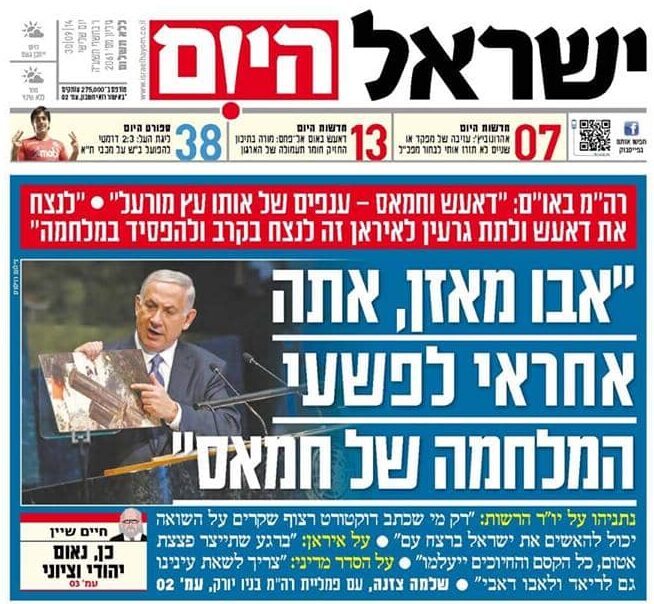
Netanyahu addresses the UN General Assembly in 2014. Headline: "Abu Mazen, You Are Responsible for Hamas' War Crimes" (Israel Hayom, September 30, 2014)
By then, Netanyahu had begun to embrace the "Hamas is an asset" doctrine, which treats the Islamist terrorist organization as a barrier to the strengthening of more moderate Palestinian forces–forces that could compel Israel to return to the path of agreements and peace. Instead of attacking Hamas, Netanyahu turned his fire on the Palestinian Authority: "Abu Mazen, you are responsible for Hamas's war crimes."
And of course there was Iran, because how could there not be? There was a gimmick, too: an enlarged photograph of Palestinian children beside rocket launchers in Gaza.
2015: Silence Suited Him
In his seventh address, Netanyahu tried to find a new gimmick to replace the cumbersome cardboard placards. In 2015, it was forty seconds of silence, meant to illustrate the UN's silence in the face of Iran’s declarations of its desire to destroy the State of Israel.
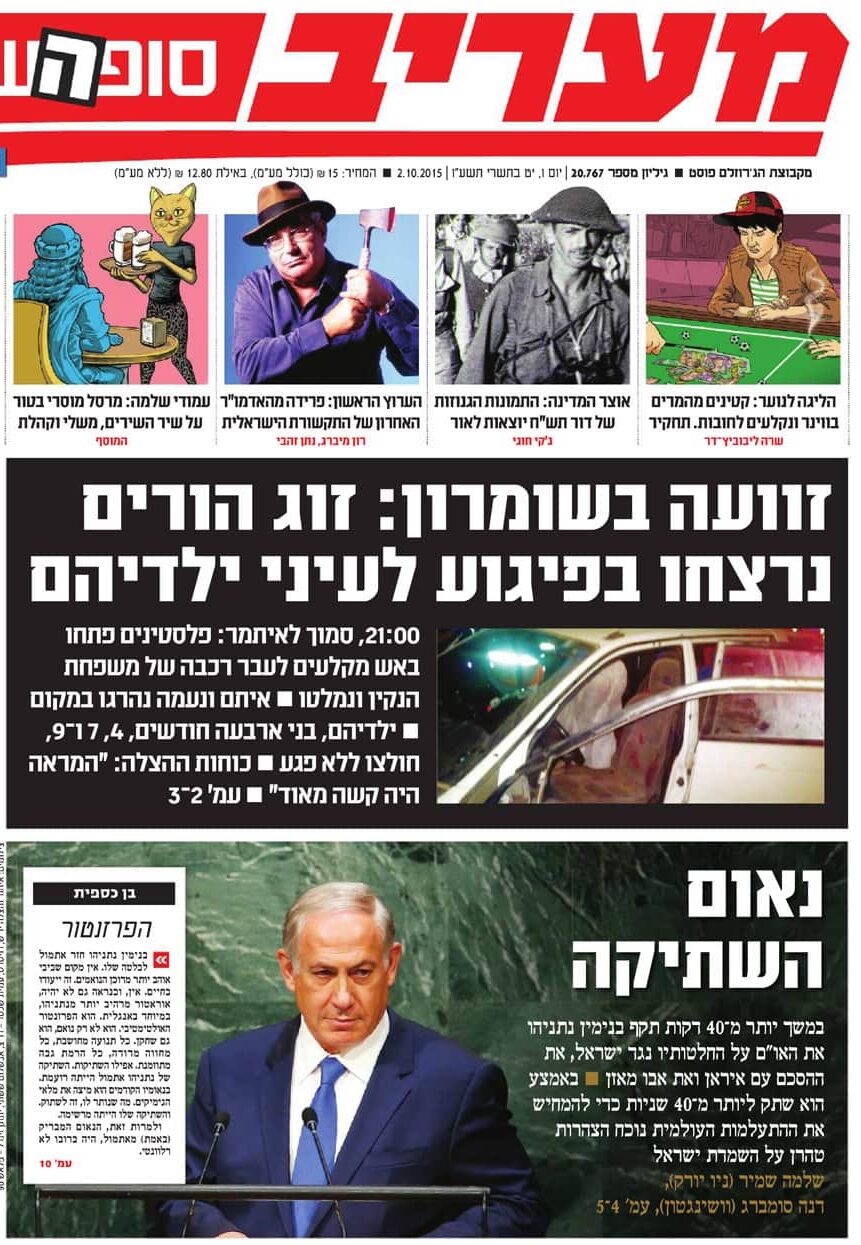
Netanyahu at the UN General Assembly in 2015. Headline: The Speech of Silence (Maariv, October 2, 2015)
Some regret that Netanyahu did not make the silence gimmick a more permanent motif in his political career.
2016: "I Am Committed to the Two-State Solution"
Netanyahu's eighth UN General Assembly address came in the middle of the U.S. presidential campaign, when Hillary Clinton seemed likely to defeat the surprise Republican candidate: a devious businessman, serial bankrupt, and reality-TV star who boasted of being a serial sexual harasser. Donald Trump.
Netanyahu, whose compass always points toward Washington, took a more moderate line. He declared that he "still believes in two states for two peoples" and argued that "the conflict has never been about the settlements, but about the existence of a Jewish state." He also proposed that Abbas address the Knesset, while he would speak in Ramallah.
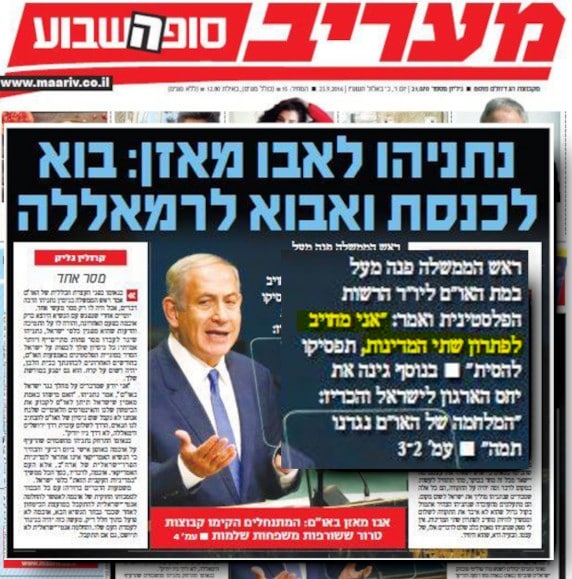
Netanyahu's UN General Assembly address in 2016. Headline: Netanyahu to Abu Mazen: Come to the Knesset, and I will Come to Ramallah (Maariv, September 23, 2016)
2017: The Speech in Persian
The gimmick in Netanyahu's ninth UN General Assembly address was a message in Persian. "You are not our enemies," he declared, arguing that Israel's conflict with Iran was with the Iranian leadership, not the Iranian people. But the most significant part of the speech was the praise Netanyahu lavished on himself, emphasizing his importance as a world leader. In the background, the criminal investigations against him were closing in.
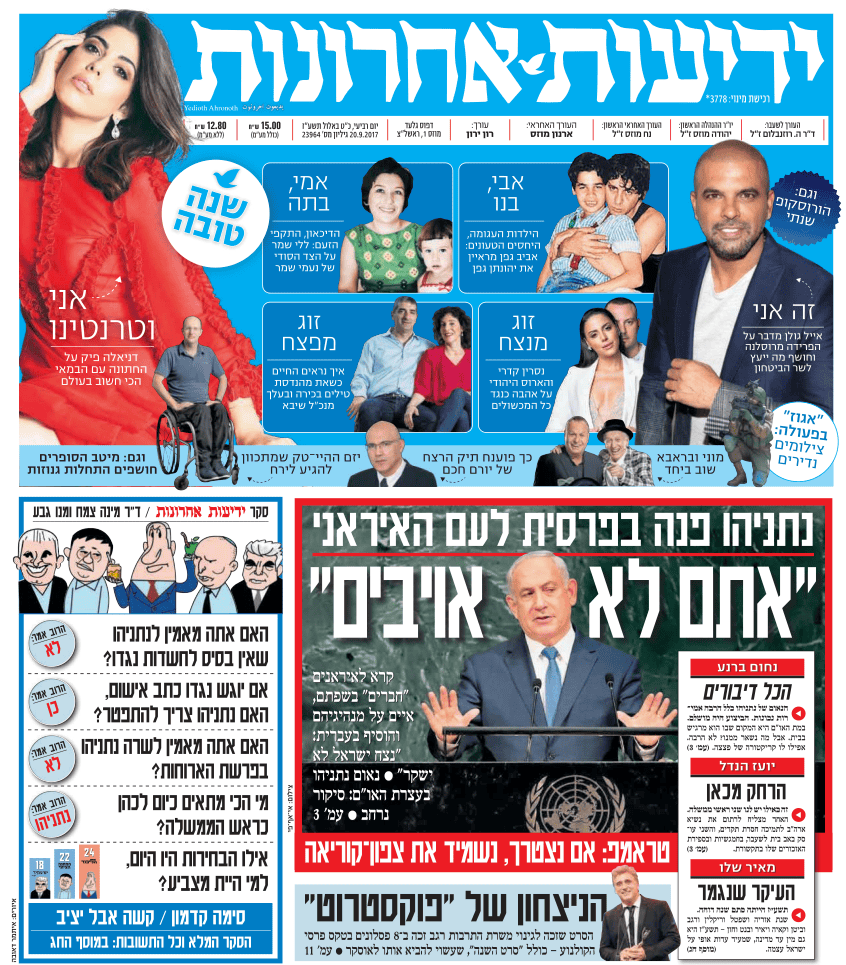
Netanyahu at the UN General Assembly in 2017. Headline: Netanyahu Addressed the Iranian People in Persian: "You Are Not Our Enemies" (Yedioth Ahronoth, September 20, 2017)
2018: The Secret Facility
The policy of "managing the conflict" and the doctrine that "Hamas is an asset," alongside the suitcases of cash that began flowing from Qatar to Hamas in Gaza, allowed Netanyahu to keep the spotlight trained on Iran. Out came the cardboard placard again, this time bearing a photograph of a "secret nuclear facility in Tehran."
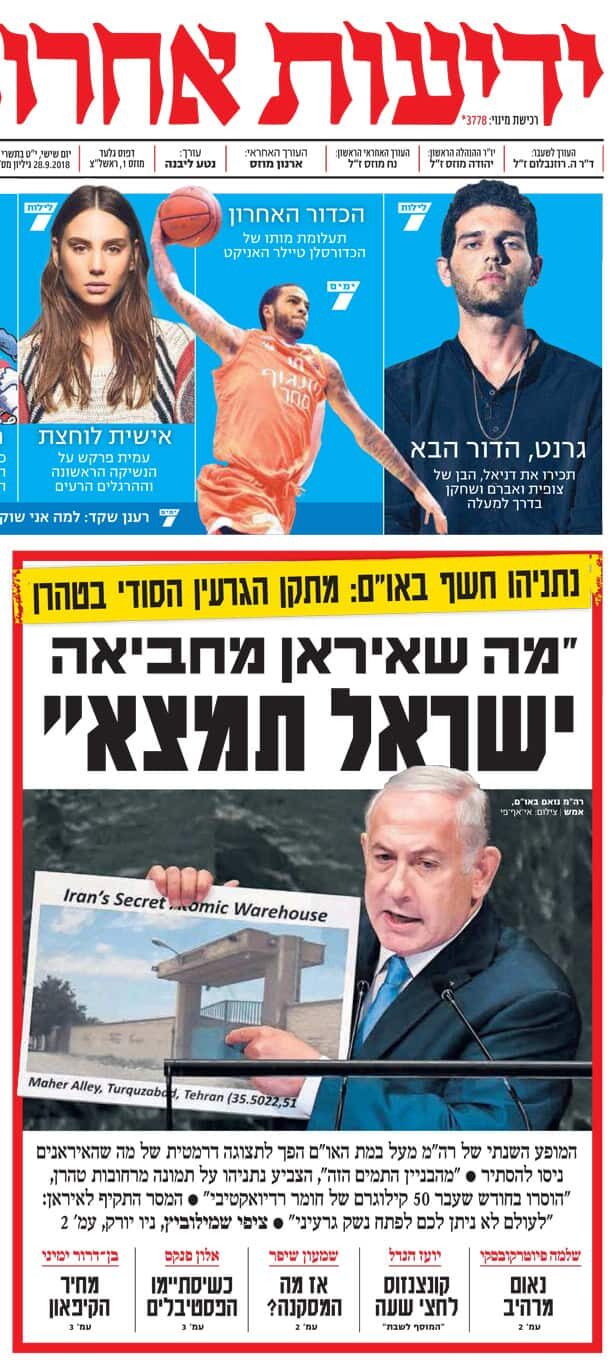
Netanyahu at the UN General Assembly in 2018. Headline: Netanyahu Exposed the Secret Nuclear Facility in Tehran. "What Iran is Hiding, Israel Will Find" (Yedioth Ahronoth, September 28, 2018)
2020: A Jump to Lebanon
Two months after the massive explosion at the Port of Beirut, Netanyahu's UN address highlighted Iran's Lebanese branch, along with another "revelation." And he did not forget Iran itself, which, he said, would have enough uranium for two bombs "within a few months."
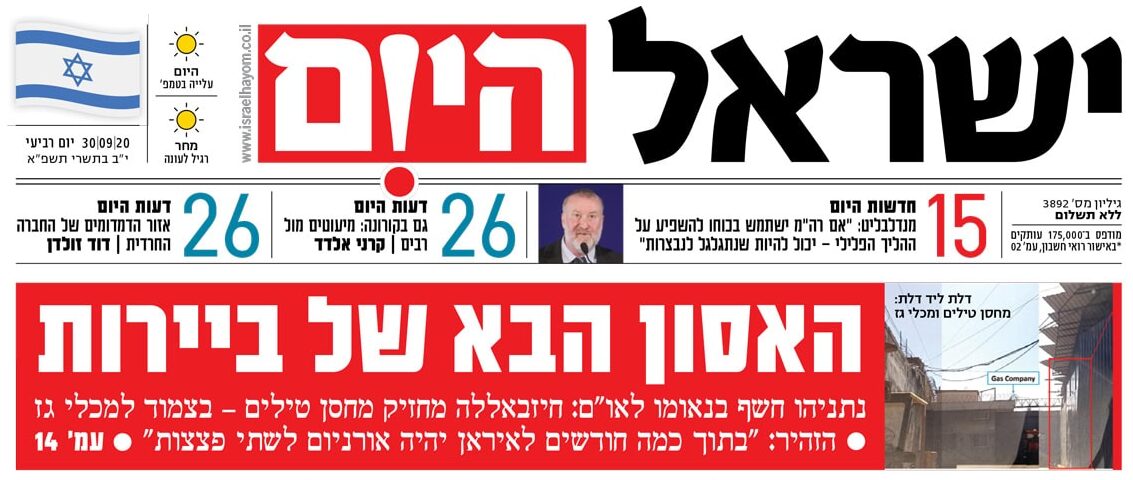
Netanyahu at the UN General Assembly in 2020. Headline: Beirut's Next Disaster (Israel Hayom, September 30, 2020)
2023: Saudi Arabia
After nine months of mass protests in Israel against his government's attempted judicial coup, and after President Biden refused to meet with him at the White House despite his pleas, Netanyahu arrived at the UN General Assembly. There, too, he encountered protesters against the coup, while unrest had continued along the Gaza border for five consecutive days. Two weeks later, Hamas murderers invaded Israel and killed 1,200 people in the gravest security failure in the country's history.
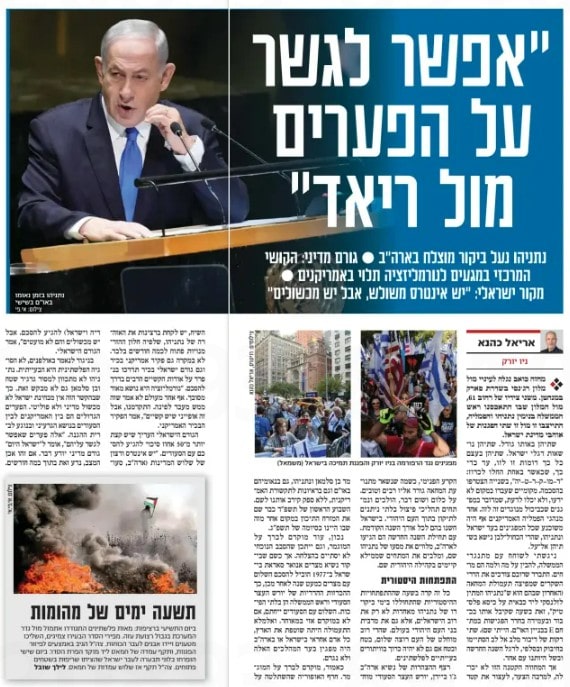
Netanyahu addresses the UN General Assembly in 2023. Headline: The Differences with Riyadh Can Be Resolved (Israel Hayom, September 24, 2023)
Inside the UN building, Netanyahu's speech focused on the prospect of a peace agreement between Israel and Saudi Arabia–a country with which Israel has never been at war. For Netanyahu, a deal with the Saudis was the joker that would silence the protests and bring the Biden administration back toward him, on the way to the goal that mattered most: having the criminal case against him dismissed.
2024: The Thirteenth Speech
No one will probably remember the content of Netanyahu's 2024 speech, which once again spoke of the opportunity for peace with Saudi Arabia and the Arab world more broadly. What history will remember is the operation to assassinate Hassan Nasrallah, the head of the Hezbollah terrorist organization, which began at the same time.
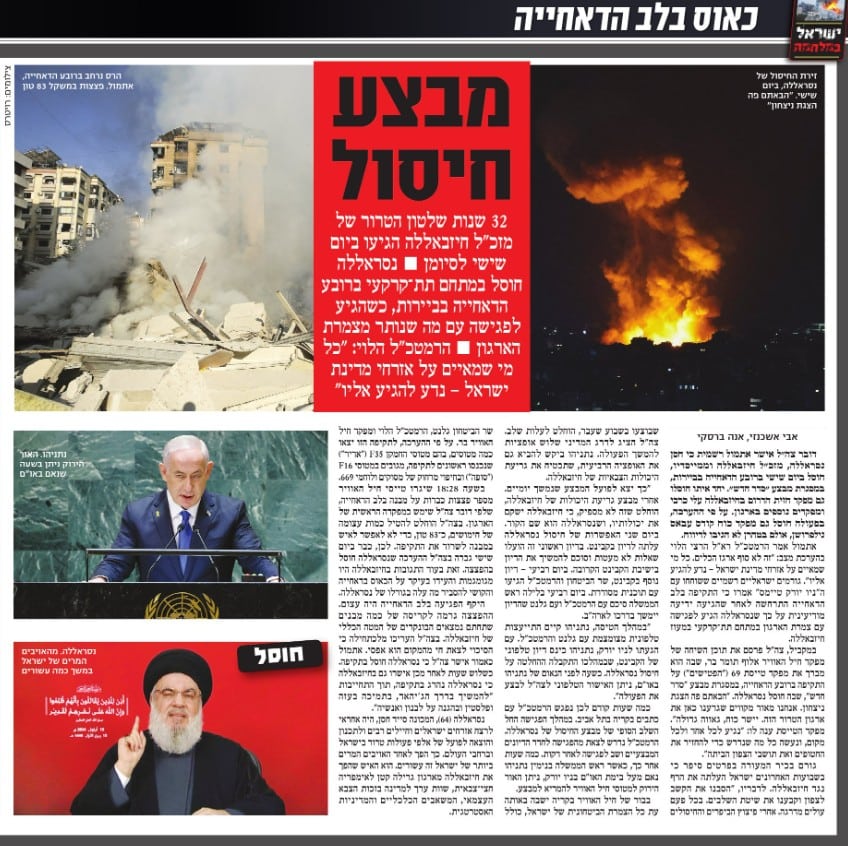
Netanyahu's UN General Assembly address in 2024. Headline: Liquidation Sale (Maariv, September 29, 2024)
The authorization for the operation was granted only after Netanyahu's plane had departed for New York. That did not stop his supporters from claiming it had been a sophisticated deception operation.
2025: The Loudspeakers Speech
The central gimmick in Netanyahu's September 26, 2025, UN address, delivered from the podium in the General Assembly hall in New York, took place in the Gaza Strip. The Prime Minister's Office instructed the IDF’s Southern Command and the C4I Corps to set up powerful sound systems on trucks and cranes outside and inside Gaza, so the speech could be broadcast to residents of the strip, tens of thousands of whom had been killed in the war by then.
But the real audience was neither in Gaza nor in New York. The speech was meant for Netanyahu's supporters in Israel. The spin wizard, who knew he could no longer withstand Trump's pressure to sign a deal to release the hostages and end the war–even at the risk of his coalition's survival–spoke of "completing the mission" and said that "the job is not yet done."
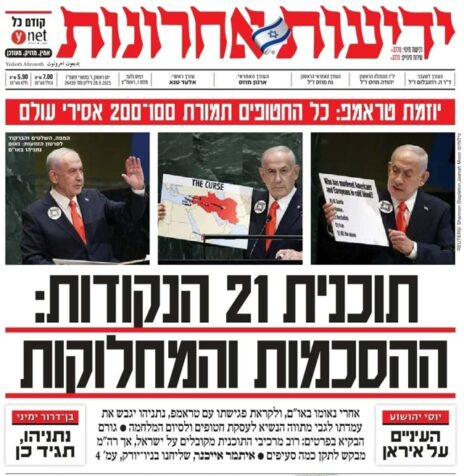
Netanyahu's UN General Assembly address in 2025. Headline: The 21-Point Plan: the Agreements and the Differences (Yedioth Ahronoth, September 28, 2025)
But Trump was unwilling to hear Netanyahu reject his twenty-one-point plan yet again. Netanyahu's order to bomb Doha, intended to deflect attention from discussion of the Qatari operatives in his office, proved the final nail in the coffin.
Exactly two weeks after the UN address, Netanyahu's government had no choice but to approve the deal to release the hostages and end the war. Trump sweetened the bitter pill for Netanyahu with a lightning visit to Israel, where he took the Knesset podium to demand that Israel's president grant Netanyahu a pardon for the charges of bribery, fraud, and breach of trust.
This article was originally published in Hebrew on September 26, 2025