


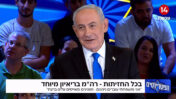






Four days into the campaign against Iran: The indicted Prime Minister Benjamin Netanyahu conducted a media blitz with foreign press, while he has been boycotting Israeli media for about five years and has refrained from giving journalistic interviews in Israel even after the October 7 massacre, the most catastrophic security failure in Israel's history.
The first interview, with Fox News, was a failure, both in message delivery and the speaker's concerning appearance. But in the two following interviews, with ABC and Iran International channel, Netanyahu recovered and demonstrated his well-known talent for message delivery, which this time focused on appealing to isolationists among the Republican audience in the US, encouraging American military involvement in the war with Iran.
After the October 7 massacre, which cost the lives of about 1,200 victims, a month passed before the face of Israel's Prime Minister could be seen on American television screens. On November 6, 2023, Netanyahu conducted his first interview after the massacre, on ABC News with David Muir.
In the Iran-Israel war, and after the impressive opening strike by the Israeli security establishment, Netanyahu needed less than four days before he began a media blitz abroad. On June 15 he was on Fox News with Brett Baier, and on June 16 he was on both ABC with Jonathan Karl and on the Iranian opposition network Iran International, where he was interviewed by Pouria Zerati.
Since the beginning of the war in 2023, Netanyahu has appeared on Israeli media platforms only five times: Four of them on Channel 14, the propaganda channel devoted to him, and once with pro-Netanyahu podcaster Gadi Taub. Other than these, Netanyahu held a limited number of press conferences, where a limited number of journalists were allowed to ask him a single question. In addition, he distributed propaganda videos starring himself.
Netanyahu gives journalistic interviews only abroad: Since the October 7 massacre, Netanyahu has appeared 35 times in English, on media channels and with online influencers. The majority of them were on sympathetic platforms, most of them (12 altogether) on Fox News, which has become Netanyahu's home channel in the US. This is Netanyahu's second interview with Baier, the previous one took place on November 9, 2023, and was Netanyahu's second interview after the massacre.
This is also his second interview with Karl on ABC, where Netanyahu was interviewed four times during that period. It is also Netanyahu's second interview with Zerati, but the previous interview took place on March 11, 2023, more than six month before the October 7 massacre.
In the Fox News interview, Netanyahu appeared tired and dishevelled, an unusual appearance for someone considered a marketing wizard and known for his meticulous attention to hair dye, makeup, and lighting setup in every public appearance, often making viewers forget that he is an elderly 76-year-old man, criminally indicted, who has endured two and a half difficult years in terms of workload and health.
Netanyahu's face appeared sagging and frighteningly pale, he looked tired and his mouth tended strangely downward on the left side of his face, perhaps due to the fact that the channel chose to flip the footage that arrived from Israel.
Content-wise as well, Netanyahu was not impressive. Fox News is indeed a Republican propaganda channel, but the interviewer, Baier, is not among Netanyahu's cheerleaders on the channel, and even if it was far from a biting interview, it wasn't fawning, nor did it include signs of worship, like Netanyahu's interviews with Sean Hannity or Mark Levin.
Netanyahu described Israel's successes, the nature of the Iranian regime that sees first of all the US as its main enemy and Israel as its satellite. The Prime Minister managed to dodge the question whether Trump vetoed the assassination of Iranian religious leader Khamenei. "There are so many false reports, about conversations that never took place, and I won't get into that," was Netanyahu's response.
The Big Gamble
Netanyahu's narrative and texts were not new, and were intended mainly for the ears of members of the isolationist camp in the Republican party, who oppose US military involvement in other countries. This is one of the prominent issues that still divides the party, which is under the almost complete control of Trump.
A day after the interview with Baier, Netanyahu faced Jonathan Karl on ABC. This was a different Netanyahu. His appearance was different, the makeup was perfect as usual, and the lighting was flattering enough. However, from the interviewer's perspective, it was a frustrating interview. In response to every question, Netanyahu repeated the same text, until it seemed that even if asked about the Super Bowl finals, Netanyahu would find a way to say again that the Iranian regime is Nazi and that Israel is doing the work for the US.
At some point Netanyahu shifted gears: "They tried to murder President Trump twice; they tried to kill me twice. Through their proxies they shot a missile straight into my bedroom window," and emphasized that this is a war of civilization against barbarians and that "this regime is a death cult."
Netanyahu also provided a new slogan, after several classic fear-mongering sentences: "Imagine what this regime that chants 'Death to America' every time, that blew up US embassies, that murdered 251 Marine soldiers in Beirut, that murdered and wounded thousands of American civilians in military service in Iraq and Afghanistan, that tried to blow up a restaurant in Washington, that burns the American flag, do you want these people to have nuclear weapons and the means to reach your cities? Today it's Tel Aviv, tomorrow it's New York."
And immediately after: "Look, I understand 'America First,'" said Netanyahu referring to one of Trump's campaign slogans, "I can't understand 'America Dead,' that's what these people want".
This wasn't one of Netanyahu's most successful slogans, but it was the key phrase in the exhausting interview. At the end of the interview, Karl held a conversation about its main points and said that Netanyahu did not aim his messages at the average American but specifically addressed Trump's isolationist supporters.
"There is a significant portion of Donald Trump movement, the MAGA movement, that is adamantly opposed to the US getting involved in another conflict in the Middle East," said Karl, and reminded that one of the central promises that Trump made was "no more forever wars" and that prominent figures in the administration hold this view.
The emphasis Netanyahu gave to these messages suggests that the interview blitz was not just a "victory lap" and boasting, riding on the breathtaking operations by the Air Force, intelligence, and Mossad, but revealed the magnitude of the gamble Netanyahu took in opening a direct war against Iran. The declared goal of the campaign is to eliminate Iran's nuclear capability potential, but it cannot be achieved without aggressive American involvement and American "bunker buster" bombs.
האם נתניהו קנה בוטים ברשת ימים לפני המתקפה באירן?
ניתוח השינוי במספר העוקבים של נתניהו מראה קפיצה משמעותית במספר העוקבים שלו ב-10/6 (תוספת של יותר מ-63K עוקבים!).
למחרת הייתה נטישה של כ-20K עוקבים, אבל ב-12/6 נוספו 25K נוספים.
והכל קורה לפני המתקפה על אירן!
השערה>>> pic.twitter.com/OL2xLjWrOs— Gil Feldman (@feldman_gil) June 17, 2025
In this regard, an American attack on Iran also appears as a condition for Netanyahu's political survival, since once the dust settles on the impressive opening strikes, and the continuation of the war of attrition and casualties on the home front, even if it ends in some agreement or another, Netanyahu will again not be able to cash the fat check of "absolute victory" which he uses for repeated postponements of the end of the war that began in October 2023.
In the interview with "Iran International" channel, Netanyahu repeated the same messages, this time directing them to Iranian ears. To Netanyahu's credit, it should be said that when the interviewer tried to force him into promises that Israel would topple the Iranian regime, Netanyahu was careful to reply that the war's goal is eliminating the Iranian nuclear and ballistic missile project, and that achieving these goals would help the regime's opponents.
As usual, Netanyahu exaggerated the millions of Iranians watching the video clips directed at them, which he publishes on social networks. In this context, it's enough to note that social networks do not reveal true data about the exposure of posts, and that it's possible to purchase views and followers on various networks, a service shown by several investigations to be used by Netanyahu's people.