


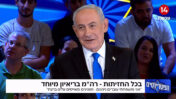






Benjamin Netanyahu's victory in the 2022 elections paid off for Channel 14. Upon formation, Netanyahu's coalition initiated a series of legislative measures for the pro-Bibi television channel, which specializes in promoting the Prime Minister's personal interests through propaganda, incitement and fake news. Exclusive data shows that alongside beneficial legislation, worth tens of millions of shekels for Channel 14, after Netanyahu returned to power there was a sharp jump in advertising purchases from the channel by government ministries headed by Likud ministers, including the Prime Minister's Office.
Simultaneously, there was a significant increase in total advertising purchased by Netanyahu's government from Channel 14 compared to its predecessor, the "Government of Change" led by Naftali Bennett and Yair Lapid.
The data was collected at the request of The Seventh Eye and Shakuf by Ifat Media Information, which specializes in collecting and analyzing statistical information about television campaigns. The current examination covers about 30 government entities that purchased airtime on Channel 14 broadcasts in the last three years (excluding digital advertising). The trend emerging from Ifat's data is supported by data collected simultaneously by another group, a civil-activist initiative of digital experts who developed an independent media monitoring system.
The amounts of money that Netanyahu's government is channeling to Channel 14 have not yet been disclosed. The actual cost of airtime is determined according to commercial placement hours, varying rating data, and rates set in negotiations with state representatives. Given the surge in the channel's rating figures over the last two years and its managers' attempts to raise advertising rates, it's likely that there has also been an increase in amounts actually paid.
These advertising budgets are public funds, and they are distributed by government ministries according to policies adopted in each of them, often with personal involvement of ministers or senior directors.
In the past, cases of exploiting government advertising budgets for political interests were exposed. Netanyahu's office and the Government Advertising Bureau (Lapam) ignored an inquiry offering them to address the possibility that this is also the explanation for the increase in advertising volume on Channel 14.
The surge in airtime purchased from Channel 14 began in July 2023, about six months after the ministers' appointments. According to Ifat's data, in the months since then, there was an approximately 35% increase in purchased airtime among the examined bodies compared to 2022, when the "Government of Change" served. The Bennett-Lapid government purchased about 109 minutes of airtime per average month during 2022. Netanyahu's government monthly average since July 2023 stands at about 148 minutes.
The data allows analysis of airtime purchases by ministry. The analysis shows that the most notable increases occurred in ministries headed by Likud ministers – including, as mentioned, the Prime Minister's Office.
In 2022, under Prime Ministers Bennett and Lapid, the airtime purchased by the Prime Minister's Office from Channel 14 was nearly zero. After Netanyahu's return to power, the trend reversed. In October 2023, after the massacre, the Prime Minister's Office began advertising on Channel 14 continuously for three months. The office purchased total airtime of about 83 minutes, more than what most other government ministries purchased throughout all of 2023. The purchasing resumed in October 2024.
This isn't personal propaganda serving Netanyahu – such content is broadcasted on Channel 14 without needing to purchase airtime – but rather a decision to allocate campaign funds from entities subordinate to the Prime Minister's Office. For example, the Hostages Families Treatment Headquarters led by Gal Hirsch, and the National Cyber Directorate, which ran a campaign starring Yaniv Biton against the "sharing epidemic", aimed at fighting fake news distribution.
A similar surge was recorded in four other government ministries currently headed by Likud ministers: the Ministry of Transportation under Miri Regev, the Ministry of Economy under Nir Barkat, the Ministry of Agriculture under Avi Dichter, and the Ministry of Defense under Yoav Gallant. Among all examined Likud ministers' offices, only one showed a significant decrease in advertising volume – the Ministry of Environmental Protection under Idit Silman.
The Transportation Ministry under Minister Regev recorded about a 65% increase in Channel 14 airtime purchases in 2023 compared to the previous year, when it was headed by Merav Michaeli of the Labor Party. In 2024, the increase intensified: by early October, Regev's ministry had purchased 140 minutes of advertising – more than any other examined government ministry. Compared to the last year of the "Government of Change," this represents a massive surge of about 480%.
The airtime purchased by Minister Regev was used, among other things, for commercials trying to convince the public that her ministry provides "optimal service during wartime" – a response to harsh criticism directed at her over the limited operation of public transportation on weekends, part of a pro-Ultra-Orthodox policy that impaired soldiers' ability to reach the front and return home.
Miri Regev is among the politicians who receive the most intensive promotion on Channel 14. In June, following a HaMakor investigation that led to a police probe, Regev was invited to the flagship program Ha Patriotim (The Patriots) to deflect claims before a flattering panel of interviewers. The channel avoided reporting in real-time on the investigation's findings, which indicated malignant politicization in the Transportation Ministry. Instead, they interviewed her associates and attacked Raviv Drucker and HaMakor.
In the case of the Ministry of Agriculture and Ministry of Economy, the surge cannot even be expressed in percentages. In 2022, these two ministries' advertising volume on Channel 14 was negligible. After Netanyahu's government formation, each has already run two waves of campaigns on the channel. The Ministry of Economy under Barkat purchased about 112 minutes of advertising in less than four months. The Ministry of Agriculture under Dichter purchased about 105 minutes in a similar timeframe.
Several Likud-controlled ministries saw a surge in airtime purchases in 2023, but it stopped in 2024, presumably due to the ongoing war: the Ministry of Energy under Eli Cohen, the Ministry of Justice under Yariv Levin, the Ministry of Culture and Sports under Miki Zohar, and the Ministry of Tourism under Haim Katz. The Defense Ministry experienced the opposite phenomenon: in 2023, the ministry purchased airtime from Channel 14 at a volume similar to that purchased during the "Government of Change" period, but in 2024 purchases jumped by about 320%.
A similar effect was recorded with the Israel Police, which is undergoing an accelerated politicization process under its supervising minister, convicted offender Itamar Ben Gvir. In 2022, under the "Government of Change," and also in 2023 under Ben Gvir, the police purchased negligible airtime from Channel 14. In 2024, suddenly, the police became one of the most prominent buyers among those examined, with about 123 minutes of advertising purchased over approximately five months.
The Israel Police commercials painted a flattering picture of police performance on October 7 and in the subsequent months of war, while simultaneously serving for recruitment purposes. According to the slide shown at their conclusion, this was a joint campaign by the police and Ben Gvir's ministry.
Among ten government ministries that showed a significant increase in airtime purchases from Channel 14 after the government's formation, only one doesn't belong to Likud: the Ministry of Labor under Minister Yoav Ben Tzur from Shas.
Channel 14 and Benjamin Netanyahu: One hand washes the other
The increase in government-purchased airtime from Channel 14 joins valuable benefits being showered upon it by Netanyahu and his loyalists in recent years. The declared owner of Channel 14 is businessman Yitzhak (Vyacheslav) Mirilashvili, who also controls the Ultra-Orthodox radio station Kol Chai and the right-wing news site 0404, and is expected to launch a television economics channel in 2025. His father, oligarch Michael Mirilashvili, is considered an ally of Netanyahu – a title he is careful to deny.
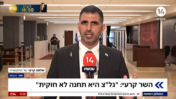
The consensus in the television industry is that Yitzhak Mirilashvili's channel has been suffering losses since its establishment. Netanyahu and the Communications Ministers serving under him consistently work to change this and improve the channel's financial situation at the expense of its competitors. The current Communications Minister, Shlomo Karhi, has been leading a series of "reforms" and legislative procedures over the past two years aimed at reducing public oversight of Channel 14, forgiving past debts and exempting it from content and management obligations that apply to competing channels. The value of these benefits is estimated at tens of millions of shekels.
Minister Karhi continues the policy of previous Likud Communications Ministers, in which Netanyahu was personally involved. The investigators assigned to the Prime Minister's criminal cases heard from state witness Nir Hefetz that Netanyahu tried to help Mirilashvili's channel (then called Channel 20) legitimize its news broadcasts – through which pro-Bibi propaganda is distributed – and free itself from the obligation to focus on heritage content, its original intended purpose.
"I remember one meeting in Balfour, with Momo (state witness Shlomo Filber, the director general who worked under Netanyahu when he served as Communications Minister; A.B.), myself, and Bibi, which dealt with the need to give backing to Channel 20," Hefetz said in his investigation. "There was a meeting where Benjamin Netanyahu, Momo and I sat in Netanyahu's room at the Prime Minister's residence, in which essentially Momo and Bibi divided between them sectors – who assists Channel 20 in which matter."
The Second Authority, headed by CEO Michelle Kremerman, whose role is to oversee commercial television in Israel, is indeed pursuing a lawsuit attempting to collect an old debt of 6.5 million shekels from Channel 14 – but its staff refrain from imposing sanctions on the channel for violating broadcasting rules, from hidden advertising to spreading fake news and incitement.
The extreme statements, which became associated with Channel 14, caused major corporations to avoid purchasing advertising packages from it. In the advertising industry, this was explained by the desire to avoid associating commercial brands with the channel's toxic political content. Channel 14 presenters claimed in response that this was a political boycott, and launched aggressive campaigns calling for boycotts of companies that refused to advertise with them, including Strauss, Bank Leumi, Tnuva and Coca-Cola Israel.
Channel 14's Ratings Rise, and with them the Rates
Government advertising in media outlets is coordinated by the Government Advertising Bureau (Lapam), a professional body that has operated under the Prime Minister's Office since 2020. In recent years, due to relocation to Jerusalem and the implementation of a voluntary retirement program, Lapam has suffered severe staffing shortages. According to a recent The Marker report, about 80% of employees have left and only about ten remain in their positions – a situation raising concerns about the ability to oversee the use of government advertising budgets, which amount to hundreds of millions of shekels annually.
Although the public interest is to distribute budgets among media outlets in the most efficient way, so that campaigns receive maximum exposure among target audiences, cases of budget allocation explicable by political motives have been exposed over the years.
These cases occurred even during periods when Lapam didn't suffer from staffing shortages and wasn't subordinate to Netanyahu. When Naftali Bennett was appointed Education Minister in 2015, for example, there was a surge in the Education Ministry's spending on advertising in religious-nationalist sector media outlets. Ministers from Yair Lapid's Yesh Atid party – Shai Piron and Yaakov Peri – purchased coverage worth millions from Yedioth Ahronoth, the media group headed by Noni Mozes, Lapid's former employer and ally. Yesh Atid ministers' campaigns in Yedioth Ahronoth caused discomfort in Lapam, and one contract was canceled after its details were exposed in the media.
The other side of the coin is using advertising budgets to punish media outlets characterized by an oppositional editorial line. In recent years, right-wing organizations and politicians have been trying to prevent government budgets from reaching the Haaretz group as punishment for its leftist agenda. The latest iteration of these attempts is led by Communications Minister Karhi, who this time is citing a speech in which Haaretz publisher Amos Schocken called Palestinian terrorists "freedom fighters."
The most blatant use of government advertising funds, which turned out to have criminal implications, was revealed during the investigation of the "Yisrael Beiteinu affair." Investigators discovered that advisers to ministers from Avigdor Lieberman's party received bribes totaling tens of thousands of shekels to channel advertising budgets of about 7.5 million shekels to an advertising company from the Adler-Chomsky group.
In another case, it was revealed that one of the ministers, Stas Misezhnikov, used to allocate advertising budgets to entities in which he had personal interests. One of Misezhnikov's deputy directors, who suspected his motives, documented the transactions and their background in an organized table.
The data on the surge in government advertising volume on Channel 14 doesn't indicate explicit instruction from Likud ministers. In fact, it could be justified. At the end of 2022, after Netanyahu's election victory, the channel's rating figures surged. In 2023, in the first months of the October 7 war, another surge was recorded. Although the trend has recently slowed, today Channel 14 is a direct competitor of Channel 12, Israel's leading media outlet.
The surge in rating figures was reflected in the channel's advertising rates. After years of charging ridiculous amounts from advertisers, Channel 14 has raised its prime-time advertising prices to a level that, at least on paper, isn't materially different from the price levels of Channel 12 and Channel 13 (per rating point). The amounts actually charged are defined as trade secrets, and all channels tend to hide them.
The Prime Minister's Office and Lapam did not respond to these matters.
This Article was first published on The Seventh Eye and Shakuf. Read it in Hebrew here