





Elad Tene, the editor of "Yedioth Aharonoth" and ynet, has emphasized in an appeal to the editorial staff the prohibition on publishing news photos that have been blatantly edited, especially photos submitted by politicians and public figures. The appeal comes against the backdrop of the insistence of the office of the accused Prime Minister Benjamin Netanyahu to distribute official photos from state events that have been edited and do not reflect reality.
“The Seventh Eye” revealed that the Prime Minister's Office (PMO) began distributing fake photos of the Prime Minister's wife, Sara Netanyahu, as early as June 2023, and starting in September 2025, this became routine: the PMO processes official photos from the Government Press Office (GPO) and distributes them to journalists, and they are published on the GPO website.
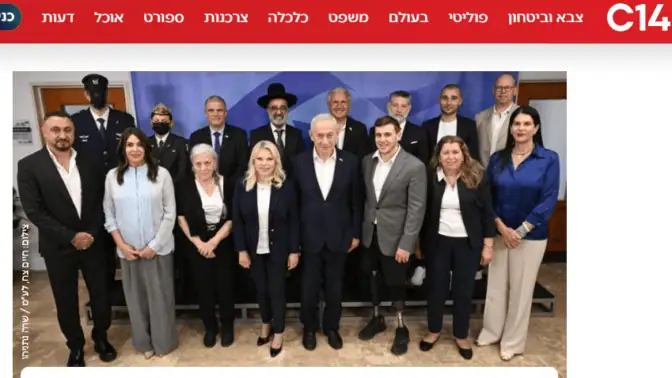
“The Seventh Eye” investigation reveals that the Israeli press avoids publishing the fake photos, with the exception of Eli Azur's “Jerusalem Post” website. In addition, doctored photos of the prime minister's wife are published on fringe media sites such as Channel 7's website, Patrick Drahi's "Kikar HaShabbat" website, and the Hamal website (also owned by Eli Azur). Fake photos are also published on Channel 14, the propaganda channel that serves Netanyahu.
On April 13, a file of five photos and one video clip was sent to reporters and press organizations on behalf of the Prime Minister's Office under the title "Prime Minister Benjamin Netanyahu and his wife Sara Netanyahu met yesterday (Sunday) with Holocaust survivors who were chosen to light a memorial torch on Holocaust Remembrance and Heroes' Day, at the Prime Minister's Office in Jerusalem."
In the five photos, Netanyahu's image was altered so that she appears years younger than her age. The photos were also published on the GPO website, but Netanyahu's office was unable to get them into the mainstream media, except for reports on ynet and the "Ma'ariv" website that Netanyahu used a meeting with Holocaust survivors to distribute retouched photos of his wife.
The only site that published a retouched image from the set of photos was the ultra-Orthodox national website Channel 7, edited by Uzi Baruch, which included it in its promo for the video clip from the event — without acknowledging that it was an edited image.
On April 19, the Prime Minister's Office again sent reporters and media outlets a set of photos, including three retouched photos of Sara Netanyahu, under the title "Prime Minister Netanyahu meeting with the torchbearers on the 78th Independence Day."
Photos from this set were published on several websites, without acknowledging that they were fake photos: on the Channel 14 website, in an article by Tobias Holcman on the “Jerusalem Post” website (but not in the printed newspaper), in an article by Hezki Baruch on Channel 7; in an article by Yoni Gabbay on Kikar HaShabbat and on the Hamal website. Retouched photos were also published on the Rega News website (Adi Neiman) and in English on the Jewish News Syndicate (JNS) agency website.
No photos from the retouched set from the Prime Minister's Office were found in the newspapers on Memorial Day and Independence Day eve.
"Avoid manipulating photos"
On September 13, after the first set of fake photos was sent, Yedioth Ahronoth and ynet editor Elad Tene sent a letter to employees in which he emphasized the ban on publishing manipulated photos.
"In the age of artificial intelligence, where the line between truth and falsehood is blurring, it is important that we present the news story to our readers in the most honest way. The upshot of this is that I ask you to avoid publishing images from news events that have been blatantly Photoshopped or manipulated.
"This ban also applies to politicians and public figures who wish to distribute photos from an event they attended after they have been processed," Tene instructed his employees, without directly referring to Netanyahu's habit of sending processed photos of his wife.
"In addition, as a media outlet that respects still photography and its readers, it is essential that we also be careful to present images, especially news images, in the cleanest way we can. Therefore, I ask that you refrain from manipulating photographs that are published in the pages of the newspaper or on the website, such as blatantly changing colors, 'flipping' an image from right to left, or actions of this nature," Tene continued to journalists.
The almost sweeping avoidance of the Israeli press, and the explicit guidance from the editor of Yedioth Ahronoth and ynet, draws a clear boundary between Israeli media outlets that still hold on to traditions of ethics and professional values, and platforms that see themselves as hollow conduits of content with the goal of increasing user traffic or spreading political propaganda.