



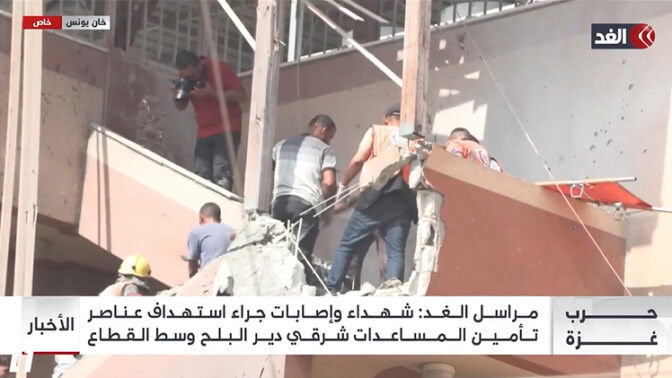


During the IDF's attack on Nasser Hospital in Khan Younis (August 25), it provided a "smoking camera" to those who believe it deliberately kills journalists.
At least five journalists were killed in the attack, with others injured. According to the initial version provided by the IDF and reported by the media in Israel and worldwide, a tank fired a first shell at a camera at the hospital suspected of monitoring soldiers' activities, and fired a second shell to ensure the camera was hit. According to reports and footage, the second shell struck medical staff who were attempting to treat the victims of the first shell.
According to international journalist protection organizations, around 200 journalists have been killed in the Gaza Strip by IDF fire since the start of the war. The IDF has mostly refrained from commenting on these incidents. In a few cases, it expressed regret over harm to uninvolved individuals, while in others, it claimed the casualties were Hamas operatives disguised as journalists - often without presenting sufficient evidence.
There is widespread consensus in much of the world that the killing of journalists in Gaza is deliberate and linked to their work. This view is based not only on the unusually high number of journalists killed there compared to other conflicts, but also on the IDF’s evasive responses and the absence of investigations by the Military Police Investigations Unit. Additionally, the outlawing of Al-Jazeera, repeated attacks on Palestinian journalists in the West Bank, confiscation of their camera equipment, and the refusal to grant international journalists access to Gaza all reinforce this perception.
The IDF spokesperson announced that the Chief of Staff has ordered an investigation into the killing of the five journalists at the hospital. However, it seems that fewer and fewer opinion leaders worldwide are willing to believe this was just another unfortunate error in a long chain of tragic mistakes by soldiers in the Gaza Strip, rather than an order or a norm within the IDF. After all, the shelling of the hospital adds to deadly shelling near food distribution centers, the attack on the Holy Family Church in Gaza City, and numerous other incidents.
Since the start of the war, Israel has been trying to convince the world and international courts that calls to commit war crimes made by ministers, Knesset members, and other public figures have been taken out of context, that these individuals are not part of the "real decision-making circle," or that Israel should be judged based on its actual actions.
But with each additional day that the war in the Gaza Strip continues -especially on days when there is a clear correlation between the shocking rhetoric and the atrocious actions - Israel digs itself deeper into a moral, social, and diplomatic abyss that will be difficult to escape even after the war ends.
The article was first published in Hebrew on August 26