











“We shall begin with stating the obvious,” Justice Daphne Barak-Erez opened her ruling on petitions filed by the Association for Civil Rights in Israel and Gisha regarding the reduction of food supply to security prisoners. “The State of Israel is a state governed by law, and therefore the obligation to provide all prisoners with the basic conditions of existence required by law is not in dispute, and cannot be in dispute. This is the ABC of the rule of law.”
Yet the obvious is not obvious at all. Although the ruling acknowledges the existence of security prisoners suffering from malnutrition, in practice Justice Barak-Erez (joined by Justice Ofer Grosskopf) legitimizes the policy of starvation, let’s call it politely a “nutritional hierarchy”, under which security prisoners are given only “the bare minimum required.”
The ruling merely adds that this “nutritional hierarchy” must be implemented according to proper administrative procedure: establishing an adequate factual basis, supervision, and oversight. This applies both to the formulation of the food menu and its implementation, including the manner of physical distribution. It also states that periodic monitoring is required over time, taking into account both the needs of all prisoners and the differences between individual inmates.
The High Court judges did not want to ”touch the hot potato” of the basic legality of creating a “nutritional hierarchy.” So they refrained from what should have been “the obvious”: writing a short, simple ruling declaring that all prisoners held in Israel Prison Service facilities must receive equal amounts of food. Full stop.
Accordingly, Justice Grosskopf wrote in his opinion that from the outset the conditional order issued in the petition “made clear that the respondents are not required to provide further clarifications regarding the policy of tightening food supply conditions for security prisoners as such, including the distinction it created in this regard between this group of prisoners and other inmates held in Israeli prisons. The implication is that this Court did not deem it appropriate to intervene in the change of feeding policy for security prisoners following the state of war in which Israel has been since October 7, 2023.”
Let us assume that the state meticulously follows every procedural detail set by the justices. Will the nutrition and medical experts of the Prison Service discover that the Palestinian human body requires less food than the Jewish human body?
It seems the judges feared that if they wrote the obvious in their ruling, they would be targeted by the fire of the Poison Machine. Perhaps they hoped that after a lengthy procedural process within the Prison Service, its experts would come to understand that there is, in fact, no difference between the needs of a Palestinian body and those of a Jewish body. If there is no difference in needs, then there should be no “nutritional hierarchy.”
Unfortunately, it is likely that the justices also know that given the reality of security prisoners already suffering from malnutrition, by the time the Prison Service completes the full proper administrative process (if it even bothers to do so), more prisoners will die under “mysterious circumstances,” infectious diseases will continue to spread, and irreversible physical harm will be inflicted on many others.
And in any case, why would Prison Service experts, who convinced Justice David Mintz that everything was in order, while at the same time allowing prisoners to reach a state of malnutrition, suddenly change their stance and decide to provide more food to all security prisoners, or to specific ones? Doing so would require them to admit failures in their past conduct and also show courage in standing up to the National Security Minister.
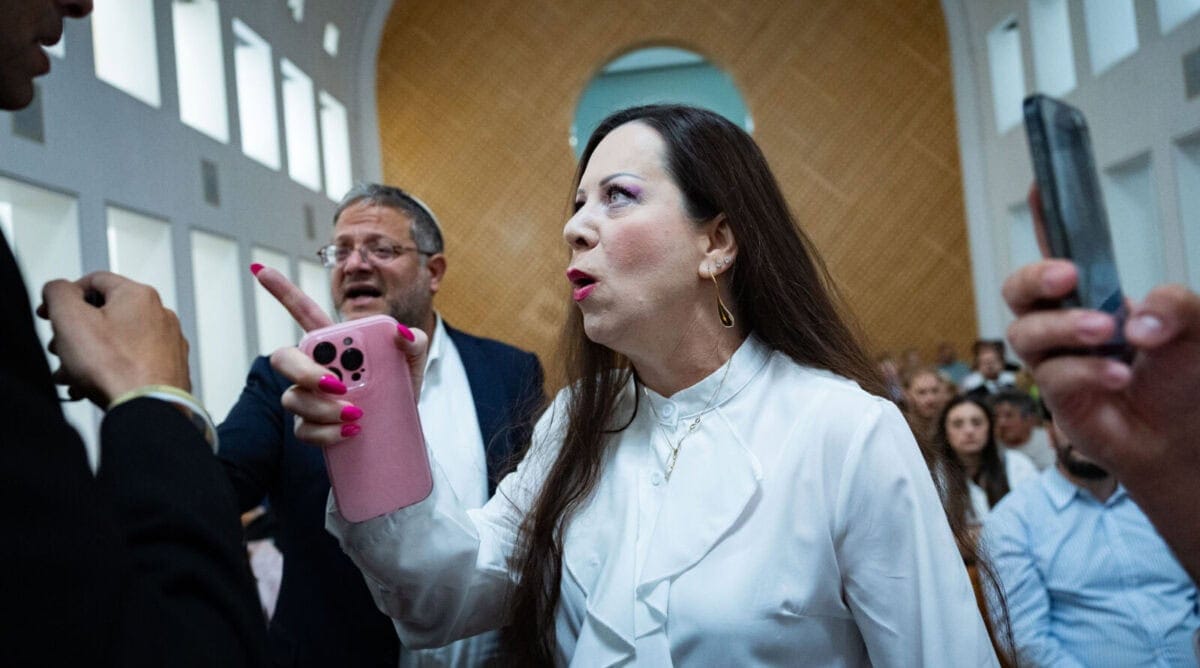
Toward the end of her ruling, Justice Barak-Erez wrote: “The echoes of war have reached the Court indirectly as well. The hearings in this case were accompanied by inappropriate behavior on the part of some attendees in the courtroom, including disruptions of the proper course of the proceedings. The pain, which we share, cannot justify harming the ability and the duty of the courts to fulfill their role, even when dealing with sensitive or controversial issues.”
Contrary to her words, the ruling is in fact a prime example of the deterioration in the ability and willingness of the Supreme Court to fulfill its role in precisely such sensitive and controversial matters. The intimidation works, and the justices of the Supreme Court are afraid of the attacks they suffer from members of the government and coalition, and from the Poison Machines they fuel.
Cowardice does not pay, and the Supreme Court’s excessive caution does not help its public standing. Immediately after the ruling was published, and regardless of its content, Itamar Ben-Gvir tweeted:
“High Court justices, are you on Israel’s side? Our hostages in Gaza have no High Court to protect them. But for the vile murderers and rapists, shamefully, the High Court protects them. We will continue to provide imprisoned terrorists only the minimal conditions set by law.”
This article was published in Hebrew on September 9, 2025