



On August 5, 2025, an article by military correspondent Yossi Yehoshua was published on Ynet, focusing on Netanyahu's demand to conquer Gaza City and the confrontation that arose between Netanyahu and Chief of Staff Zamir as a result. The article was ostensibly critical and reflected, as is typical of military correspondents' reports, mainly the viewpoint of the Chief of Staff and senior military command, who are skeptical of Netanyahu's conquest idea.
Yehoshua warned of three dangers inherent in such a conquest, if implemented: "harm to the lives of hostages, many casualties for the IDF, and a severe logistical problem – where to evacuate about a million civilians still in Gaza City." We have already destroyed the rest of the Gaza Strip from its foundation, Yehoshua explained, so there is no place left to move them to. Indeed, this is quite a logistical problem.
How did we reach a situation where the fate of about a million Gazans, many of them bereaved parents and children, homeless and suffering from hunger and thirst, became in the eyes of an Israeli journalist, living dozens of kilometers away from them, a "logistical" problem?
I am convinced that Yehoshua is not morally worse than other correspondents, and I even suspect that he did not plan at all consciously to describe the Palestinians as if they were a million packages that Amazon needs to find a way to move so they arrive at their destination before Christmas. He simply internalized the new rules that Israeli media outlets have shaped since October 7, 2023.
According to these rules, there are three types of people in Gaza: Israeli soldiers, Israeli hostages, and Hamas terrorists. All the rest are irrelevant and there is no reason to report on them.
The concealment of uncomfortable parts of reality by Israeli mainstream media did not begin, of course, on October 7th. It was already prominent before then – and continues today as well – in reports, and especially in the absence of reports, about what happens to the Palestinian civilian population in the West Bank vis-à-vis Israel's occupation and settlement processes there.
But since the scope and intensity of violence used by Israel in the Gaza Strip are, by estimates, among the most extensive in the 21st century, the media concealment mechanisms had to intensify and become more sophisticated accordingly to remain effective.
The following lines will describe eight main techniques of popular media in Israel for concealing the reality in Gaza. I will not deal here with the important question of why the media wants to deny the reality in Gaza, and will only mention in this context the Accord Institute research from June 2025 that found that 64% of the Israeli public believes there is no need to present a broader picture than that shown in the media about what is happening in Gaza.
I will focus on the reality denial techniques themselves, hoping that awareness of them will enable a more critical view by Israelis of the consciousness-distorting mechanisms developed by the main information producers surrounding us. The techniques I will mention characterize, in my assessment, the reports and news commentaries of all popular Hebrew-language media outlets in Israel, led by Channel 12 television, IDF Radio and KAN B radio, and "Yedioth Ahronoth" and Ynet in print and online media.
The only exception, especially in the past year, is "Haaretz" newspaper. It is also important to say that the most important factors in shaping the concealment of civilian reality in Gaza are not the journalists – although it is clear that they too have a part in it – but the editors of programs, websites and newspapers.
* * *
What, then, are the effective techniques by which Israeli news media manage to avoid reporting on events and phenomena covered by media outlets in the rest of the world, and in this way leave most Israelis in the dark regarding the catastrophic situation of Gaza's population?
Technique 1: The most moral information in the world
To understand what is happening in Gaza, newsrooms use only pictures and information that the IDF spokesperson provides them. In doing so, they adopt the army's perspective and his alone.
They dwell, for example, on the army's dilemmas about whether to launch a ground operation or not, and report again and again on the elimination of Hamas officials, on the explosion of tunnels, on the destruction of buildings where terrorists were hiding, on messages conveyed to Palestinians in advance to move to humanitarian areas, and sometimes also on those "logistical" problems we saw in Yehoshua's article.
In contrast, Israeli media will not highlight or will not report at all on the killing of dozens of uninvolved people who stayed near eliminated Hamas officials, or the killing in air bombings of Gazan refugees who stayed in tent camps to which they were forcibly transferred by the IDF itself.
An interesting example of the sharp selection of reports, as reported in The Seventh Eye, is the examination of he Representation Index of reports on the renewal of humanitarian aid to the Gaza Strip by Israel at the end of May 2025. Out of hundreds of reports on the renewal of humanitarian aid, only 18% bothered to refer at all to the humanitarian crisis itself, which necessitated the urgent need to renew humanitarian aid.
Reporting on statistical data of killing and destruction is also almost completely absent: while in the world there are debates about whether about 60,000 people have been killed in Gaza since the beginning of the war, as claimed in the conservative report based on identity documents from the Palestinian Ministry of Health, or close to 100,000 people as claimed by world expert on wartime mortality Michael Spagat, news broadcasts will almost never refer to numbers, except when it comes to IDF estimates regarding the number of terrorists killed since the beginning of the war or in a specific incident.
Technique 2: Washing at 90 degrees with bleach
When names are given to "indefensible" events, this is done "without calling up mental pictures of them," as George Orwell noted in his famous essay "Politics and the English Language." Therefore, when the IDF bombs from the air, destroys buildings and kills dozens of Gazans, we get reports using sanitized language such as "the IDF has intensified pressure in the northern Strip in recent days."
This technique has been perfected, incidentally, over the years "thanks to" Israeli media reports on what is happening in the West Bank, where particularly serious acts have also been frequently occurring since October 7th, under the cover of war.
Thus, when settlers carry out a pogrom in a Palestinian village – beating its residents, burning, stealing livestock, blocking water sources, threatening residents with death if they do not evacuate and sometimes also killing, and all this without intervention by IDF forces present at the scene (in the best case) – the usual report is that "an IDF force dispersed a violent incident this evening between Palestinians and settlers near Ramallah; three Palestinians were arrested."
Technique 3: Folk tales
Sometimes Israeli media have no choice but to mention accusations against Israel, because without them it is impossible to understand certain things whose coverage is unavoidable – for example, Trump's statements regarding hunger in Gaza or European countries' sanctions on Israel following reports in world media about massive killing of innocents.
In such cases, the solution of newsrooms is to briefly don a post-modernist cloak and refer to all reports in world media in a tone ranging from shocked to cynical as narratives that reflect not necessarily events that actually happened but mainly the anti-Israeli hostile identity and position of the reporters from the outset: the hunger "campaign," "stories" circulated on social networks about a doctor who lost her entire family in one bombing, "viral images" of unknown origin of bodies trapped under rubble and "posts" by influencers condemning this.
The not-so-hidden message behind such reports is: how easy it is to trap the liberal and naive free world countries, whose limited understanding of what is happening in the Middle East and woke sensitivity cause them to echo the manipulative psychological pressure that Hamas exerts out of naive thinking that they support the poor Palestinians.
To ensure that no viewer missed the intention, immediately after such reports, the categorical denial of the IDF spokesperson (or the angry commentator on duty) will usually be heard (in particularly serious cases that cannot be fully denied due to the amount of evidence: "the IDF is investigating the incident") who will get an opportunity to refute the narrative presented in world media and connect it to antisemitism or uncritical adoption of Hamas propaganda.
The killing, destruction and starvation in Gaza will not be presented in Israeli mainstream media as solid facts but as some dubious version – wrong in the best case and malicious in the worst case.
Technique 4: A day without fear of antisemitism is a wasted day
It seems that since October 7th, in every news broadcast and every news page, at least one item about an antisemitic action that occurred in the world must appear.
Whether it's a pro-Palestinian demonstration on an American campus, a store owner in a South American capital who confronted an Israeli customer, a confrontation between provocative Maccabi Tel Aviv fans and Muslims in Amsterdam, a Scandinavian country's sanction against selling products from occupied territories, defining Israel's actions in Gaza as genocide by an expert in the field, or a Belgian university stopping cooperation with an Israeli university – the event will be framed as part of the "antisemitic wave," and no minimal separation will be made between acts stemming from anger over Israel's actions in Gaza, those that broke out following violent behavior by Israelis abroad, those stemming from reasoned opposition to Israeli government policy, and those that indeed stem from hatred of Jews.
There is also near-total disregard for the fact that many Jews take part in pro-Palestinian demonstrations worldwide. The result is that audiences come away believing that any criticism of Israel stems from antisemitism. And if antisemitism is seen as a constant threat everywhere, then the focus shifts to fighting it—rather than reflecting on the killing of more than 18,000 children in the Gaza Strip.
Technique 5: Ethnic cleansing of the studios
To maintain safe discourse, news programs have apparently reached the conclusion that it is vital to clean the studios of Arab journalists and especially Arab interviewees. According to The Seventh Eye's Representation Index, in 2024 only 1.6% of speakers in current affairs programs on mainstream broadcast media were Arabs, while their weight in the population is 18%.
Five programs that "stood out" in excluding Arabs more than all others in this context were all broadcast on Channel 12. Throughout 2024, one Arab speaker appeared on the Friday Studio show. The only Arab interviewee who managed to regularly penetrate current affairs programs that year is Yoseph Haddad, with exceptionally hawkish views in Arab society, who was interviewed more than twice as much as any other Arab speaker.
The lack of media representation of Arabs, what is called in research "symbolic annihilation," ensures not only preventing the possibility that a non-Zionist perspective, God forbid, would contaminate the broadcast, but also that we get used to a daily life devoid of Arabness and Arabs, and inadvertently Arab presence in the Israeli public space after October 7th increasingly seems illegitimate.
Technique 6: False debates
Linguist and political activist Noam Chomsky argued that during the Vietnam War, the central debate in American media was whether or not there was a possibility of winning the war. His own position, according to which it was forbidden from the outset to go to this criminal war, was not presented at all, because unlike the other two, it endangered the dominant ideology.
As Chomsky argued, "the smart way to keep people passive and obedient is to strictly limit the spectrum of acceptable opinion, but allow very lively debate within that spectrum." According to this exact formula, on television panels we often see heated and intense debates, which give us viewers a feeling that pluralistic discussions between "left" and "right" are taking place.
This feeling causes us not to notice that panel editors are careful not to give a foothold to any speaker whose position deviates from the dominant ideology, for example one claiming that the war should be ended immediately because of the wholesale killing of innocents in Gaza or to strive for a viable peace agreement with the Palestinians within which they would be given a state.
A beautiful example of a false debate of the type common in media outlets could be found in a Maariv poll from August 8, 2025, in which respondents were asked to answer the question: "Which side are you on in the debate about continuing the fighting in the Gaza Strip, on the side of the Chief of Staff or on the side of Netanyahu?" As you may recall, both believed the war should continue – the first through siege and the second through conquest. The possibility that there are those who believe the war should be ended did not occur to the poll editors at all, unless the insulting option "don't know" was meant to indicate this.
Technique 7: Our enemies will encounter a harsh and painful response
Here and there, attempts are made by individuals to crack, even a little, the conspiracy of silence around the lack of reporting on the severe harm to the civilian population in Gaza. Remembered in this context is the courageous statement by former Chief of Staff Moshe Ya'alon from November 2024 that ethnic cleansing is taking place in Gaza. In recent months, attempts to represent the silenced reality are increasing – from Arad Nir's rebellion through Emmanuelle Elbaz-Phelps to the artists' petition, to mention some reality descriptions that caused media storms.
These efforts to change even a little the status quo regarding what is permitted and forbidden in reporting encounter significant sanctions. Sometimes they are formal – the Second Authority opened a violation procedure against Channel 12 due to Nir's statement that the planned "humanitarian city" is actually a concentration camp – but often they are even more informal: curses on social networks, non-invitation to media panels, threats to cancel performances for protesting artists, and so on.
The result is that a significant portion of the rebels return to the fold while beating their chests: Nir apologized, the singer Assaf Amdursky prostrated himself before ultra right wing rapper known as The Shadow and another singer, Alon Oleartchik. retracted his signature from the petition and explained that he only wanted to support the hostages. This repentance strengthens the validity of the unwritten rules that guide Israeli media behavior, and clarifies to anyone who needs it that this is the only legitimate way, and it is forbidden to deviate from it.
Journalists and broadcasters, as well as interviewees, understand that if they want to continue being present in the media space (and make a living from it), they must stay within the rigid expression boundaries that have been shaped in the past two years.
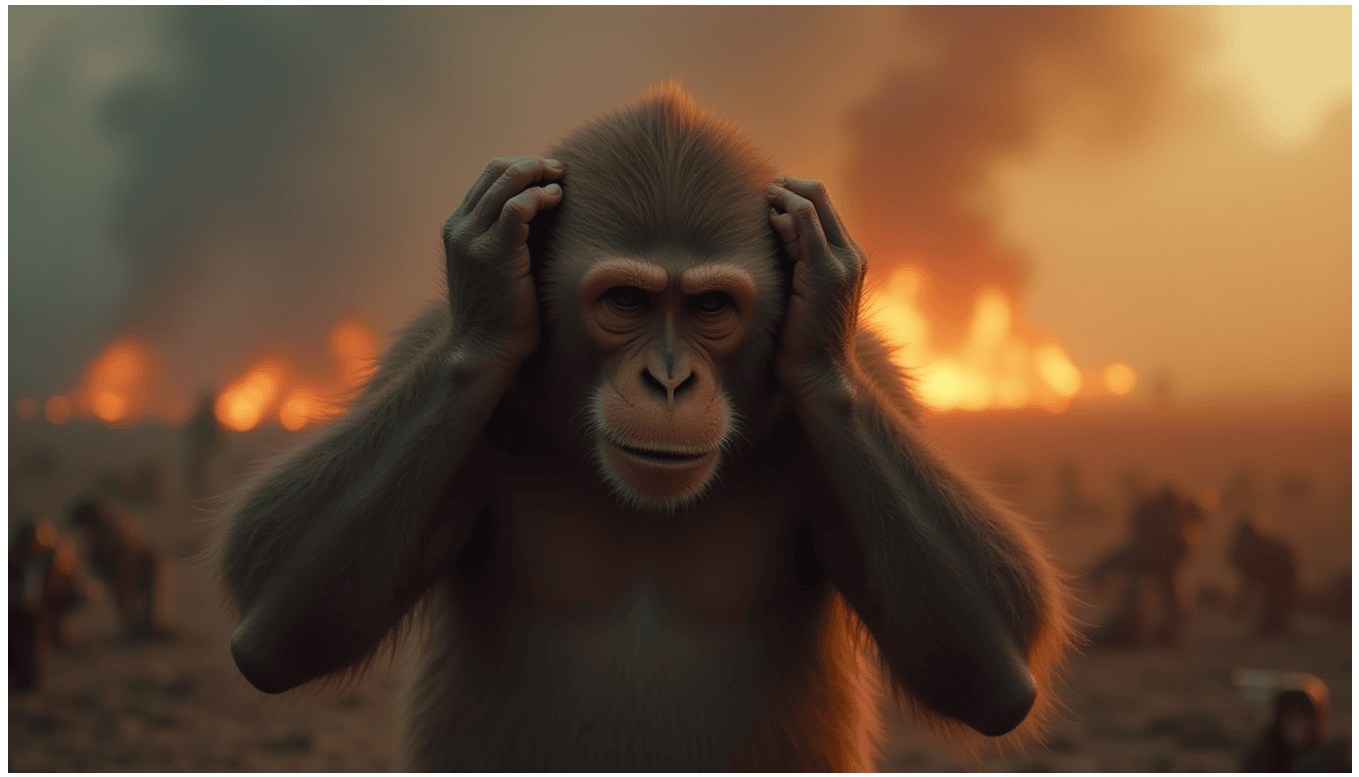
Technique 8: The three monkeys
This is probably the most common technique: completely ignoring any information that implies that Israel is committing unworthy acts. The idea is childish but amazingly effective: if we don't talk about it and don't see it, from the Israeli public's perspective it simply didn't happen. As the cliché saying goes: you did it and didn't publish it – you didn't do it.
World press reports on the killing, for no apparent reason, of unarmed paramedic crews who marked themselves with orange vests and in every other possible way? On television channels we find a color feature of our correspondent who accompanied fighters in Gaza.
Palestinian doctors claim they ran out of means to treat the wounded and sick following the bombing of hospitals and prevention of entry of medical supplies? The news website will put in the main headline an article explaining how Hamas leaders are hiding in the basements of Al-Shifa Hospital
A human rights organization published a report concluding that the IDF is committing genocide? All we can see is a long item about Trump mumbling next to the presidential helicopter statements about there soon being a deal.
Research by media researcher Dr. Ayala Panievsky showed that out of a sample of 700 items from Channel 12 news broadcasts aired in the first half year of the war, only four contained mentions of civilian killings in Gaza, and only two of them also presented visual imagery.
It should be said, however, that this technique – which was very effective for most months of the war – is gradually beginning to lose its power due to the growing accumulation of reliable information testifying to the horrific catastrophe in Gaza, which is leaking here and there even into the Israeli echo chamber.
* * *
As a result of using these concealment techniques in everything related to coverage of what is happening in Gaza, the valuable information that can be learned from mainstream media in Israel is very minimal. In contrast, quite a bit can be inferred from it regarding the moods of the government, the IDF and the Israeli mainstream.
In this sense, media consumption in Israel today regarding what is happening in Gaza is not very different from newspaper consumption in dictatorial states in the past and present.
And yet, there is an important difference, which media researcher Daniel Dor pointed out in his critical books about Israeli media: in dictatorial states, the public usually knows that the media in the country reports lies or half-truths, and ignores realities that are not convenient for the regime, and therefore does not relate to its reports as reflecting reality. However, in countries perceived by their public as democratic, there is no such awareness – they believe that all important things happening in their environment are brought to their attention on an ongoing basis.
Therefore, the impact that the denial of the terrible reality prevailing in the Gaza Strip in Israeli media has on all of us is particularly great, because many of us are not aware at all, or at least can choose to continue being unaware, that this is the situation prevailing there.
The horrific humanitarian disaster occurring an hour's drive from central Israel, and Israel's significant, though not exclusive, responsibility for its creation, are not part of our "Zone of Interest," which only hostages and soldiers killed manage to enter.
The result is not only a process of severe moral corruption both as individuals and as a society, but also the formation of patterns characteristic of a cult: we, Israeli Jews, are certain that all justice is with us and have difficulty understanding, to put it mildly, the extensive criticism directed at Israel in the rest of the world and which seems to us malicious.
If there is one factor that can be held responsible for this situation, more than all others, it is Israeli mainstream media.
Dr. Amnon Yuval is a historian and education researcher.
This article was first published in Hebrew on August 20.