


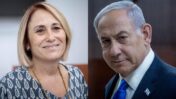


MK Galit Distel-Etberian (Likud) said yesterday (December 16) in the Knesset plenum that the Netanyahu government is fighting the security and legal systems and the media. "This is the triangle we are fighting against, the top of the IDF, the top of the legal system and the media. One protects the other. they can dream that we will allow them to set up a tribunal of inquiry into the massacre disaster," said the former minister, Refering to the October 7th massacre.
Yesterday, after publications about her statement, Distel-Etberian tweeted: "I stand behind everything I said last night in the plenum." She called the media outlets that reported what she said "junk media" and "your poison machine." "Poison machine" is the common term for the propaganda apparatus that promotes Prime Minister Benjamin Netanyahu, of whom Distel-Etberian is one of the most vocal spokespeople.
This is not the first time that Distel-Etberian has exposed the machine's poisonous logic. After she was forced to resign as Minister of Public Diplomacy, following the enormous damage caused to Israel's image in the world during her tenure, she said in an interview on Channel 13 that "a hundred people from politics, the media and the leaders of the network drove 9 million Israelis into the abyss" because they promoted polarization and hatred.
"I was part of the people who caused the country to weaken," Distel-Etberian testified, "I created a rift and I created division and I created tension, and this tension led to weakness. And this weakness in many ways led to the massacre." In doing so, the former minister pointed to one of the basic propaganda principles of populist leaders like Netanyahu: pitting the parts of society against each other, emphasizing the value of loyalty to the leader as the highest value, and labeling anyone who is not loyal to him as a traitor.
This week, she inadvertently revealed another fundamental principle of authoritarian populism: a war of attrition against state and democratic institutions, with the aim of undermining any power other than the populist leader. In this struggle, nothing is sacred, and the target can also be institutions like the IDF, which enjoy an aura of protection among Netanyahu's voting public.
The attack on the media has been a central part of Netanyahu's consistent campaign since his first term as prime minister in the 1990s. After he was caught in a series of alleged criminal acts and the police began investigating him and his entourage, he turned his campaign against the police and later, with the indictments against him, also against the judicial system and the prosecution.
The peak of the campaign came with the formation of Netanyahu's sixth government in December 2022, and the launch of the The Judicial Overhaul. The enormous civil protest that arose as a result, led, among others, by veterans of elite military units, expanded the campaign to include the IDF. Subsequently, the need to shift responsibility for the October 7 failure deepened the campaign against the defense establishment.