










The Union of Journalists in Israel together with the Haaretz-TheMarker journalists' union petitioned the Supreme Court against the government's decision to sever all advertising ties with the newspaper. According to the petitioners, the decision severely and disproportionately infringes on press freedom and is part of the government's "comprehensive plan" intended to intimidate Israeli media.
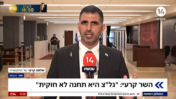
Several weeks ago, Haaretz publisher Amos Schocken gave a speech at a conference in London where he called for sanctions against entities in Israel and claimed that those whom the government defines as terrorists are actually freedom fighters. Following this, the Israeli government accepted a proposal submitted by Communications Minister Dr. Shlomo Karhi to boycott Haaretz newspaper.
The proposal adopted by the government opened with the statement that "the Israeli government believes in free press and freedom of media expression at all times, including during wartime." However, immediately afterward, the government clarified that despite this, it "will not accept a situation where a publisher of an official newspaper in Israel calls for sanctions against it and supports the country's enemies during wartime, while international bodies harm Israel's legitimacy, its right to self-defense, and actually impose sanctions against it and its leaders (including criminal sanctions)."
The government further stated that "editorials that were published in Haaretz during the war harmed Israel's legitimacy in the world and its right to self-defense. Additionally, Haaretz publisher, Amos Schocken, spoke at the newspaper's London conference in support of terrorism and called for sanctions against the government as follows: 'Palestinian terrorists are freedom fighters and sanctions should be imposed on the Prime Minister and Ministers Smotrich and Ben Gvir', 'Netanyahu's government doesn't care about imposing cruel apartheid rule on the Palestinian population.'"
"Therefore, following previous announcements by most government ministers, the government hereby declares its intention to sever all advertising ties with Haaretz newspaper and calls on all its branches, ministries, bodies, and any government corporation or government-funded body, not to engage with Haaretz newspaper in any way and not to publish any advertisements in it."
Karhi tried to advance a similar proposal, with slightly different wording, a year ago, but it was blocked.
The petition, filed by Attorney Amir Basha, is directed at Communications Minister Karhi, the Israeli government, the Ministry of Communications, and Attorney General Gali Baharav-Miara. According to the petition, even before the government made its decision, the Journalists union approached the Attorney General to present its position on the issue, but the government decision was made before receiving a response.
The petitioners note that immediately after Minister Karhi presented his intention to bring to the government a decision to boycott Haaretz, several weeks before the decision was actually made, directors-general of about ten government ministries ordered an immediate halt to all advertising or commercial cooperation with the newspaper.
These directives, the petitioners argue, were issued "without any authority or legal basis, or at the very least, with abuse of authority." The petition emphasizes that the government declared its intention to sever all advertising ties, and nothing beyond that.
According to the petition, the government ministries' decision also met with internal opposition. On November 15, a group of 35 veteran Foreign Ministry employees approached the incoming minister, MK Gideon Sa'ar, requesting him to cancel his predecessor's decision and renew the Haaretz subscriptions.
"We want to immediately clarify that we find the statements of Haaretz's publisher outrageous and completely dissociate ourselves from them," the Foreign Ministry employees wrote to Minister Sa'ar, noting that even Haaretz's editorial condemned the publisher's remarks. "In other words," they explained, "Mr. Schocken's words do not represent the newspaper's official position."
The ministry employees argued that their subscriptions to the newspaper should be renewed primarily because "every ministry employee is entitled to receive a daily newspaper of their choice." According to them, "There is a slippery and dangerous slope here that threatens to slide into censorship. Such a decision is very problematic especially in a country that prides itself, justifiably, on being the only democracy in the Middle East."
Moreover, the employees noted, "Haaretz, as critical as it may be, is one of the most important newspapers in Israel and even globally." Those who read the newspaper, they clarified, don't necessarily agree with all its content. "The fact that we'll stop reading the newspaper won't make it disappear," they wrote.
"Our many interlocutors around the world read Haaretz (usually in its English edition) and will continue to read it even after we stop. The knowledge that Israeli diplomats are prohibited from receiving this newspaper will harm Israel's democratic, liberal, and pluralistic image in the eyes of these interlocutors. In this sense, Haaretz is an important work tool and its removal from our limited list of work tools will harm us and our important work in the international arena, especially in these days."
The Journalists' union and Haaretz journalists argue in their petition that the government's decision contains "a message and even a threat to other media outlets, their owners, or their leaders, in what appears to be a slippery slope toward silencing media outlets, and thus, harming press freedom and the public."
The petitioners add that "this is an aggressive step [...] in reaction to a statement by one of the media outlet's shareholders, aimed at harming the media outlet through economic damage, and consequently, harming press freedom and the public."
The government's decision, the petitioners warn, could lead to a "chilling effect on journalists, both at the formal respondent to the petition [Haaretz] and in general, who will fear to carry out their journalistic work lest their workplace be harmed."
The petitioners also mention that the decision comes against the backdrop of government actions against other media outlets, such as the Public Broadcasting Corporation and Army Radio, "in what appears to be a comprehensive plan by the government to harm media outlets, including commercial ones, with some of the legislative proposals being submitted as private bills intentionally, to bypass the proper government work process."
Justice Gila Kanfi-Steinitz ordered the respondents to submit a preliminary response within a month.